Pitlick Mitchell M, Li James T, Pongdee Thanai
Division of Allergic Diseases, Mayo Clinic, Rochester, MN, USA.
World Allergy Organ J. 2022 Jul 31;15(8):100676. doi: 10.1016/j.waojou.2022.100676. eCollection 2022 Aug.
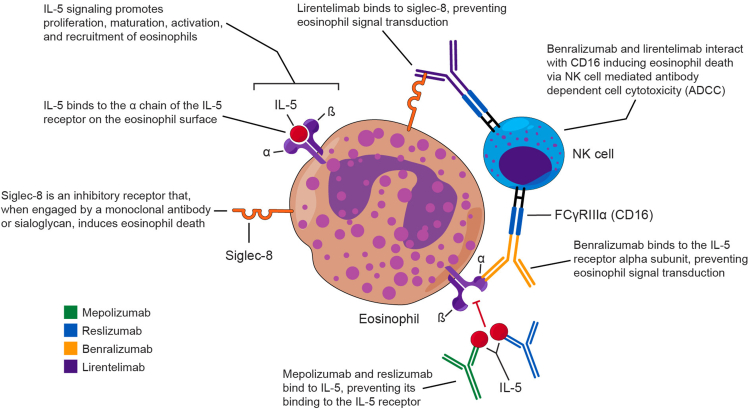
Eosinophilic disorders include a wide array of conditions in which eosinophils play a primary pathophysiologic role. While historically treated with corticosteroids and immunosuppressants, knowledge of eosinophil biology has led to the development of several biologics targeting eosinophils. In this review, we discuss the current US Food and Drug Administration (FDA) approved eosinophil-specific biologics targeting IL-5 (mepolizumab and reslizumab) and IL-5R (benralizumab) along with biologics under investigation targeting siglec-8 (lirentelimab). We discuss efficacy and safety data from trials of these medications in conditions including eosinophilic asthma, hypereosinophilic syndrome (HES), eosinophilic granulomatosis with polyangiitis (EGPA), chronic rhinosinusitis with nasal polyposis (CRSwNP), eosinophilic esophagitis (EoE), and eosinophilic gastrointestinal disease (EGID). Additionally, we discuss case reports utilizing these medications in conditions including drug reaction with eosinophilia and systemic symptoms (DRESS), allergic bronchopulmonary aspergillosis (ABPA), and eosinophilic pneumonia, among others. While eosinophilic targeting biologic therapy has been successful in eosinophilic asthma, HES, EGPA, and CRSwNP leading to FDA approval for these conditions, trials treating EoE and EGID have been disappointing to date. Given the increasing number of trials utilizing these biologics, it will be imperative for the allergist-immunologist to stay up to date on the latest treatment options to provide the most optimal care for eosinophilic disorders.
嗜酸性粒细胞疾病包括一系列嗜酸性粒细胞在其中发挥主要病理生理作用的病症。虽然过去一直使用皮质类固醇和免疫抑制剂进行治疗,但对嗜酸性粒细胞生物学的了解促使了几种靶向嗜酸性粒细胞的生物制剂的研发。在本综述中,我们讨论了目前美国食品药品监督管理局(FDA)批准的靶向白细胞介素-5(美泊利单抗和瑞利珠单抗)和白细胞介素-5受体(贝那利珠单抗)的嗜酸性粒细胞特异性生物制剂,以及正在研究的靶向唾液酸结合免疫球蛋白样凝集素-8(利伦替单抗)的生物制剂。我们讨论了这些药物在嗜酸性粒细胞性哮喘、高嗜酸性粒细胞综合征(HES)、嗜酸性肉芽肿性多血管炎(EGPA)、伴鼻息肉的慢性鼻-鼻窦炎(CRSwNP)、嗜酸性粒细胞性食管炎(EoE)和嗜酸性粒细胞性胃肠疾病(EGID)等病症试验中的疗效和安全性数据。此外,我们还讨论了在药物反应伴嗜酸性粒细胞增多和全身症状(DRESS)、变应性支气管肺曲霉病(ABPA)和嗜酸性粒细胞性肺炎等病症中使用这些药物的病例报告。虽然靶向嗜酸性粒细胞的生物疗法在嗜酸性粒细胞性哮喘、HES、EGPA和CRSwNP中取得了成功,并导致FDA批准用于这些病症,但迄今为止治疗EoE和EGID的试验结果令人失望。鉴于使用这些生物制剂的试验数量不断增加,过敏症专科医生-免疫学家必须了解最新的治疗选择,以便为嗜酸性粒细胞疾病提供最优化的治疗。