
丝氨酸而非半胱氨酸催化三联体的 Nϵ-规则。
The Nϵ-Rule for Serine, but Not Cysteine Catalytic Triads.
机构信息
International Institute of Molecular and Cell Biology, Trojdena 4, 02-109, Warsaw, Poland.
Institute of Biochemistry and Biophysics of the Polish Academy of Sciences, Pawinskiego 5a, 02-106, Warsaw, Poland.
出版信息
Angew Chem Int Ed Engl. 2022 Oct 17;61(42):e202206945. doi: 10.1002/anie.202206945. Epub 2022 Sep 5.
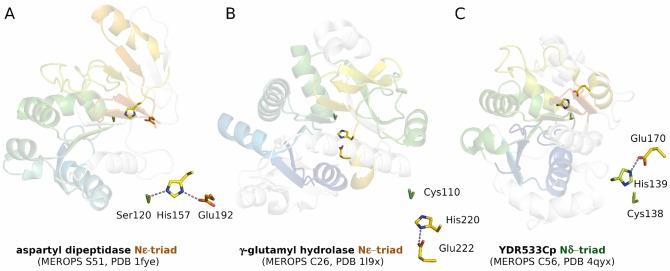
Catalytic triads, composed of a serine or cysteine nucleophile, a histidine, and a third triad residue (typically Asp/Glu/Asn), are common in enzyme active sites and catalyze a wide variety of chemical reactions. Two types of triads can be distinguished: We refer to them as Nδ- or Nϵ-configured, depending on whether the histidine imidazole Nδ or Nϵ atom is close to the nucleophile Oγ/Sγ. In this study, we have analyzed triad configuration. In structural triads, the more stable Nδ-configuration predominates. For catalytic triads, the configuration depends on the nucleophile. When it is a cysteine residue, both configuration types occur, depending on the family. However, when the nucleophile is a serine residue, the less stable Nϵ-configuration is almost exclusively found. We posit that the energetically less favored conformation is selected for in serine triads to facilitate the otherwise difficult proton transfer from the nucleophile to the histidine residue.
催化三联体由丝氨酸或半胱氨酸亲核体、组氨酸和第三个三联体残基(通常为 Asp/Glu/Asn)组成,常见于酶活性部位,并催化各种化学反应。可以区分两种类型的三联体:根据组氨酸咪唑 Nδ 或 Nϵ 原子是否靠近亲核体 Oγ/Sγ,我们将它们称为 Nδ- 或 Nϵ- 构型。在这项研究中,我们分析了三联体的构型。在结构三联体中,更稳定的 Nδ- 构型占主导地位。对于催化三联体,构型取决于亲核体。当亲核体是半胱氨酸残基时,根据家族的不同,两种构型都会出现。然而,当亲核体是丝氨酸残基时,几乎只发现了不太稳定的 Nϵ- 构型。我们假设,在丝氨酸三联体中选择了能量上不利的构象,以促进从亲核体到组氨酸残基的质子转移,否则这将非常困难。



 Zotero 插件