Biology+ Joint Research Center, School of Chemical Engineering and Technology, Zhengzhou University, Zhengzhou 450001, China.
National Engineering Technique Research Center for Biotechnology, State Key Laboratory of Materials-Oriented Chemical Engineering, College of Biotechnology and Pharmaceutical Engineering, Nanjing Tech University, Nanjing 210009, China.
Ultrason Sonochem. 2022 Sep;89:106118. doi: 10.1016/j.ultsonch.2022.106118. Epub 2022 Aug 8.
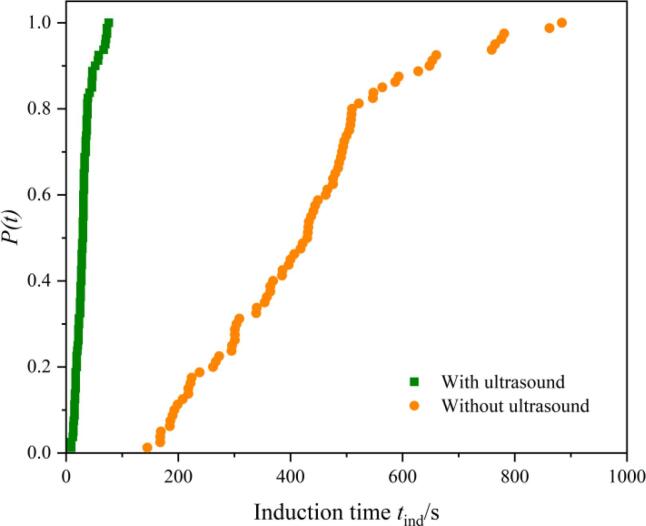
Molecular self-assembly plays a vital role in the nucleation process and sometimes determines the nucleation outcomes. In this study, ultrasound technology was applied to control polymorph nucleation. For the first time, different ultrasonic application methods based on the nucleation mechanisms have been proposed. For PZA-water and DHB-toluene systems that the molecular self-assembly in solution resembles the synthon in crystal structure, ultrasound pretreatment strategy was conducted to break the original molecular interactions to alter the nucleated form. When the solute molecular self-associates can't give sufficient information to predict the nucleated polymorph like INA-ethanol system, the method of introducing continuous ultrasonic irradiation in the nucleation stage was applied. The induction of ultrasound during nucleation process can break the original interactions firstly by shear forces and accelerate the occurrence of nucleation to avoid the reorientation and rearrangement of solute molecules. These strategies were proved to be effective in polymorph control and have a degree of applicability.
分子自组装在成核过程中起着至关重要的作用,有时甚至决定了成核的结果。本研究应用超声技术控制多晶型成核。首次提出了基于成核机制的不同超声应用方法。对于 PZA-水和 DHB-甲苯体系,其溶液中的分子自组装类似于晶体结构中的连接物,采用超声预处理策略破坏原始分子相互作用,改变成核形式。当溶质分子自组装不能提供足够的信息来预测成核多晶型时,如 INA-乙醇体系,采用在成核阶段引入连续超声辐射的方法。成核过程中超声的诱导首先通过剪切力破坏原始相互作用,并加速成核的发生,从而避免溶质分子的重新取向和重排。这些策略在控制多晶型方面被证明是有效的,具有一定的适用性。