Li Cunyu, Shen Xin, Qiu Ranyun, Xing Dantong, Zhi Xinglei
College of Pharmacy, Nanjing University of Chinese Medicine, Nanjing 210023, China; State Key Laboratory on Technologies for Chinese Medicine Pharmaceutical Process Control and Intelligent Manufacture, Nanjing University of Chinese Medicine, Nanjing 210023, China; Jiangsu Collaborative Innovation Center of Chinese Medicinal Resources Industrialization, Nanjing 210023, China; Jiangsu Engineering Research Center of Classical Prescriptions, Nanjing 210023, China.
College of Pharmacy, Nanjing University of Chinese Medicine, Nanjing 210023, China.
Ultrason Sonochem. 2025 Jul;118:107382. doi: 10.1016/j.ultsonch.2025.107382. Epub 2025 May 10.
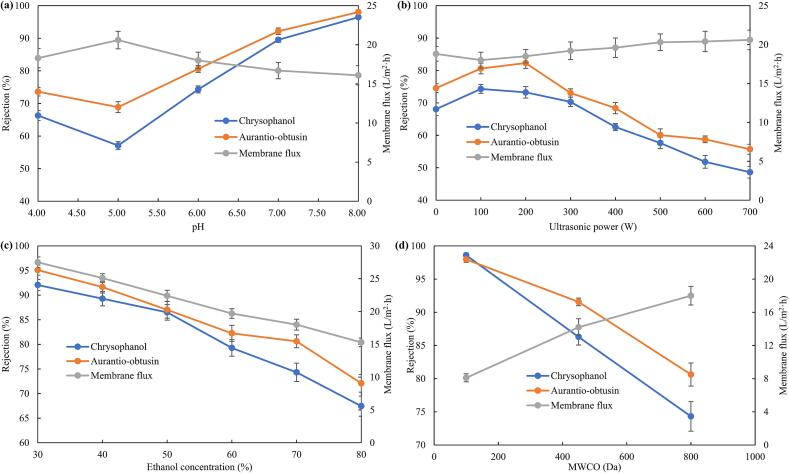
Anthraquinone components sublimate during heat treatment refining, causing equipment pipeline contamination and a drop in component output, which is a challenging technical problem for pharmaceutical manufacturers to resolve. Furthermore, the waste liquid generated during pipeline cleaning simultaneously increases production costs and pollutes the environment. Although nanofiltration has the technological advantage of traditional temperature refining, anthraquinone components are absorbed onto the membrane surface during the concentration of cassia seed ethanol extract, leading to membrane pollution and a significant decrease in separation efficiency. Based on the π-π stacking effect and ultrasonic cavitation effect of anthraquinone components, this study proposes the hypothesis of enhancing nanofiltration separation by ultrasonic regulation of the self-assembly of anthraquinone components. The effects of pH, ethanol concentration, ultrasonic power, and the molecular weight cut-off of nanofiltration membranes on the solute rejection and membrane flux were all systematically explored in this work. The separation processes of chrysophanol and aurantio-obtusin were clarified by combining the relationship between ultrasonic power and the existing state. It was discovered that the self-assembly behavior of chrysophanol and aurantio-obtusin was regulated bidirectionally by ultrasonic power. In the range of 100 W - 300 W, the proportion of molecular states of anthraquinone components drops as the particle size distribution of the solution increases. Ultrasound encouraged the π-π stacking effect among anthraquinones, resulting in self-assembly and reduced surface pollution under the cavitation effect, leading to efficient nanofiltration separation. Ultrasonic power showed a logarithmic correlation with the molecular proportion of anthraquinones components in 300 W - 700 W, and ultrasound promoted the breakage of hydrogen bonds between supramolecular structures, resulting in an increase in the molecular proportion and a decrease in solute rejection. The response surface method was used to optimize the separation parameters of ultrasonic-enhanced nanofiltration. Chrysophanol and aurantio-obtusin rejections in cassia seed extract with ethanol concentrations of 35 % - 65 % were both greater than 88 % and 91 %, respectively, as the separation volume increased from 2 L to 20 L. Based on the intermolecular forces of the anthraquinone components in various ethanol solutions, this study used an ultrasonic bidirectional self-assembly ratio to purify cassia seed extract at room temperature through ultrasonic-enhanced nanofiltration, thereby avoiding the problems of component sublimation and environmental contamination brought on by conventional concentration.
蒽醌类成分在热处理精制过程中会升华,导致设备管道污染和成分产量下降,这是制药企业亟待解决的技术难题。此外,管道清洗产生的废液同时增加了生产成本并污染环境。尽管纳滤具有传统升温精制的技术优势,但在决明子乙醇提取物浓缩过程中,蒽醌类成分会吸附在膜表面,导致膜污染并使分离效率大幅降低。基于蒽醌类成分的π-π堆积效应和超声空化效应,本研究提出通过超声调控蒽醌类成分自组装强化纳滤分离的假说。本工作系统考察了pH、乙醇浓度、超声功率和纳滤膜截留分子量对溶质截留率和膜通量的影响。结合超声功率与存在状态的关系阐明了大黄酚和橙黄决明素的分离过程。发现大黄酚和橙黄决明素的自组装行为受超声功率双向调控。在100 W - 300 W范围内,随着溶液粒径分布增大,蒽醌类成分分子态比例下降。超声促进了蒽醌之间的π-π堆积效应,在空化作用下导致自组装并减少表面污染,从而实现高效纳滤分离。在300 W - 700 W范围内,超声功率与蒽醌类成分分子比例呈对数相关,超声促进超分子结构间氢键断裂,导致分子比例增加和溶质截留率降低。采用响应面法优化超声强化纳滤的分离参数。随着分离体积从2 L增加到20 L,乙醇浓度为35% - 65%的决明子提取物中大黄酚和橙黄决明素的截留率分别大于88%和91%。基于不同乙醇溶液中蒽醌类成分的分子间作用力,本研究采用超声双向自组装率在室温下通过超声强化纳滤纯化决明子提取物,从而避免了传统浓缩带来的成分升华和环境污染问题。