Department of Orthopaedic Surgery, Duke University, 200 Morris Street, Durham, NC, 27001, USA.
Duke Clinical Research Institute, Duke University, Durham, NC, USA.
J Orthop Surg Res. 2022 Aug 19;17(1):396. doi: 10.1186/s13018-022-03288-x.
Patient-Reported Outcomes Measurement Information System (PROMIS) domains for sleep disturbance, anxiety, and dyspnea have been under-reported for total joint arthroplasty (TJA). The aims of this study were to report postoperative differences for these domains based on TJA location and chronic pain state. We also investigated whether these domains were associated with physical function and pain interference outcomes.
This was a retrospective, observational study of patients who underwent hip, knee, or shoulder TJA (primary and revision surgeries) at a single academic tertiary referral center. A subset of these patients completed an email-based survey for chronic pain grade (Chronic Pain Grade Scale-Revised) and sleep disturbance, anxiety, dyspnea, physical function, and pain interference (PROMIS short forms). Pre-operative and operative data were extracted from the electronic health record. Data analysis investigated PROMIS domains for differences in TJA location and chronic pain grade. Hierarchical linear regression determined associations of these domains with physical function and pain interference.
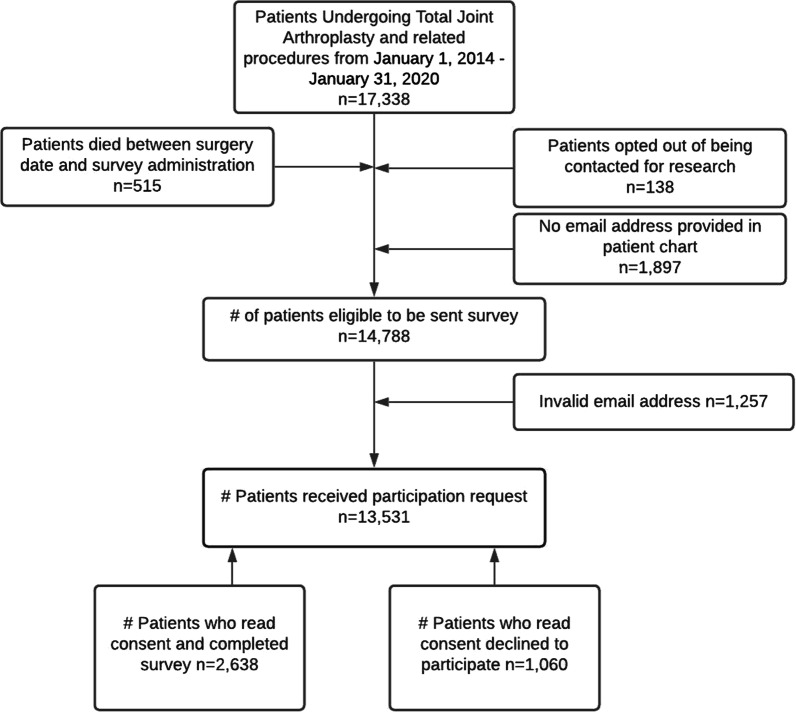
A total of 2638 individuals provided informed consent and completed the email survey. In the ANOVA models for sleep disturbance, anxiety, and dyspnea, there was no location by chronic pain grade interaction (p > 0.05) and no difference based on TJA location (p > 0.05). There were differences for chronic pain grade (p < 0.01). The poorest postoperative outcome score for each domain was associated with high impact chronic pain. Furthermore, sleep disturbance and dyspnea had the strongest associations with physical function and pain interference (p < 0.01).
Sleep disturbance, anxiety, and dyspnea did not vary based on TJA location, but were associated with postoperative chronic pain grade. Sleep disturbance and dyspnea were strongly associated with commonly reported outcomes of physical function and pain interference. These findings provide guidance for those interested in expanding TJA outcome assessment to include sleep disturbance, anxiety, and/or dyspnea.
在全膝关节置换术(TJA)中,患者报告的结局测量信息系统(PROMIS)领域的睡眠障碍、焦虑和呼吸困难报告不足。本研究的目的是根据 TJA 部位和慢性疼痛状态报告这些领域的术后差异。我们还研究了这些领域是否与身体功能和疼痛干扰结果相关。
这是一项回顾性、观察性研究,纳入了在一家学术性三级转诊中心接受髋关节、膝关节或肩关节 TJA(初次和翻修手术)的患者。这些患者中有一部分完成了电子邮件形式的慢性疼痛分级(慢性疼痛分级量表修订版)和睡眠障碍、焦虑、呼吸困难、身体功能和疼痛干扰(PROMIS 短表)的调查。术前和手术数据从电子健康记录中提取。数据分析调查了 TJA 部位和慢性疼痛分级对 PROMIS 领域的影响差异。分层线性回归确定了这些领域与身体功能和疼痛干扰的关联。
共有 2638 人提供了知情同意并完成了电子邮件调查。在睡眠障碍、焦虑和呼吸困难的方差分析模型中,TJA 部位和慢性疼痛分级之间没有交互作用(p>0.05),也没有基于 TJA 部位的差异(p>0.05)。慢性疼痛分级存在差异(p<0.01)。每个领域术后最差的结局评分与高影响慢性疼痛相关。此外,睡眠障碍和呼吸困难与身体功能和疼痛干扰的关联最强(p<0.01)。
睡眠障碍、焦虑和呼吸困难与 TJA 部位无关,但与术后慢性疼痛分级相关。睡眠障碍和呼吸困难与身体功能和疼痛干扰等常见结局密切相关。这些发现为那些有兴趣将 TJA 结局评估扩展到包括睡眠障碍、焦虑和/或呼吸困难的人提供了指导。