Department of Anesthesiology and Critical Care, Saitama Medical Center, Jichi Medical University, 1-847 Amanuma-cho, Omiya-ku, Saitama City, Saitama, 330-8503, Japan.
Department of Anesthesiology and Perioperative Medicine, Tohoku University Graduate School of Medicine, 1-1 Seiryo-machi, Aoba-ku, Sendai, Miyagi, 980-8574, Japan.
BMC Endocr Disord. 2022 Aug 20;22(1):209. doi: 10.1186/s12902-022-01126-z.
Sodium-glucose cotransporter 2 inhibitors are a novel class of anti-hyperglycemic agents. Although several cases of perioperative euglycemic diabetic ketoacidosis have been linked to these medications, the association remains unclear. This study aimed to examine the association between sodium-glucose cotransporter 2 inhibitor use and the incidence of perioperative metabolic acidosis with euglycemia, the surrogating outcome of perioperative euglycemic diabetic ketoacidosis.
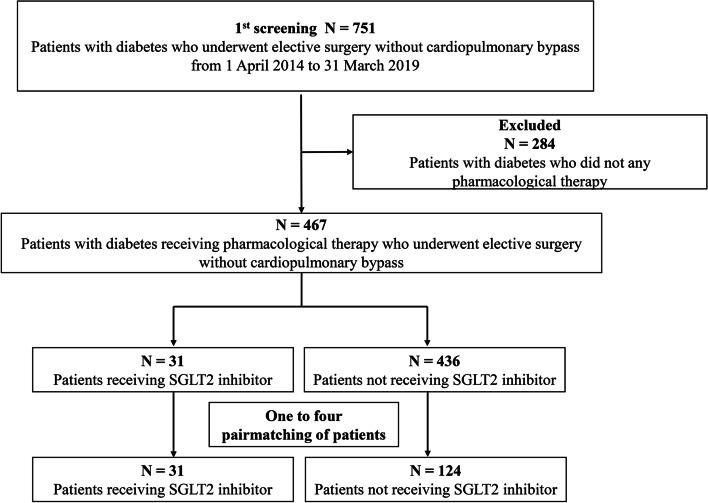
This was a retrospective, matched cohort study, which was conducted in the intensive care unit of a tertiary care facility in Japan. We identified patients aged 20 years or older with diabetes mellitus who received pharmacologic therapy and were admitted to the intensive care unit after elective surgery between April 2014 and March 2019. We extracted the following data from the electronic medical record for matching: age, sex, surgery year, surgical site, hemoglobin A1c level, and prescription for sodium-glucose cotransporter 2 inhibitors. Eligible patients were divided into two groups, those who were prescribed sodium-glucose cotransporter 2 inhibitors (SGLT2-i group) and those who were not (control group). For each patient in the SGLT2-i group, we randomly selected four patients from the control group matched for the extracted characteristics. The primary outcome was the incidence of metabolic acidosis with an elevated anion gap and euglycemia. The secondary outcome was the lowest pH value of each patient during their ICU stay.
A total of 155 patients were included in this study. Patients receiving sodium-glucose cotransporter 2 inhibitors had comparable characteristics to control participants; however, the proportions of patients undergoing dialysis were not similar. Metabolic acidosis with euglycemia was seen in 7/31 (22.6%) patients receiving sodium-glucose cotransporter 2 inhibitors and in 10/124 (8.1%) control patients (p = 0.047).
This study shows that the use of sodium-glucose cotransporter 2 inhibitors is associated with a significantly higher incidence of metabolic acidosis with euglycemia. Patients receiving sodium-glucose cotransporter 2 inhibitors who are scheduled to undergo invasive surgical procedures should be closely monitored for the development of euglycemic diabetic ketoacidosis.
钠-葡萄糖共转运蛋白 2 抑制剂是一类新型的抗高血糖药物。尽管有几例围手术期血糖正常的糖尿病酮症酸中毒与这些药物有关,但这种关联仍不清楚。本研究旨在探讨钠-葡萄糖共转运蛋白 2 抑制剂的使用与围手术期代谢性酸中毒伴血糖正常的关系,后者是围手术期血糖正常的糖尿病酮症酸中毒的替代结局。
这是一项在日本一家三级医疗机构的重症监护病房进行的回顾性匹配队列研究。我们确定了年龄在 20 岁或以上、接受药物治疗并在 2014 年 4 月至 2019 年 3 月期间择期手术后入住重症监护病房的糖尿病患者。我们从电子病历中提取了以下数据进行匹配:年龄、性别、手术年份、手术部位、糖化血红蛋白水平和钠-葡萄糖共转运蛋白 2 抑制剂的处方。符合条件的患者被分为两组,即服用钠-葡萄糖共转运蛋白 2 抑制剂的患者(SGLT2-i 组)和未服用的患者(对照组)。对于 SGLT2-i 组中的每位患者,我们从对照组中随机选择 4 名具有提取特征的患者进行匹配。主要结局是代谢性酸中毒伴高阴离子间隙和血糖正常的发生率。次要结局是每位患者在重症监护病房期间的最低 pH 值。
本研究共纳入 155 例患者。接受钠-葡萄糖共转运蛋白 2 抑制剂治疗的患者与对照组患者的特征相似,但接受透析治疗的患者比例不同。接受钠-葡萄糖共转运蛋白 2 抑制剂治疗的患者中有 7/31(22.6%)发生代谢性酸中毒伴血糖正常,对照组中有 10/124(8.1%)(p=0.047)。
本研究表明,使用钠-葡萄糖共转运蛋白 2 抑制剂与代谢性酸中毒伴血糖正常的发生率显著升高相关。计划接受有创手术的接受钠-葡萄糖共转运蛋白 2 抑制剂治疗的患者应密切监测血糖正常的糖尿病酮症酸中毒的发生。