Service de Pneumologie, Hôpital Avicenne (AP-HP), Université Sorbonne Paris Nord, INSERM U1272, Bobigny, France.
Service de Transplantation Pulmonaire et Centre de Compétence de la Mucoviscidose, Hôpital Foch, Suresnes, France.
Am J Transplant. 2022 Dec;22(12):2990-3001. doi: 10.1111/ajt.17177. Epub 2022 Sep 3.
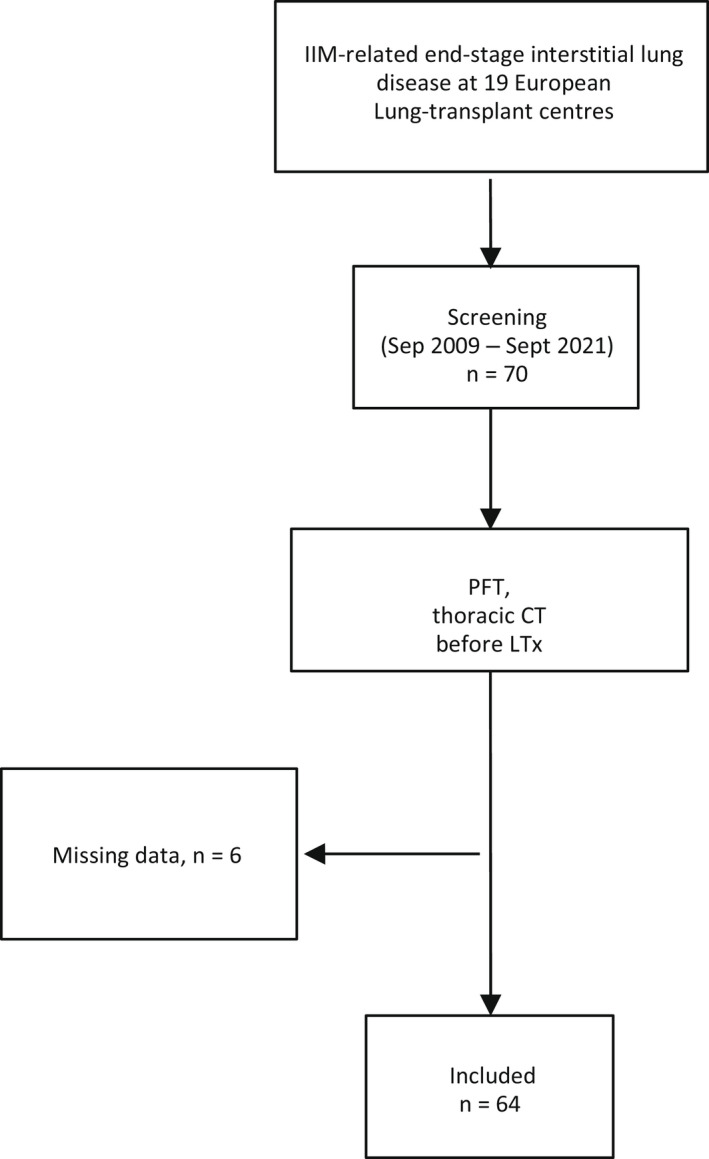
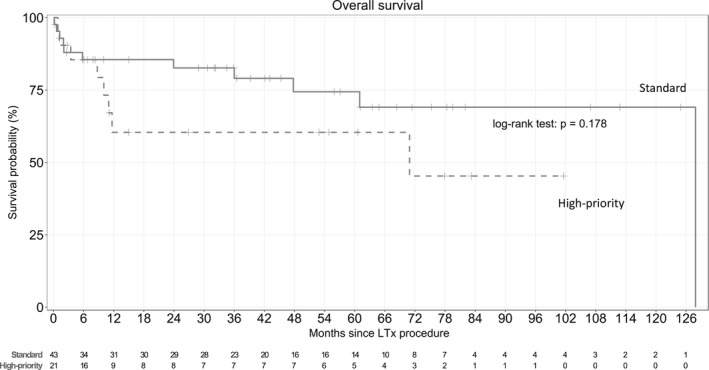
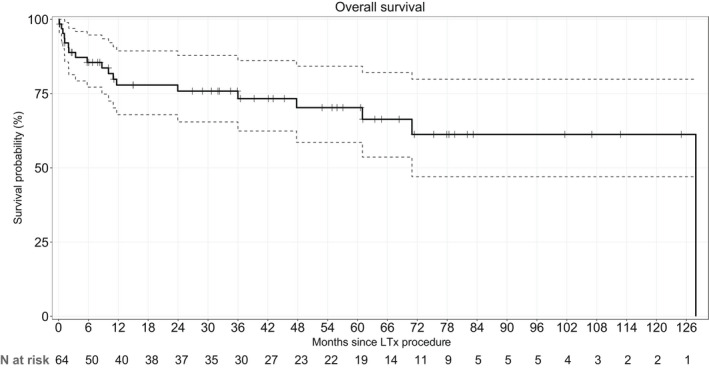
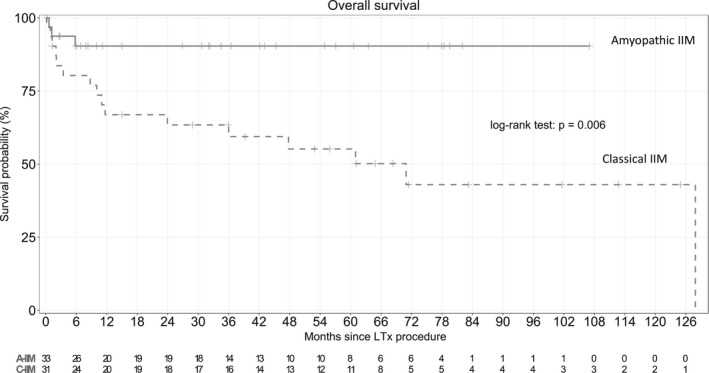
In patients with interstitial lung disease (ILD) complicating classical or amyopathic idiopathic inflammatory myopathy (IIM), lung transplantation outcomes might be affected by the disease and treatments. Here, our objective was to assess survival and prognostic factors in lung transplant recipients with IIM-ILD. We retrospectively reviewed data for 64 patients who underwent lung transplantation between 2009 and 2021 at 19 European centers. Patient survival was the primary outcome. At transplantation, the median age was 53 [46-59] years, 35 (55%) patients were male, 31 (48%) had classical IIM, 25 (39%) had rapidly progressive ILD, and 21 (33%) were in a high-priority transplant allocation program. Survival rates after 1, 3, and 5 years were 78%, 73%, and 70%, respectively. During follow-up (median, 33 [7-63] months), 23% of patients developed chronic lung allograft dysfunction. Compared to amyopathic IIM, classical IIM was characterized by longer disease duration, higher-intensity immunosuppression before transplantation, and significantly worse posttransplantation survival. Five (8%) patients had a clinical IIM relapse, with mild manifestations. No patient experienced ILD recurrence in the allograft. Posttransplantation survival in IIM-ILD was similar to that in international all-cause-transplantation registries. The main factor associated with worse survival was a history of muscle involvement (classical IIM). In lung transplant recipients with idiopathic inflammatory myopathy, survival was similar to that in all-cause transplantation and was worse in patients with muscle involvement compared to those with the amyopathic disease.
在并发经典型或无肌病特发性炎性肌病(IIM)的间质性肺疾病(ILD)患者中,肺移植的结局可能受疾病和治疗的影响。在此,我们旨在评估特发性炎性肌病合并ILD 患者的肺移植受者的生存率和预后因素。我们回顾性分析了 2009 年至 2021 年期间在 19 个欧洲中心接受肺移植的 64 例患者的数据。患者生存率为主要结局。移植时,中位年龄为 53 [46-59] 岁,35 例(55%)为男性,31 例(48%)为经典型 IIM,25 例(39%)为快速进展性ILD,21 例(33%)为高优先级移植分配方案。1、3 和 5 年的生存率分别为 78%、73%和 70%。在随访期间(中位时间 33 [7-63] 个月),23%的患者出现慢性肺移植物功能障碍。与无肌病 IIM 相比,经典 IIM 的特征是疾病持续时间更长、移植前免疫抑制强度更高,以及显著更差的移植后生存率。5 例(8%)患者出现临床 IIM 复发,表现轻微。无患者出现移植物内ILD 复发。特发性炎性肌病合并ILD 患者的肺移植后生存率与国际全因移植登记处相似。与更好的生存相关的主要因素是肌肉受累史(经典 IIM)。在特发性炎性肌病的肺移植受者中,生存率与全因移植相似,且肌肉受累患者的生存率差于无肌病患者。