Department of Anesthesiology, Perioperative, and Pain Medicine, Brigham and Women's Hospital, Boston, Massachusetts, USA.
Department of Anesthesiology, Perioperative, and Pain Medicine, Stanford University, Palo Alto, California, USA.
Psychooncology. 2022 Oct;31(10):1753-1761. doi: 10.1002/pon.6020. Epub 2022 Aug 25.
Little is known about how changes in psychosocial factors impact changes in pain outcomes among patients with cancer and chronic pain. This longitudinal cohort study of cancer patients investigated the relationships between changes in psychosocial factors and changes in pain severity and interference over time.
Data from patients with cancer and chronic pain (n = 316) treated at a tertiary pain clinic were prospectively collected. At their baseline visit (Time 1), patients provided demographic and clinical information, and completed validated psychosocial and pain assessments. Psychosocial and pain assessments were repeated at a follow-up visit (Time 2), on average 4.9 months later. Change scores (Time 2-Time 1) were computed for psychosocial and pain variables. Multivariable hierarchical linear regressions assessed the associations between changes in psychosocial factors with changes in pain outcomes over time.
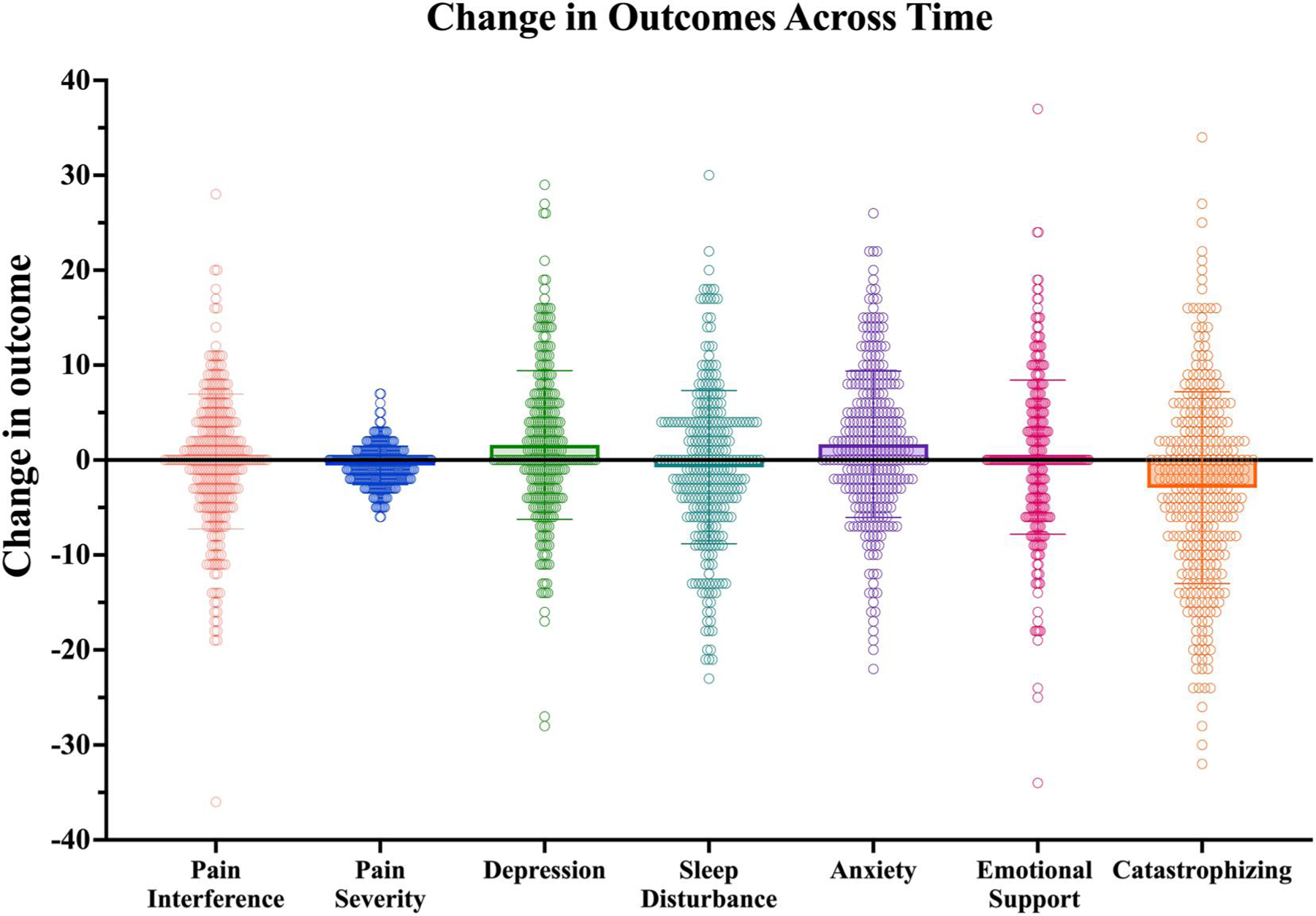
Participants were an average age of 59 years, were 61% female, and 69% White. Overall, a decrease in pain severity (p ≤ 0.001), but not pain interference, was observed among the group over time. In multivariable analyses, increased pain catastrophizing was significantly associated with increased pain severity over time (β = 0.24, p ≤ 0.001). Similarly, increased pain catastrophizing (β = 0.21, p ≤ 0.001) and increased depression (β = 0.20, p ≤ 0.003) were significantly associated with increased pain interference over time. Demographic and clinical characteristics were not significantly related to changes in pain outcomes.
Increased pain catastrophizing was uniquely associated with increased chronic pain severity and interference. Our findings indicate that cancer patients with chronic pain would likely benefit from the incorporation of nonpharmacological interventions, simultaneously addressing pain and psychological symptoms.
对于癌症和慢性疼痛患者,心理社会因素的变化如何影响疼痛结局,目前知之甚少。本项针对癌症患者的纵向队列研究调查了心理社会因素的变化与疼痛严重程度和干扰随时间的变化之间的关系。
前瞻性收集了在一家三级疼痛诊所接受治疗的癌症合并慢性疼痛患者(n=316)的数据。在基线访视(时间 1)时,患者提供了人口统计学和临床信息,并完成了经过验证的心理社会和疼痛评估。平均在 4.9 个月后进行了随访访视(时间 2),并计算了心理社会和疼痛变量的变化分数(时间 2-时间 1)。多变量分层线性回归评估了随时间推移,心理社会因素变化与疼痛结局变化之间的关联。
参与者的平均年龄为 59 岁,61%为女性,69%为白人。总体而言,该组人群的疼痛严重程度随时间呈下降趋势(p≤0.001),但疼痛干扰程度没有变化。在多变量分析中,疼痛灾难化程度增加与疼痛严重程度随时间的增加显著相关(β=0.24,p≤0.001)。同样,疼痛灾难化程度增加(β=0.21,p≤0.001)和抑郁程度增加(β=0.20,p≤0.003)与疼痛干扰随时间的增加显著相关。人口统计学和临床特征与疼痛结局的变化无显著相关性。
疼痛灾难化程度增加与慢性疼痛严重程度和干扰增加具有独特的相关性。我们的研究结果表明,患有慢性疼痛的癌症患者可能会受益于非药物干预措施的结合,同时解决疼痛和心理症状。