Department of Biological Chemistry, UCLA-DOE Institute, Howard Hughes Medical Institute, and Molecular Biology Institute, UCLA, Los Angeles, California, USA.
Department of Biological Chemistry, UCLA-DOE Institute, Howard Hughes Medical Institute, and Molecular Biology Institute, UCLA, Los Angeles, California, USA.
J Biol Chem. 2022 Oct;298(10):102396. doi: 10.1016/j.jbc.2022.102396. Epub 2022 Aug 18.
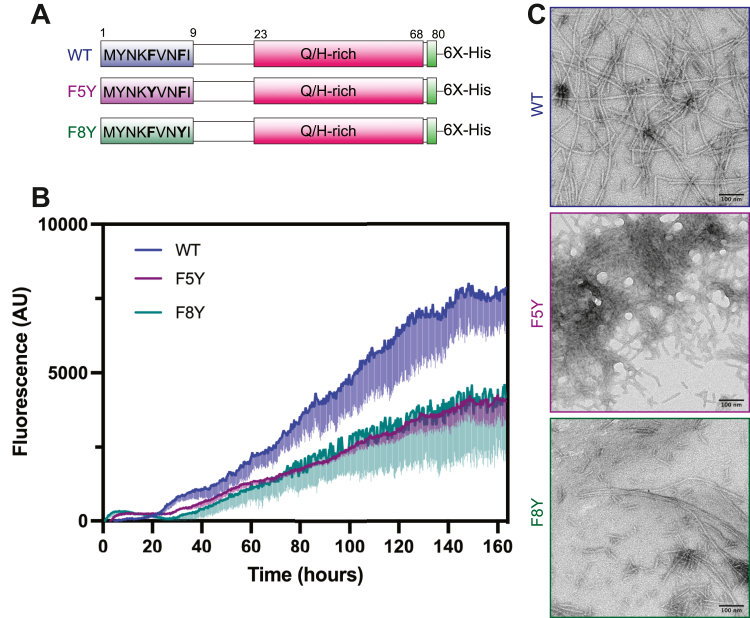
Amyloid protein aggregation is commonly associated with progressive neurodegenerative diseases, however not all amyloid fibrils are pathogenic. The neuronal cytoplasmic polyadenylation element binding protein is a regulator of synaptic mRNA translation and has been shown to form functional amyloid aggregates that stabilize long-term memory. In adult Drosophila neurons, the cytoplasmic polyadenylation element binding homolog Orb2 is expressed as 2 isoforms, of which the Orb2B isoform is far more abundant, but the rarer Orb2A isoform is required to initiate Orb2 aggregation. The N terminus is a distinctive feature of the Orb2A isoform and is critical for its aggregation. Intriguingly, replacement of phenylalanine in the fifth position of Orb2A with tyrosine (F5Y) in Drosophila impairs stabilization of long-term memory. The structure of endogenous Orb2B fibers was recently determined by cryo-EM, but the structure adopted by fibrillar Orb2A is less certain. Here we use micro-electron diffraction to determine the structure of the first 9 N-terminal residues of Orb2A, at a resolution of 1.05 Å. We find that this segment (which we term M9I) forms an amyloid-like array of parallel in-register β-sheets, which interact through side chain interdigitation of aromatic and hydrophobic residues. Our structure provides an explanation for the decreased aggregation observed for the F5Y mutant and offers a hypothesis for how the addition of a single atom (the tyrosyl oxygen) affects long-term memory. We also propose a structural model of Orb2A that integrates our structure of the M9I segment with the published Orb2B cryo-EM structure.
淀粉样蛋白聚集通常与进行性神经退行性疾病有关,但并非所有淀粉样纤维都是致病的。神经元细胞质多聚腺苷酸化元件结合蛋白是突触 mRNA 翻译的调节剂,已被证明能形成功能性淀粉样聚集物,稳定长期记忆。在成年果蝇神经元中,细胞质多聚腺苷酸化元件结合蛋白同源物 Orb2 表达为 2 种异构体,其中 Orb2B 异构体更为丰富,但罕见的 Orb2A 异构体是启动 Orb2 聚集所必需的。N 端是 Orb2A 异构体的一个独特特征,对其聚集至关重要。有趣的是,在果蝇中用酪氨酸(F5Y)替换 Orb2A 第 5 位的苯丙氨酸会损害长期记忆的稳定。最近通过 cryo-EM 确定了内源性 Orb2B 纤维的结构,但纤维状 Orb2A 采用的结构不太确定。在这里,我们使用微电子衍射以 1.05 Å的分辨率确定了 Orb2A 的前 9 个 N 端残基的结构。我们发现该片段(我们称之为 M9I)形成了平行排列的平行β-折叠的淀粉样排列,通过芳香族和疏水性残基的侧链交错相互作用。我们的结构解释了 F5Y 突变体观察到的聚集减少,并为添加单个原子(酪氨酸氧)如何影响长期记忆提供了假设。我们还提出了 Orb2A 的结构模型,将我们的 M9I 片段结构与已发表的 Orb2B cryo-EM 结构整合在一起。