Pogorzelski David, McKay Paula, Weaver Michael J, Jaeblon Todd, Hymes Robert A, Gaski Greg E, Fraifogl Joanne, Ahn James S, Bzovsky Sofia, Slobogean Gerard, Sprague Sheila, Slobogean Gerard P, Sprague Sheila, Wells Jeffrey, Bhandari Mohit, O'Toole Robert V, D'Alleyrand Jean-Claude, Eglseder Andrew, Johnson Aaron, Langhammer Christopher, Lebrun Christopher, Nascone Jason, Pensy Raymond, Pollak Andrew, Sciadini Marcus, Slobogean Gerard P, Degani Yasmin, Demyanovich Haley K, Howe Andrea, O'Hara Nathan N, Phipps Heather, Hempen Eric
Division of Orthopaedic Surgery, Department of Surgery, McMaster University, Hamilton, Ontario, Canada.
Department of Orthopaedic Surgery, Brigham and Women's Hospital, Harvard Medical School, Boston, MA, USA.
Contemp Clin Trials Commun. 2022 Oct;29:100973. doi: 10.1016/j.conctc.2022.100973. Epub 2022 Aug 17.
At the initiation of the COVID-19 pandemic, restrictions forced researchers to decide whether to continue their ongoing clinical trials. The PREPARE (Pragmatic Randomized Trial Evaluating Pre-Operative Alcohol Skin Solutions in Fractured Extremities) trial is a pragmatic cluster-randomized crossover trial in patients with open and closed fractures. PREPARE was enrolling over 200 participants per month at the initiation of the pandemic. We aim to describe how the COVID-19 research restrictions affected participant enrollment.
The PREPARE protocol permitted telephone consent, however, sites were obtaining consent in-person. To continue enrollment after the initiation of the restrictions participating sites obtained ethics approval for telephone consent scripts and the waiver of a signature on the consent form. We recorded the number of sites that switched to telephone consent, paused enrollment, and the length of the pause. We used t-tests to compare the differences in monthly enrollment between July 2019 and November 2020.
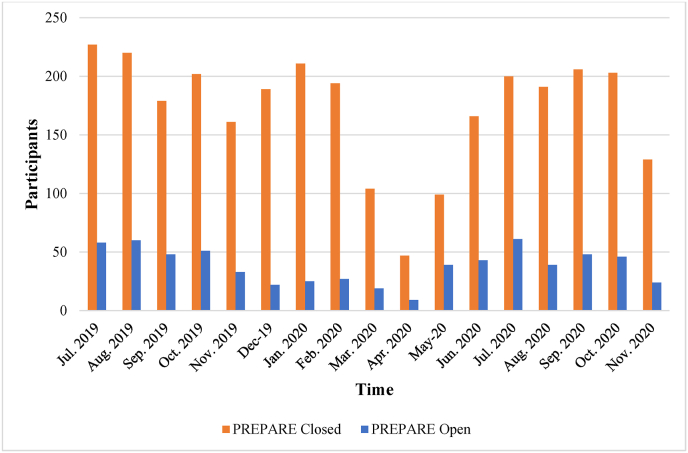
All 19 sites quickly implement telephone consent. Fourteen out of nineteen (73.6%) sites paused enrollment due to COVID-19 restrictions. The median length of enrollment pause was 46.5 days (range, 7-121 days; interquartile range, 61 days). The months immediately following the implementation of restrictions had significantly lower enrollment.
A pragmatic design allowed sites to quickly adapt their procedures for obtaining informed consent via telephone and allowed for minimal interruptions to enrollment during the pandemic.
在新冠疫情初期,各种限制措施迫使研究人员决定是否继续他们正在进行的临床试验。“PREPARE(评估四肢骨折术前酒精皮肤溶液的实用随机试验)”试验是一项针对开放性和闭合性骨折患者的实用整群随机交叉试验。在疫情开始时,“PREPARE”试验每月招募超过200名参与者。我们旨在描述新冠疫情研究限制措施如何影响参与者招募。
“PREPARE”方案允许电话同意,但各研究点此前采用的是当面获取同意。在限制措施实施后,为继续招募,参与研究的各点获得了关于电话同意脚本及同意书签字豁免的伦理批准。我们记录了转为电话同意的研究点数量、暂停招募的研究点数量以及暂停的时长。我们使用t检验来比较2019年7月和2020年11月每月招募人数的差异。
所有19个研究点都迅速实施了电话同意。19个研究点中有14个(73.6%)因新冠疫情限制措施而暂停招募。招募暂停的中位时长为46.5天(范围7 - 121天;四分位间距61天)。限制措施实施后的几个月招募人数显著降低。
一个实用的设计使各研究点能够迅速调整通过电话获取知情同意的程序,并在疫情期间使招募受到的干扰最小化。