School of Public Health, Sun Yat-Sen University, Guangzhou, China.
Molecular Epidemiology Research Centre, Guangzhou Twelfth People's Hospital, Guangzhou, China.
Front Endocrinol (Lausanne). 2022 Aug 3;13:916851. doi: 10.3389/fendo.2022.916851. eCollection 2022.
Existing diabetes risk prediction models based on regression were limited in dealing with collinearity and complex interactions. Bayesian network (BN) model that considers interactions may provide additional information to predict risk and infer causation.
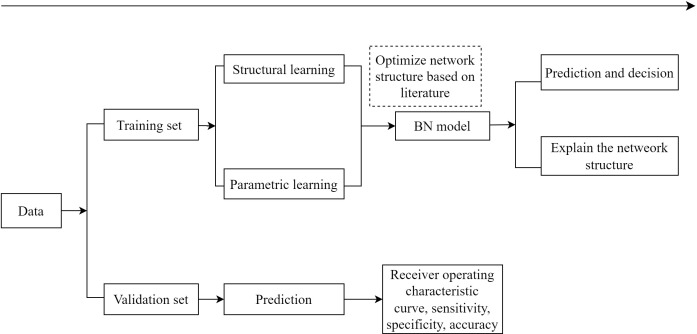
BN model was constructed for new-onset diabetes using prospective data of 15,934 participants without diabetes at baseline [73% women; mean (standard deviation) age = 61.0 (6.9) years]. Participants were randomly assigned to a training (n = 12,748) set and a validation (n = 3,186) set. Model performances were assessed using area under the receiver operating characteristic curve (AUC).
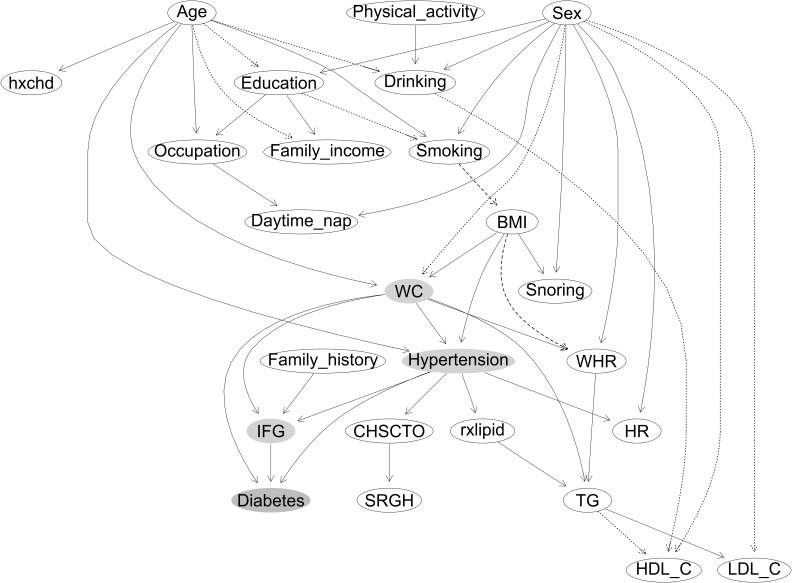
During an average follow-up of 4.1 (interquartile range = 3.3-4.5) years, 1,302 (8.17%) participants developed diabetes. The constructed BN model showed the associations (direct, indirect, or no) among 24 risk factors, and only hypertension, impaired fasting glucose (IFG; fasting glucose of 5.6-6.9 mmol/L), and greater waist circumference (WC) were directly associated with new-onset diabetes. The risk prediction model showed that the post-test probability of developing diabetes in participants with hypertension, IFG, and greater WC was 27.5%, with AUC of 0.746 [95% confidence interval CI) = 0.732-0.760], sensitivity of 0.727 (95% CI = 0.703-0.752), and specificity of 0.660 (95% CI = 0.652-0.667). This prediction model appeared to perform better than a logistic regression model using the same three predictors (AUC = 0.734, 95% CI = 0.703-0.764, sensitivity = 0.604, and specificity = 0.745).
We have first reported a BN model in predicting new-onset diabetes with the smallest number of factors among existing models in the literature. BN yielded a more comprehensive figure showing graphically the inter-relations for multiple factors with diabetes than existing regression models.
现有的基于回归的糖尿病风险预测模型在处理共线性和复杂交互方面存在局限性。考虑交互作用的贝叶斯网络(BN)模型可能会提供额外的信息来预测风险和推断因果关系。
使用无糖尿病的 15934 名参与者的前瞻性数据[73%为女性;平均(标准差)年龄=61.0(6.9)岁]构建新发病例糖尿病的 BN 模型。参与者被随机分配到训练集(n=12748)和验证集(n=3186)。使用接受者操作特征曲线下面积(AUC)评估模型性能。
在平均 4.1(四分位距=3.3-4.5)年的随访中,1302 名(8.17%)参与者发生了糖尿病。所构建的 BN 模型显示了 24 个风险因素之间的关联(直接、间接或无),只有高血压、空腹血糖受损(空腹血糖 5.6-6.9mmol/L)和更大的腰围(WC)与新发糖尿病直接相关。风险预测模型显示,高血压、IFG 和更大 WC 的参与者发生糖尿病的后测概率为 27.5%,AUC 为 0.746[95%置信区间(CI)=0.732-0.760],敏感性为 0.727(95%CI=0.703-0.752),特异性为 0.660(95%CI=0.652-0.667)。与使用相同三个预测因子的逻辑回归模型相比(AUC=0.734,95%CI=0.703-0.764,敏感性=0.604,特异性=0.745),该预测模型似乎表现更好。
我们首次报道了一种 BN 模型,用于预测新发病例糖尿病,该模型在文献中现有的模型中使用的因素数量最少。BN 产生了一个更全面的图形,直观地显示了多个因素与糖尿病之间的相互关系,优于现有的回归模型。