Nab Linda, Groenwold Rolf H H, Klok Frederikus A, Bhoelan Soerajja, Kruip Marieke J H A, Cannegieter Suzanne C
Department of Clinical Epidemiology Leiden University Medical Center Leiden The Netherlands.
Department of Biomedical Data Sciences Leiden University Medical Center Leiden The Netherlands.
Res Pract Thromb Haemost. 2022 Aug 15;6(6):e12776. doi: 10.1002/rth2.12776. eCollection 2022 Aug.
Coagulation abnormalities and coagulopathy are recognized as consequences of severe acute respiratory syndrome coronavirus 2 infection and the resulting coronavirus disease 2019 (COVID-19). Specifically, venous thromboembolism (VTE) has been reported as a frequent complication. By May 27, 2021, at least 93 original studies and 25 meta-analyses investigating VTE incidence in patients with COVID-19 had been published, showing large heterogeneity in reported VTE incidence ranging from 0% to 85%. This large variation complicates interpretation of individual study results as well as comparisons across studies, for example, to investigate changes in incidence over time, compare subgroups, and perform meta-analyses.
This study sets out to provide an overview of sources of heterogeneity in VTE incidence studies in patients with COVID-19, illustrated using examples.
The original studies of three meta-analyses were screened and a list of sources of heterogeneity that may explain observed heterogeneity across studies was composed.
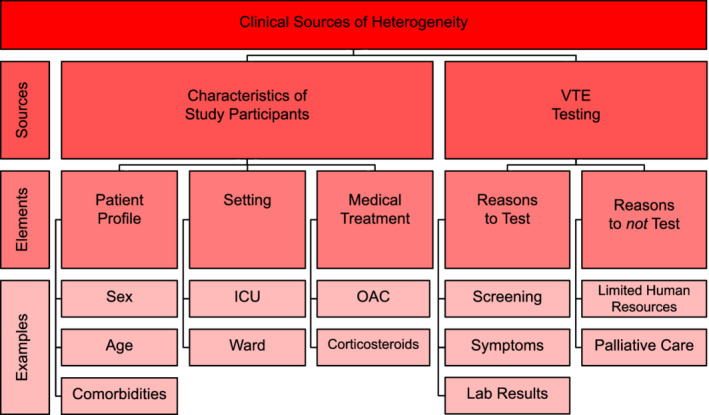
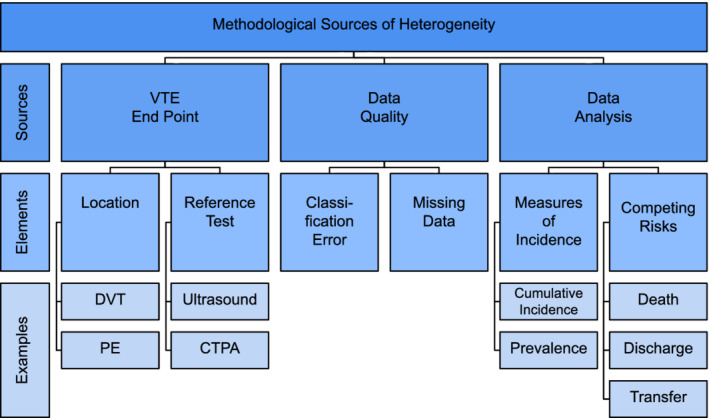
The sources of heterogeneity in VTE incidence were classified as clinical sources and methodologic sources. Clinical sources of heterogeneity include differences between studies regarding patient characteristics that affect baseline VTE risk and protocols used for VTE testing. Methodologic sources of heterogeneity include differences in VTE inclusion types, data quality, and the methods used for data analysis.
To appreciate reported estimates of VTE incidence in patients with COVID-19 in relation to its etiology, prevention, and treatment, researchers should unambiguously report about possible clinical and methodological sources of heterogeneity in those estimates. This article provides suggestions for that.
凝血异常和凝血病被认为是严重急性呼吸综合征冠状病毒2感染及由此导致的2019冠状病毒病(COVID-19)的后果。具体而言,静脉血栓栓塞(VTE)已被报道为一种常见并发症。截至2021年5月27日,至少有93项关于COVID-19患者VTE发生率的原始研究和25项荟萃分析已发表,报告的VTE发生率差异很大,从0%到85%不等。这种巨大的差异使个体研究结果的解释以及跨研究比较变得复杂,例如,调查发病率随时间的变化、比较亚组以及进行荟萃分析。
本研究旨在概述COVID-19患者VTE发生率研究中异质性的来源,并举例说明。
筛选了三项荟萃分析的原始研究,并列出了可能解释各研究间观察到的异质性的异质性来源清单。
VTE发生率的异质性来源分为临床来源和方法学来源。临床异质性来源包括不同研究在影响基线VTE风险的患者特征以及VTE检测所用方案方面的差异。方法学异质性来源包括VTE纳入类型、数据质量以及数据分析方法的差异。
为了理解COVID-19患者VTE发生率的报告估计值与其病因、预防和治疗的关系,研究人员应明确报告这些估计值中可能存在的临床和方法学异质性来源。本文为此提供了建议。