Wu Changgang, Liu Yunlong, Cai Xiangjing, Zhang Wenming, Li Yongjie, Fu Chunsheng
Department of Respiration, Liaocheng Infectious Disease Hospital, Liaochen, China.
Department of Infectious Diseases, Liaocheng Infectious Disease Hospital, Liaocheng, China.
Front Med (Lausanne). 2021 Apr 29;8:603558. doi: 10.3389/fmed.2021.603558. eCollection 2021.
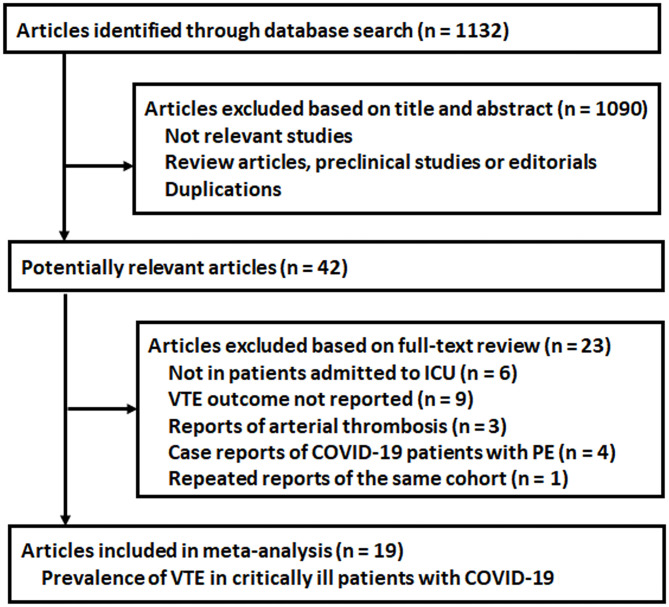
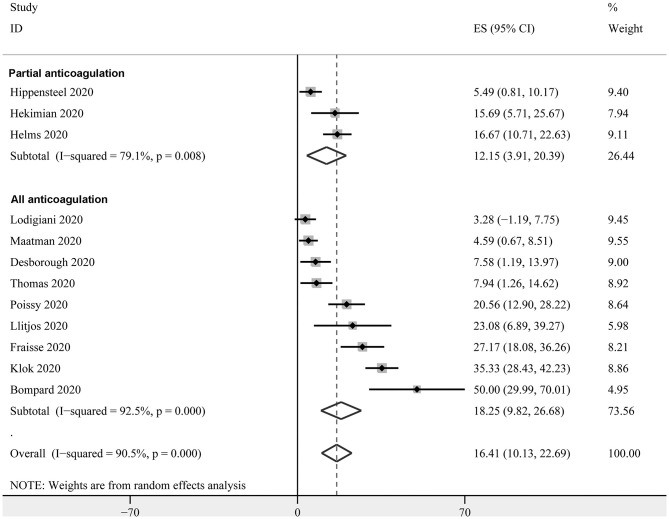
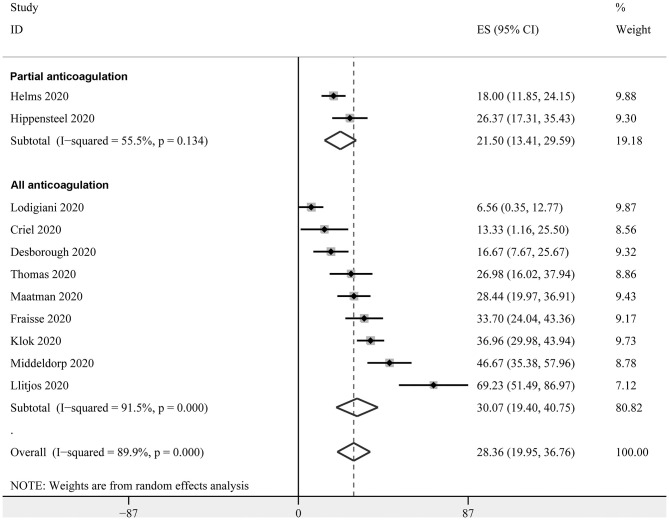
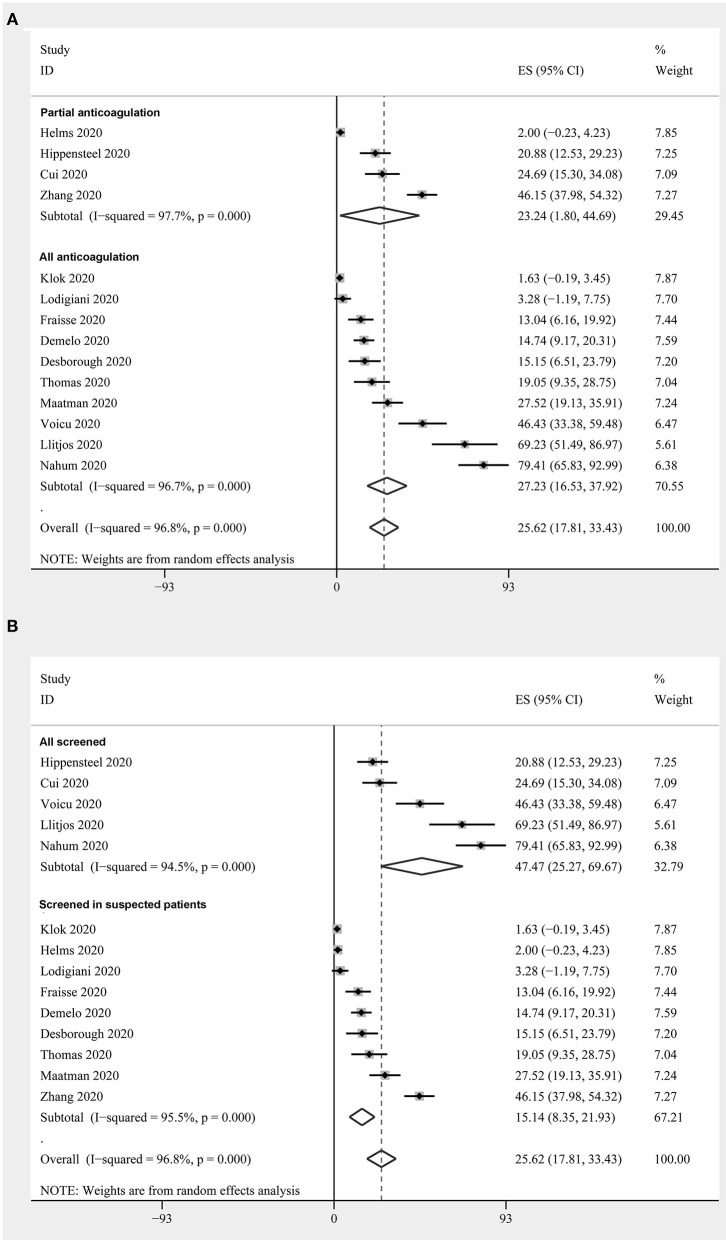
Accumulating evidence suggests that coronavirus disease 2019 (COVID-19) is associated with hypercoagulative status, particularly for critically ill patients in the intensive care unit. However, the prevalence of venous thromboembolism (VTE) in these patients under routine prophylactic anticoagulation remains unknown. A meta-analysis was performed to evaluate the prevalence of VTE in these patients by pooling the results of these observational studies. Observational studies that reported the prevalence of VTE in critically ill patients with COVID-19 were identified by searching the PubMed and Embase databases. A random-effect model was used to pool the results by incorporating the potential heterogeneity. A total of 19 studies with 1,599 patients were included. The pooled results revealed that the prevalence of VTE, deep venous thrombosis (DVT), and pulmonary embolism (PE) in critically ill patients with COVID-19 was 28.4% [95% confidence interval (CI): 20.0-36.8%], 25.6% (95% CI: 17.8-33.4%), and 16.4% (95% CI: 10.1-22.7%), respectively. Limited to studies, in which all patients received routine prophylactic anticoagulation, and the prevalence for VTE, DVT, and PE was 30.1% (95% CI: 19.4-40.8%), 27.2% (95% CI: 16.5-37.9%), and 18.3% (95% CI: 9.8%-26.7%), respectively. The prevalence of DVT was higher in studies with routine screening for all patients, when compared to studies with screening only in clinically suspected patients (47.5% vs. 15.1%, < 0.001). Critically ill patients with COVID-19 have a high prevalence of VTE, despite the use of present routine prophylactic anticoagulation.
越来越多的证据表明,2019冠状病毒病(COVID-19)与高凝状态有关,尤其是对重症监护病房中的重症患者而言。然而,在这些接受常规预防性抗凝治疗的患者中,静脉血栓栓塞(VTE)的患病率仍然未知。通过汇总这些观察性研究的结果,进行了一项荟萃分析,以评估这些患者中VTE的患病率。通过检索PubMed和Embase数据库,确定了报告COVID-19重症患者VTE患病率的观察性研究。采用随机效应模型,通过纳入潜在的异质性来汇总结果。总共纳入了19项研究,涉及1599名患者。汇总结果显示,COVID-19重症患者中VTE、深静脉血栓形成(DVT)和肺栓塞(PE)的患病率分别为28.4%[95%置信区间(CI):20.0-36.8%]、25.6%(95%CI:17.8-33.4%)和16.4%(95%CI:10.1-22.7%)。仅限于所有患者均接受常规预防性抗凝治疗的研究,VTE、DVT和PE的患病率分别为30.1%(95%CI:19.4-40.8%)、27.2%(95%CI:16.5-37.9%)和18.3%(95%CI:9.8%-26.7%)。与仅对临床疑似患者进行筛查的研究相比,对所有患者进行常规筛查的研究中DVT的患病率更高(47.5%对15.1%,<0.001)。尽管使用了目前的常规预防性抗凝治疗,COVID-19重症患者的VTE患病率仍然很高。