Wadsworth Center, New York State Department of Health, Albany.
Department of Biomedical Sciences, School of Public Health, University at Albany, Albany, New York.
JAMA Netw Open. 2022 Aug 1;5(8):e2227995. doi: 10.1001/jamanetworkopen.2022.27995.
Serosurveys can be used to monitor population-level dynamics of COVID-19 and vaccination. Dried blood spots (DBSs) collected from infants contain maternal IgG antibodies and are useful for serosurveys of individuals recently giving birth.
To examine SARS-CoV-2 antibody prevalence in pregnant individuals in New York State, identify associations between SARS-CoV-2 antibody status and maternal and infant characteristics, and detect COVID-19 vaccination among this population.
DESIGN, SETTING, AND PARTICIPANTS: A population-based, repeated cross-sectional study was conducted to detect SARS-CoV-2 nucleocapsid (N) and spike (S) IgG antibodies. Deidentified DBS samples and data submitted to the New York State Newborn Screening Program between November 1, 2019, and November 30, 2021, were analyzed.
Prenatal exposure to SARS-CoV-2 antibodies.
The presence of IgG antibodies to SARS-CoV-2 N and S antigens was measured using a microsphere immunoassay. Data were analyzed by geographic region and compared with reported COVID-19 cases and vaccinations among reproductive-aged females (15-44 years of age). Data were stratified by infant birth weight, gestational age, maternal age, and multiple birth status.
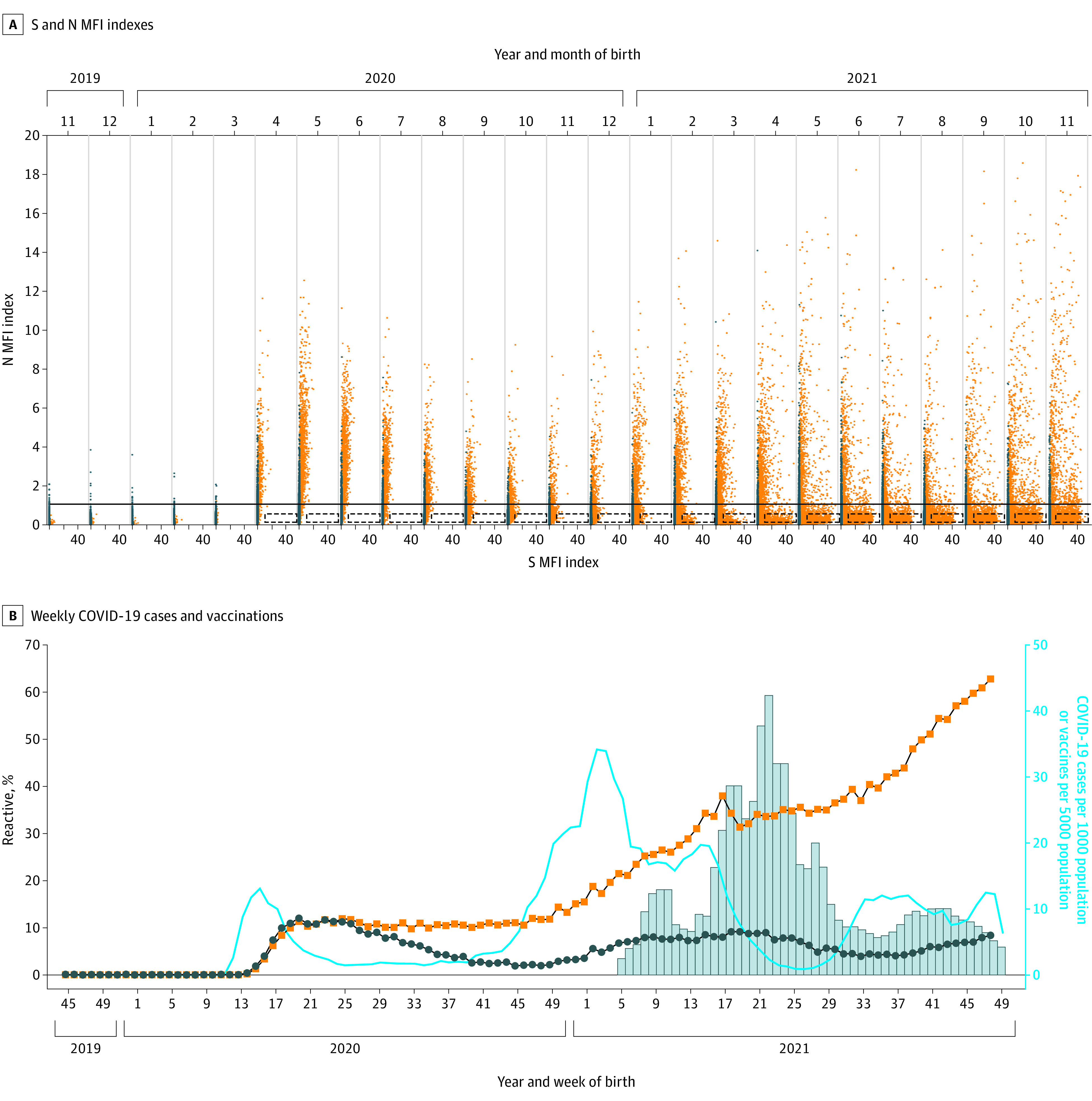
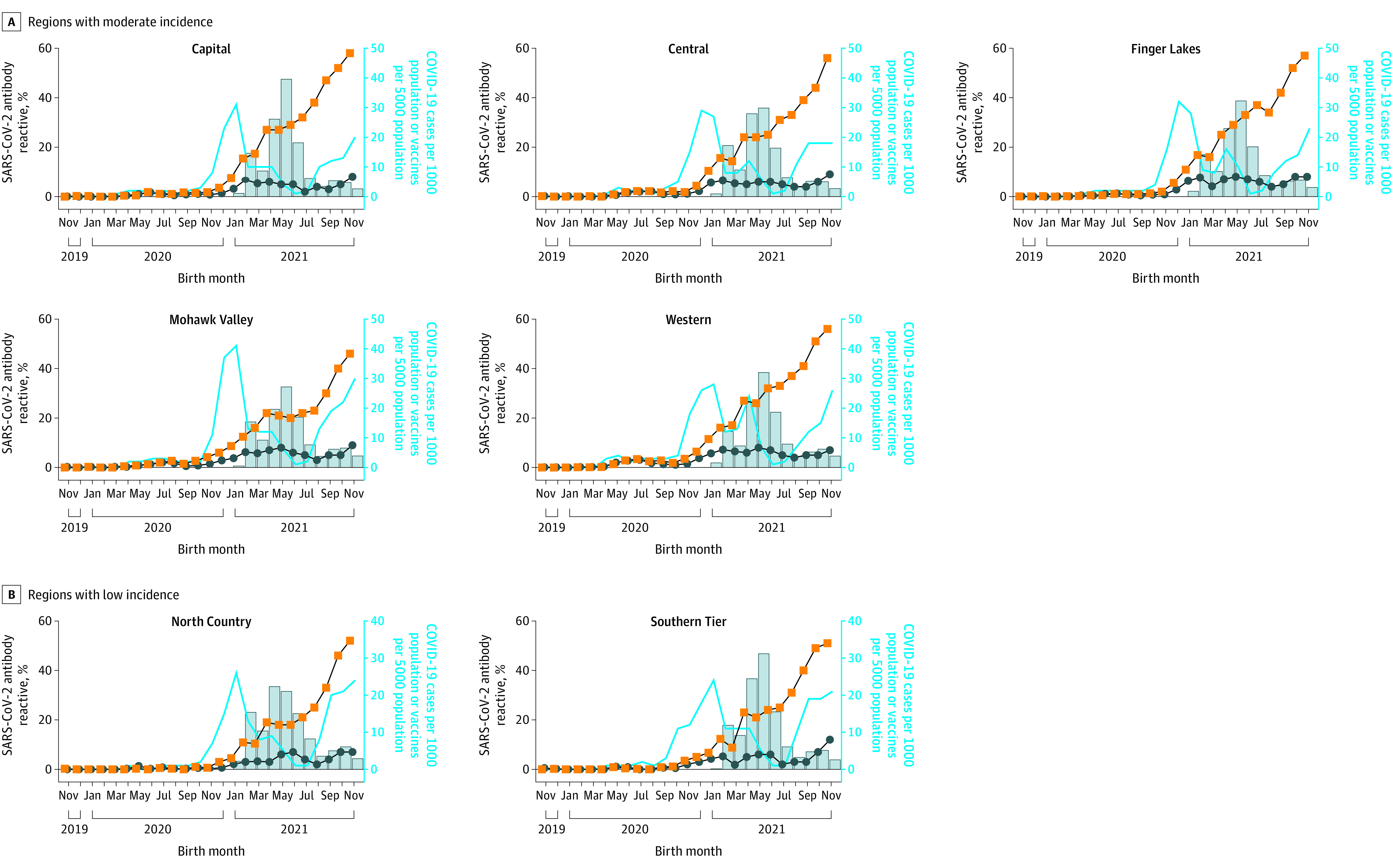
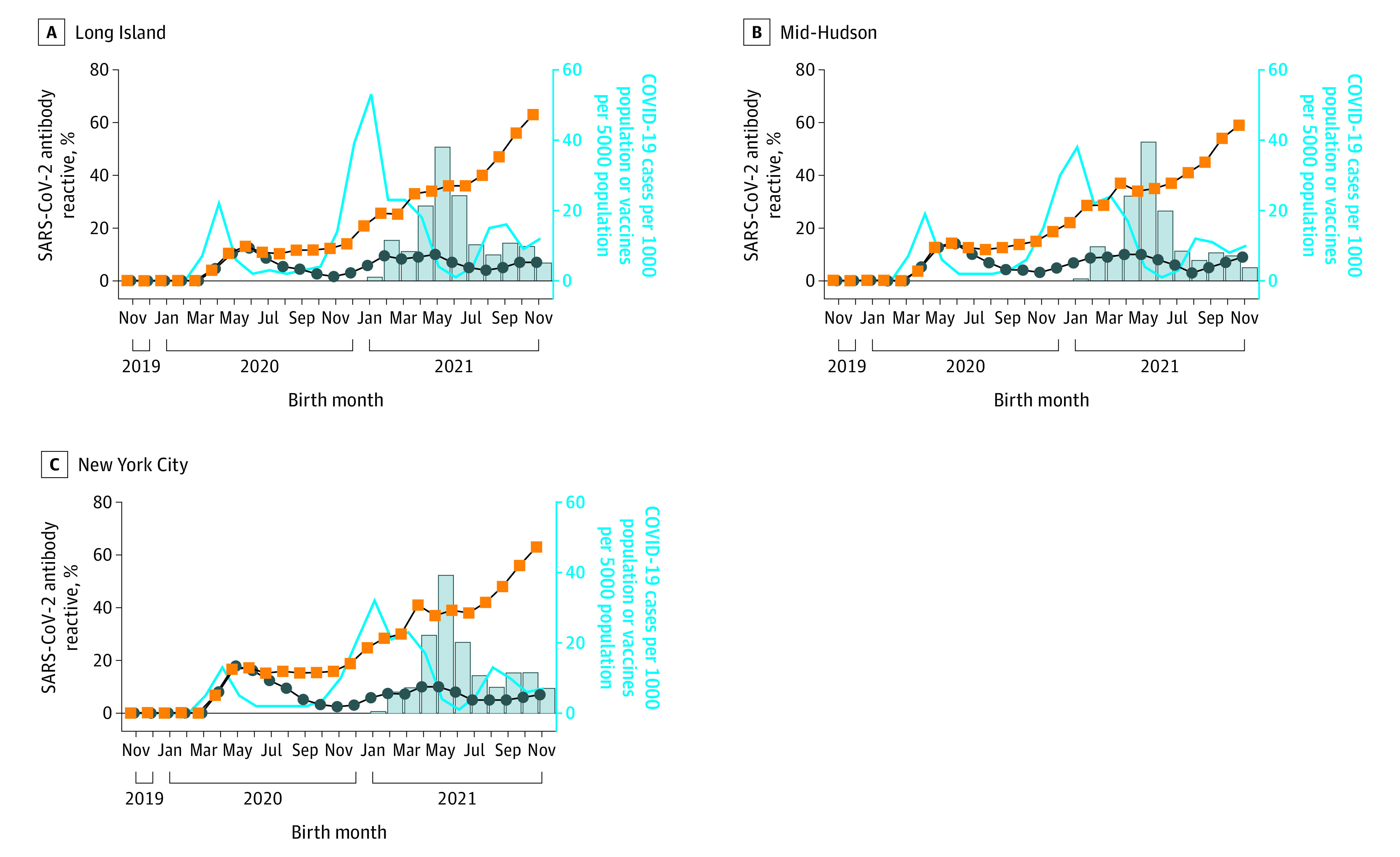
Dried blood spot samples from 415 293 infants (median [IQR] age, 1.04 [1.00-1.20] days; 210 805 [51.1%] male) were analyzed for SARS-CoV-2 antibodies. The first known antibody-positive infant in New York State was born on March 29, 2020. SARS-CoV-2 seroprevalence reflected statewide and regional COVID-19 cases among reproductive-aged females in the prevaccine period. From February through November 2021, S seroprevalence was strongly correlated with cumulative vaccinations in each New York State region and in the state overall (rs = 0.92-1.00, P ≤ .001). S and N seroprevalences were significantly lower in newborns with very low birth weight (720 [14.8%] for S and 138 [2.8%] for N, P < .001) and low birth weight (5160 [19.3%] for S and 1233 [4.6%] for N, P = .009) compared with newborns with normal birth weight (77 116 [20.1%] for S and 19 872 [5.2%] for N). Lower N and higher S seroprevalences were observed in multiple births (odds ratio [OR], 0.84; 95% CI, 0.75-0.94; P = .002 for N and OR, 1.24; 95% CI, 1.18-1.31; P < .001 for S) vs single births and for maternal age older than 30 years (OR, 0.87; 95% CI, 0.80-0.94; P < .001 for N and OR, 1.17; 95% CI, 1.11-1.23; P < .001 for S) vs younger than 20 years.
In this study, seroprevalence in newborn DBS samples reflected COVID-19 case fluctuations and vaccinations among reproductive-aged women during the study period. These results demonstrate the utility of using newborn DBS testing to estimate SARS-CoV-2 seroprevalence in pregnant individuals.
血清调查可用于监测 COVID-19 和疫苗接种的人群水平动态。从婴儿身上采集的干血斑 (DBS) 含有母体 IgG 抗体,可用于最近分娩的个体的血清调查。
检查纽约州孕妇的 SARS-CoV-2 抗体流行率,确定 SARS-CoV-2 抗体状态与母婴特征之间的关系,并检测该人群中的 COVID-19 疫苗接种情况。
设计、地点和参与者:进行了一项基于人群的重复横断面研究,以检测 SARS-CoV-2 核衣壳 (N) 和刺突 (S) IgG 抗体。分析了 2019 年 11 月 1 日至 2021 年 11 月 30 日期间向纽约州新生儿筛查计划提交的匿名 DBS 样本和数据。
产前接触 SARS-CoV-2 抗体。
使用微球免疫测定法测量 SARS-CoV-2 N 和 S 抗原的 IgG 抗体存在情况。通过地理区域进行数据分析,并与生殖年龄女性(15-44 岁)的报告 COVID-19 病例和疫苗接种情况进行比较。根据婴儿出生体重、胎龄、母亲年龄和多胎状态对数据进行分层。
对 415293 名婴儿的 DBS 样本(中位数[IQR]年龄,1.04[1.00-1.20]天;210805[51.1%]男性)进行了 SARS-CoV-2 抗体分析。纽约州首例已知抗体阳性婴儿于 2020 年 3 月 29 日出生。在疫苗接种前时期,SARS-CoV-2 血清阳性率反映了全州和各地区生殖年龄女性的 COVID-19 病例。从 2 月到 11 月,S 血清阳性率与纽约州每个地区和全州的累积疫苗接种量呈强相关(rs=0.92-1.00,P≤.001)。与正常出生体重的新生儿相比,极低出生体重(S 为 720[14.8%],N 为 138[2.8%],P<0.001)和低出生体重(S 为 5160[19.3%],N 为 1233[4.6%],P=0.009)的新生儿的 S 和 N 血清阳性率明显较低。与单胎分娩相比,多胎分娩(比值比[OR],0.84;95%CI,0.75-0.94;P=0.002 用于 N 和 OR,1.24;95%CI,1.18-1.31;P<0.001 用于 S)和母亲年龄大于 30 岁(OR,0.87;95%CI,0.80-0.94;P<0.001 用于 N 和 OR,1.17;95%CI,1.11-1.23;P<0.001 用于 S)的 N 和 S 血清阳性率较高。
在这项研究中,新生儿 DBS 样本的血清阳性率反映了研究期间生殖年龄女性 COVID-19 病例的波动和疫苗接种情况。这些结果表明,使用新生儿 DBS 检测来估计孕妇 SARS-CoV-2 血清阳性率是有用的。