Leading Center for the Development and Research of Cancer Medicine, Juntendo University Graduate School of Medicine, Bunkyo-ku, Tokyo, Japan.
Institute for Medical Regulatory Science, Waseda University, Shinjuku-ku, Tokyo, Japan.
Open Heart. 2022 Aug;9(2). doi: 10.1136/openhrt-2022-002053.
Adjuvant chemotherapy with trastuzumab improves the postoperative life expectancy of women with early-stage breast cancer. Although trastuzumab is reportedly cardiotoxic, quantification based on real-world evidence is lacking. Therefore, in this study, we aimed to analyse trastuzumab cardiotoxicity using a nationwide claim-based database.
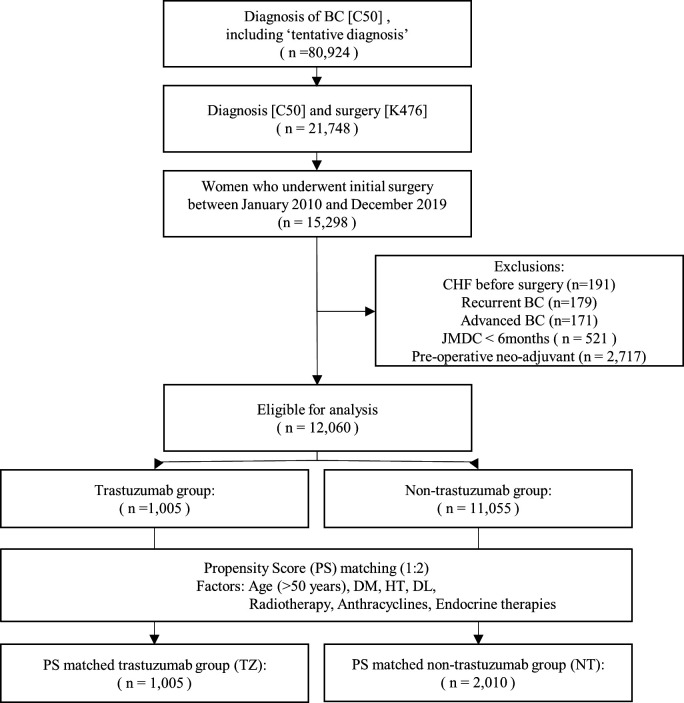
In this retrospective study, we used data from a nationwide claims database (Japan Medical Data Center, Tokyo, Japan) under the universal healthcare system. Women with breast cancer who underwent initial surgery were included. Patients with recurrent or advanced-stage breast cancer, with a history of heart failure, receiving neoadjuvant chemotherapy or a preoperative history of less than 6 months were excluded. Propensity score (PS) was calculated using logistic regression based on age, cardiovascular risk factors, radiotherapy and concomitant anthracyclines (AC).
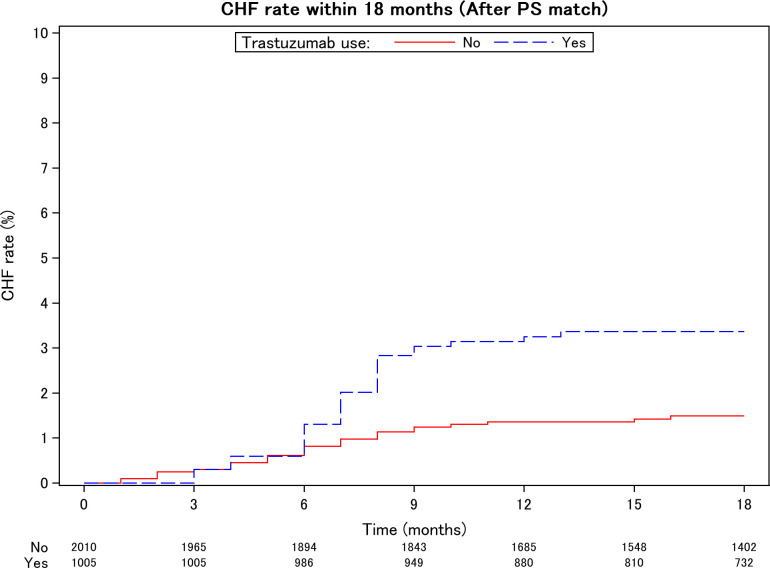
We identified 12 060 eligible patients (mean age 50.8±8.56 years) between January 2010 and December 2019. After 1:2 PS matching (trastuzumab users, TZ, n=1005; non-users, NT, n=2010), Cox proportional hazards model analysis showed that the rate of heart failure development within 18 months postoperative was significantly higher in the TZ group than in the NT group (adjusted HR 2.28, 95% CI 1.38 to 3.77). Baseline cardiac evaluation in the combined AC/TZ cases was 27.2% preoperative, 66.0% pre-AC and 86.6% pre-TZ, respectively.
Trastuzumab cardiotoxicity remained relevant in the claim-based analysis adjusted for AC effects. Further collaborative studies in cardio-oncology with real-world data are warranted to improve the rate of baseline cardiovascular risk assessment in patients with cancer scheduled for cardiotoxic cancer treatment.
曲妥珠单抗辅助化疗可提高早期乳腺癌患者的术后预期寿命。尽管曲妥珠单抗据报道具有心脏毒性,但缺乏基于真实世界证据的量化评估。因此,本研究旨在使用全国性基于理赔的数据库分析曲妥珠单抗的心脏毒性。
在这项回顾性研究中,我们使用了全民医保系统下的全国理赔数据库(日本医疗数据中心,东京,日本)的数据。纳入了接受初始手术的乳腺癌患者。排除了复发性或晚期乳腺癌患者、有心力衰竭病史、接受新辅助化疗或术前病史不足 6 个月的患者。基于年龄、心血管危险因素、放疗和同时使用蒽环类药物(AC),使用逻辑回归计算倾向评分(PS)。
我们在 2010 年 1 月至 2019 年 12 月期间确定了 12060 名符合条件的患者(平均年龄 50.8±8.56 岁)。在 1:2 PS 匹配(曲妥珠单抗使用者,TZ,n=1005;非使用者,NT,n=2010)后,Cox 比例风险模型分析显示,术后 18 个月内心力衰竭的发生率在 TZ 组显著高于 NT 组(调整后的 HR 2.28,95%可信区间 1.38 至 3.77)。联合 AC/TZ 病例的基线心脏评估分别为术前 27.2%、术前 66.0%和术前 86.6%。
在调整 AC 作用的基于理赔的分析中,曲妥珠单抗的心脏毒性仍然存在。需要进一步开展癌症心脏病学领域的合作研究,使用真实世界数据,以提高计划接受心脏毒性癌症治疗的癌症患者的基线心血管风险评估率。