Gender and Women's Health, Centre for Health Equity, School of Population and Global Health, The University of Melbourne, Carlton, Australia.
Maternal, Child and Adolescent Health Program, Burnet Institute, Melbourne, Australia.
PLoS Med. 2022 Aug 23;19(8):e1004074. doi: 10.1371/journal.pmed.1004074. eCollection 2022 Aug.
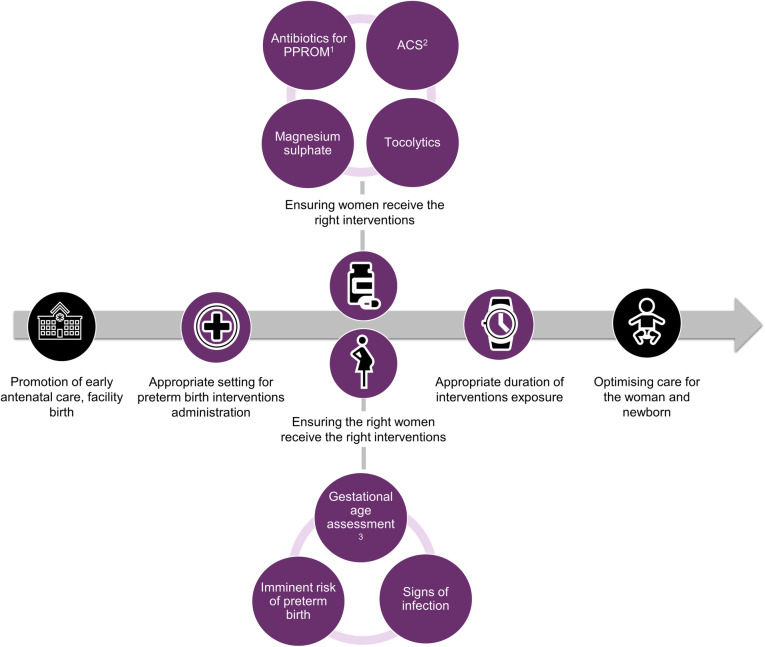
Preterm birth-related complications are the leading cause of death in newborns and children under 5. Health outcomes of preterm newborns can be improved with appropriate use of antenatal corticosteroids (ACSs) to promote fetal lung maturity, tocolytics to delay birth, magnesium sulphate for fetal neuroprotection, and antibiotics for preterm prelabour rupture of membranes. However, there are wide disparities in the rate and consistency in the use of these interventions across settings, which may underlie the differential health outcomes among preterm newborns. We aimed to assess factors (barriers and facilitators) affecting the appropriate use of ACS, tocolytics, magnesium sulphate, and antibiotics to improve preterm birth management.
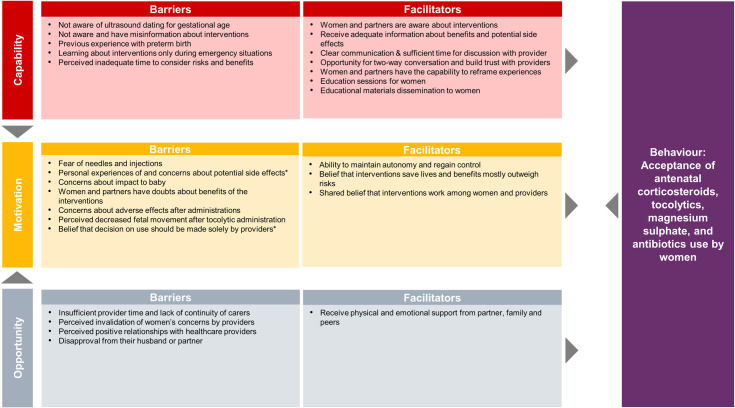
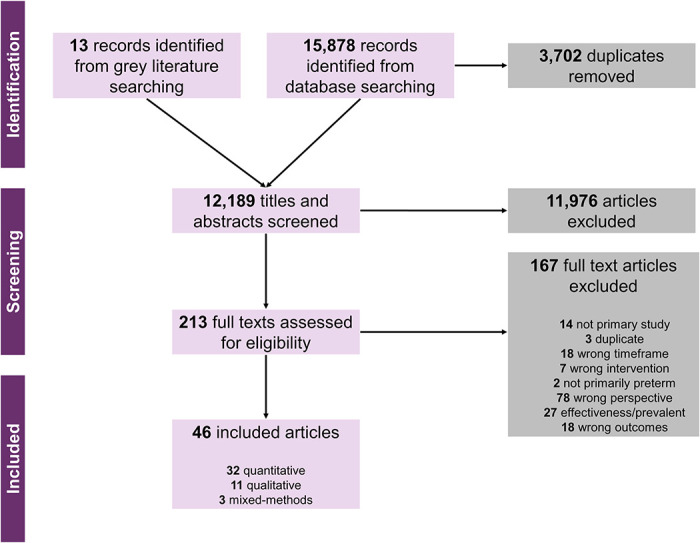
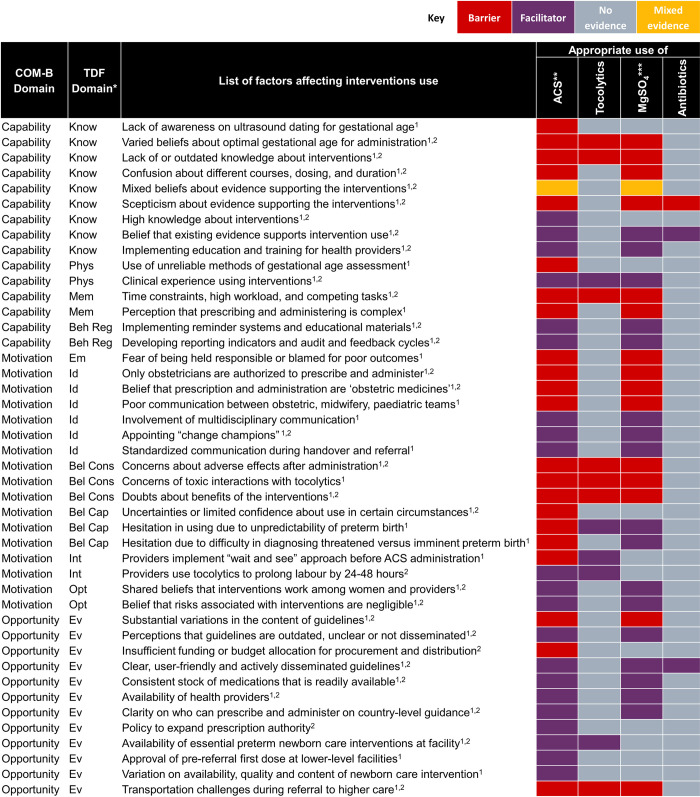
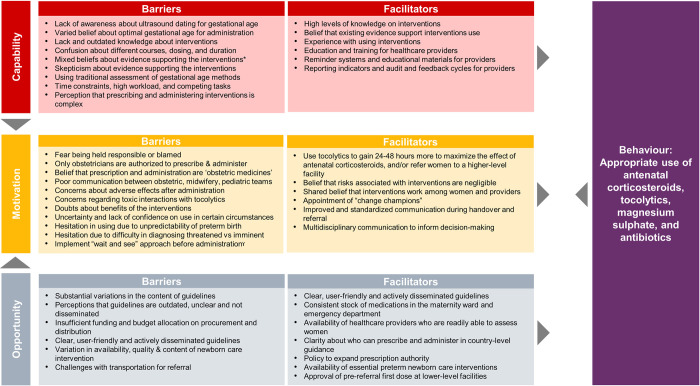
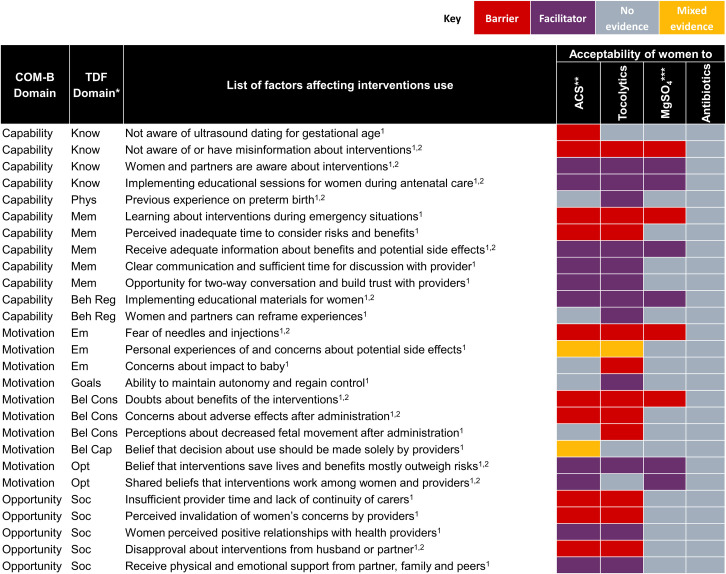
We conducted a mixed-methods systematic review including primary qualitative, quantitative, and mixed-methods studies. We searched MEDLINE, EMBASE, CINAHL, Global Health, and grey literature from inception to 16 May 2022. Eligible studies explored perspectives of women, partners, or community members who experienced preterm birth or were at risk of preterm birth and/or received any of the 4 interventions, health workers providing maternity and newborn care, and other stakeholders involved in maternal care (e.g., facility managers, policymakers). We used an iterative narrative synthesis approach to analysis, assessed methodological limitations using the Mixed Methods Appraisal Tool, and assessed confidence in each qualitative review finding using the GRADE-CERQual approach. Behaviour change models (Theoretical Domains Framework; Capability, Opportunity, and Motivation (COM-B)) were used to map barriers and facilitators affecting appropriate use of these interventions. We included 46 studies from 32 countries, describing factors affecting use of ACS (32/46 studies), tocolytics (13/46 studies), magnesium sulphate (9/46 studies), and antibiotics (5/46 studies). We identified a range of barriers influencing appropriate use of the 4 interventions globally, which include the following: inaccurate gestational age assessment, inconsistent guidelines, varied knowledge, perceived risks and benefits, perceived uncertainties and constraints in administration, confusion around prescribing and administering authority, and inadequate stock, human resources, and labour and newborn care. Women reported hesitancy in accepting interventions, as they typically learned about them during emergencies. Most included studies were from high-income countries (37/46 studies), which may affect the transferability of these findings to low- or middle-income settings.
In this study, we identified critical factors affecting implementation of 4 interventions to improve preterm birth management globally. Policymakers and implementers can consider these barriers and facilitators when formulating policies and planning implementation or scale-up of these interventions. Study findings can inform clinical preterm birth guidelines and implementation to ensure that barriers are addressed, and enablers are reinforced to ensure these interventions are widely available and appropriately used globally.
早产相关并发症是导致新生儿和 5 岁以下儿童死亡的主要原因。适当使用产前皮质类固醇(ACS)来促进胎儿肺成熟、使用宫缩抑制剂延迟分娩、使用硫酸镁进行胎儿神经保护以及使用抗生素治疗早产胎膜早破,可以改善早产新生儿的健康结局。然而,在不同环境中,这些干预措施的使用率和一致性存在很大差异,这可能是导致早产新生儿健康结局不同的原因。本研究旨在评估影响 ACS、宫缩抑制剂、硫酸镁和抗生素合理使用的因素(障碍和促进因素),以改善早产管理。
我们进行了一项混合方法系统评价,包括初级定性、定量和混合方法研究。我们从建库到 2022 年 5 月 16 日在 MEDLINE、EMBASE、CINAHL、全球卫生和灰色文献中进行了检索。合格研究探讨了经历早产或有早产风险并接受了上述 4 种干预措施之一的妇女、伴侣或社区成员、提供产妇和新生儿护理的卫生工作者以及参与产妇护理的其他利益相关者(如设施管理人员、政策制定者)的观点。我们使用迭代叙述性综合方法进行分析,使用混合方法评估工具评估方法学局限性,并使用 GRADE-CERQual 方法评估每个定性审查结果的信心。使用行为改变模型(理论领域框架;能力、机会和动机(COM-B))来映射影响这些干预措施合理使用的障碍和促进因素。我们纳入了来自 32 个国家的 46 项研究,描述了影响 ACS(46 项研究中的 32 项)、宫缩抑制剂(46 项研究中的 13 项)、硫酸镁(46 项研究中的 9 项)和抗生素(46 项研究中的 5 项)使用的因素。我们确定了全球范围内影响这 4 种干预措施合理使用的一系列障碍,包括以下内容:不准确的孕龄评估、不一致的指南、知识差异、感知的风险和益处、管理中的感知不确定性和限制、处方和管理权限的混淆以及库存、人力资源以及劳工和新生儿护理不足。妇女报告说,她们对接种干预措施犹豫不决,因为她们通常是在紧急情况下了解这些措施的。大多数纳入的研究来自高收入国家(46 项研究中的 37 项),这可能会影响这些研究结果在中低收入国家的可转移性。
在这项研究中,我们确定了影响全球改善早产管理的 4 种干预措施实施的关键因素。政策制定者和实施者在制定政策和规划这些干预措施的实施或扩大规模时,可以考虑这些障碍和促进因素。研究结果可以为临床早产指南的制定和实施提供信息,以确保解决障碍,并加强促进因素,以确保这些干预措施在全球范围内广泛可用并得到合理使用。