Dimitrov Yves, Krummel Thierry, Chantrel François, Faller Anne-Laure, Ott Julien, David Daniela, Bazin-Kara Dorothée, Hannedouche Thierry, Borni Claire
Service de Néphrologie, Centre Hospitalier de Haguenau, Haguenau, France.
Service de Néphrologie-Dialyse, Centre Hospitalo-Universitaire de Strasbourg, Strasbourg, France.
Clin Kidney J. 2022 Mar 21;15(9):1720-1726. doi: 10.1093/ckj/sfac082. eCollection 2022 Sep.
Severe acute respiratory syndrome coronavirus-2 (SARS-CoV-2) infection is more frequent and severe in patients with chronic kidney disease (CKD) on maintenance haemodialysis (HD). Vaccines are now available, but the protective response rates and determinants of humoral response to the vaccine are poorly described.
This prospective observational study describes the response rates of detectable and protective antibody titres 1 month after each dose of an mRNA vaccine in a cohort of 851 patients on maintenance HD.
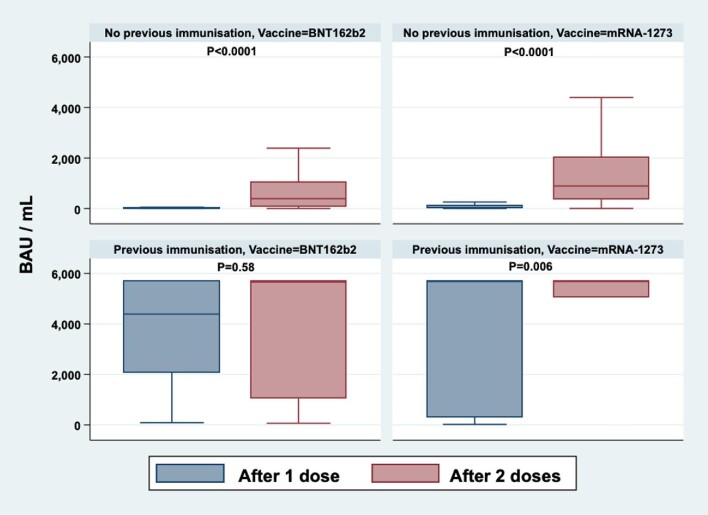
Among naïve SARS-CoV-2 patients, a vast majority produced detectable (95.2%) or protective levels of antibodies (69.6%) 1 month after the second vaccine dose. In addition, the response rate was significantly higher with the mRNA-1273 than with the BNT162b2 vaccine 1 month after the second dose (79.8 versus 59.1%, respectively; P < 0.001). The main determinants for an inadequate humoral response were older age, treatment with immunosuppressants or oral anticoagulants and low serum albumin. All the patients who encountered coronavirus disease 2019 before vaccination also reached a highly protective humoral response.
We found an acceptable humoral response rate in patients on maintenance HD, much higher than in transplant recipients. Therefore the third dose of vaccine may be justified in those patients with an inadequate humoral response, particularly those with a history of organ transplantation or immunosuppressive treatment.
严重急性呼吸综合征冠状病毒2(SARS-CoV-2)感染在接受维持性血液透析(HD)的慢性肾脏病(CKD)患者中更为常见且严重。目前已有疫苗可用,但对疫苗的体液免疫反应保护率及其决定因素的描述较少。
这项前瞻性观察性研究描述了851例接受维持性HD治疗的患者在接种每剂mRNA疫苗1个月后可检测到的抗体滴度和保护性抗体滴度的反应率。
在未感染过SARS-CoV-2的患者中,绝大多数人在接种第二剂疫苗1个月后产生了可检测到的抗体(95.2%)或保护性抗体水平(69.6%)。此外,在接种第二剂疫苗1个月后,mRNA-1273疫苗的反应率显著高于BNT162b2疫苗(分别为79.8%和59.1%;P<0.001)。体液免疫反应不足的主要决定因素是年龄较大、使用免疫抑制剂或口服抗凝剂治疗以及血清白蛋白水平较低。所有在接种疫苗前感染过2019冠状病毒病的患者也都产生了高度保护性的体液免疫反应。
我们发现维持性HD患者的体液免疫反应率是可以接受的,远高于移植受者。因此,对于体液免疫反应不足的患者,尤其是有器官移植史或接受过免疫抑制治疗的患者,可能有必要接种第三剂疫苗。