Dekervel Marine, Henry Nicolas, Torreggiani Massimo, Pouteau Lise-Marie, Imiela Jean-Paul, Mellaza Chloé, Garnier Anne-Sophie, Dujardin Amaury, Asfar Marine, Ducancelle Alexandra, Paquin Axelle, Blanchi Sophie, Besson Virginie, Piccoli Giorgina Barbara, Augusto Jean-François
Service de Néphrologie-Dialyse-Transplantation, CHU d'Angers, Angers, France.
Service de Néphrologie, CH Le Mans, Le Mans, France.
Clin Kidney J. 2021 Aug 13;14(11):2349-2355. doi: 10.1093/ckj/sfab152. eCollection 2021 Nov.
Humoral response against sudden acute respiratory syndrome coronavirus 2 (SARS-CoV-2) after two doses of BNT162b2 (Pfizer-BioNTech) has been proven to be less intense in maintenance dialysis patients as compared with healthy subjects, leading the French authorities to recommend a third injection in this population. Here we investigated the response to the third injection in two cohorts of haemodialysis (HD) patients.
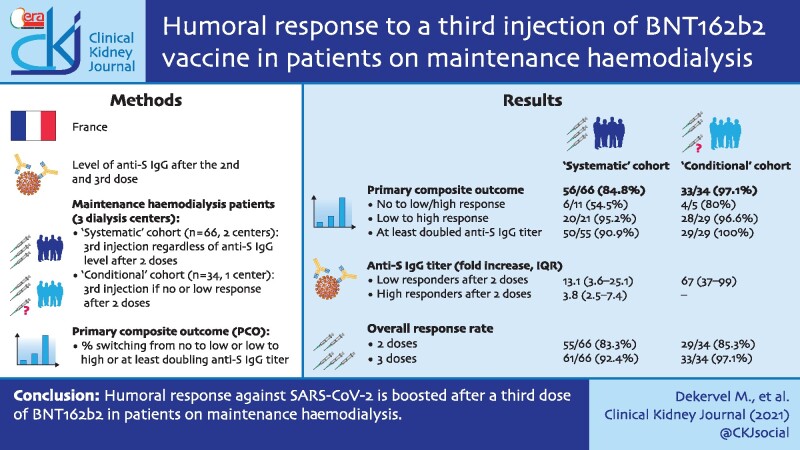
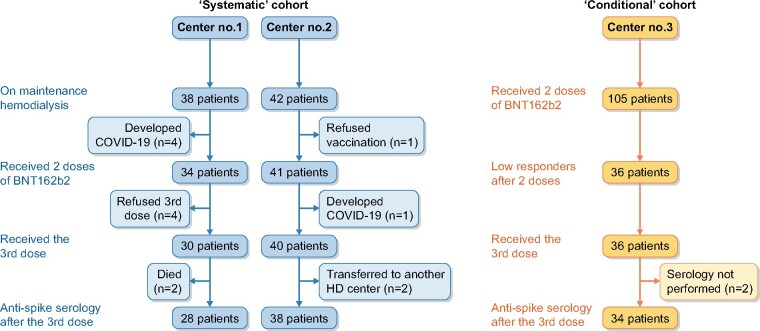
Data from two prospective observational cohorts were collected. In the first ('systematic') cohort, patients from two HD centres ( = 66) received a third injection of BNT162b2, regardless of the response after two injections. In the second ('conditional') cohort, the injection was only prescribed to patients ( = 34) with no or low response to the previous two doses. In both cohorts, the third dose was injected 1-2 months after the second dose. Serology was performed after the second and third doses to assess anti-Spike immunoglobulin G (S IgG) antibody titre.
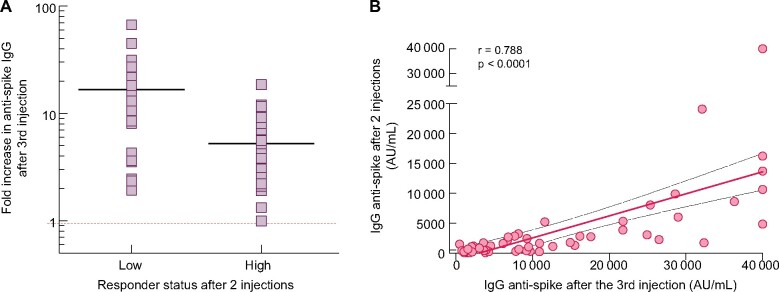
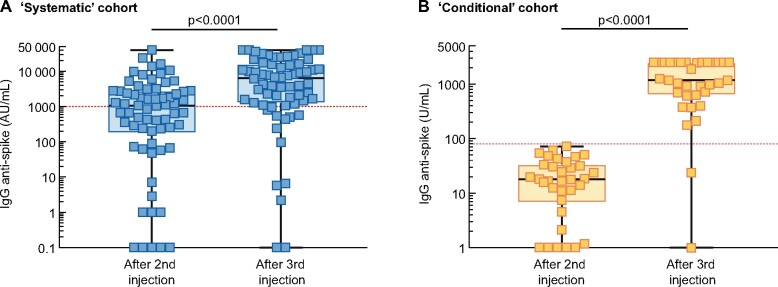
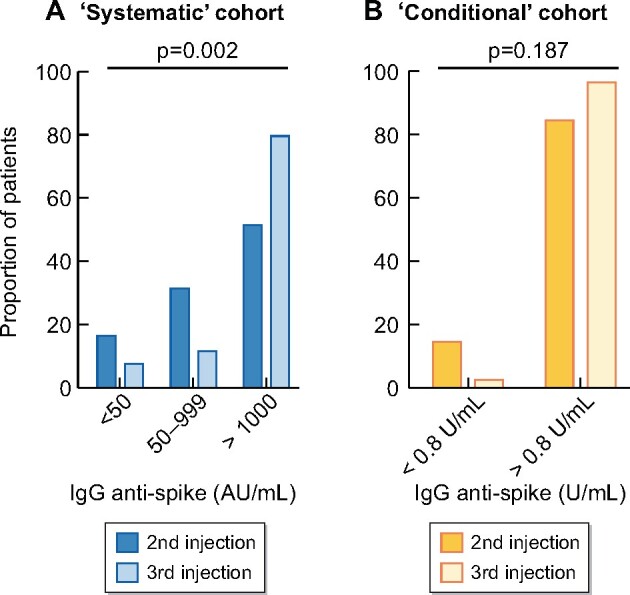
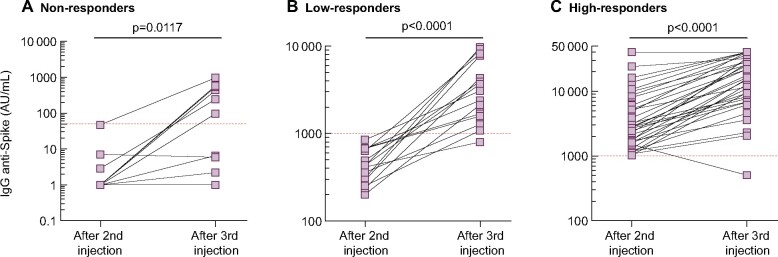
In the systematic cohort, anti-S IgG was found in 83.3 and 92.4% of patients after the second and third doses of BNT162b2, respectively. In this cohort, 6/11 (54.5%) and 20/21 (95.2%) patients switched from non-responder to low responder and from low responder to high responder, respectively. In low and high responders to two doses, 50/55 (90.9%) at least doubled their anti-S IgG titre. Similar trends were observed in the conditional cohort.
In maintenance HD patients, humoral response against SARS-CoV-2 was boosted after a third dose of BNT162b2, allowing seroconversion in more than half of non-responders. These data may support an intensified vaccination protocol with a third dose of BNT162b2 in dialysis patients.
与健康受试者相比,维持性透析患者在接种两剂BNT162b2(辉瑞-生物科技公司)后,针对严重急性呼吸综合征冠状病毒2(SARS-CoV-2)的体液免疫反应较弱,这使得法国当局建议该人群接种第三针疫苗。在此,我们研究了两组血液透析(HD)患者对第三针疫苗的反应。
收集了两个前瞻性观察队列的数据。在第一个(“系统性”)队列中,来自两个血液透析中心的患者(n = 66)接种了第三剂BNT162b2,无论前两针接种后的反应如何。在第二个(“有条件”)队列中,仅对前两剂无反应或反应较弱的患者(n = 34)进行接种。在两个队列中,第三剂均在第二剂接种后1 - 2个月注射。在第二剂和第三剂接种后进行血清学检测,以评估抗刺突免疫球蛋白G(S IgG)抗体滴度。
在系统性队列中,第二剂和第三剂BNT162b2接种后,分别有83.3%和92.4%的患者检测到抗S IgG。在该队列中,分别有6/11(54.5%)和20/21(95.2%)的患者从无反应者转变为低反应者,以及从低反应者转变为高反应者。在两剂接种后的低反应者和高反应者中,50/55(90.9%)的患者抗S IgG滴度至少翻倍。在有条件队列中也观察到了类似趋势。
在维持性血液透析患者中,第三剂BNT162b2增强了针对SARS-CoV-2的体液免疫反应,使超过一半的无反应者实现血清转化。这些数据可能支持在透析患者中采用强化接种方案,即接种第三剂BNT162b2。