Etebari Kayvan, Hereward James, Sailo Apenisa, Ahoafi Emeline M, Tautua Robert, Tsatsia Helen, Jackson Grahame V, Furlong Michael J
School of Biological Sciences, The University of Queensland, St Lucia, Queensland 4072, Australia.
Koronivia Research Station, Ministry of Agriculture, Nausori, Fiji.
Curr Res Insect Sci. 2021 May 13;1:100015. doi: 10.1016/j.cris.2021.100015. eCollection 2021.
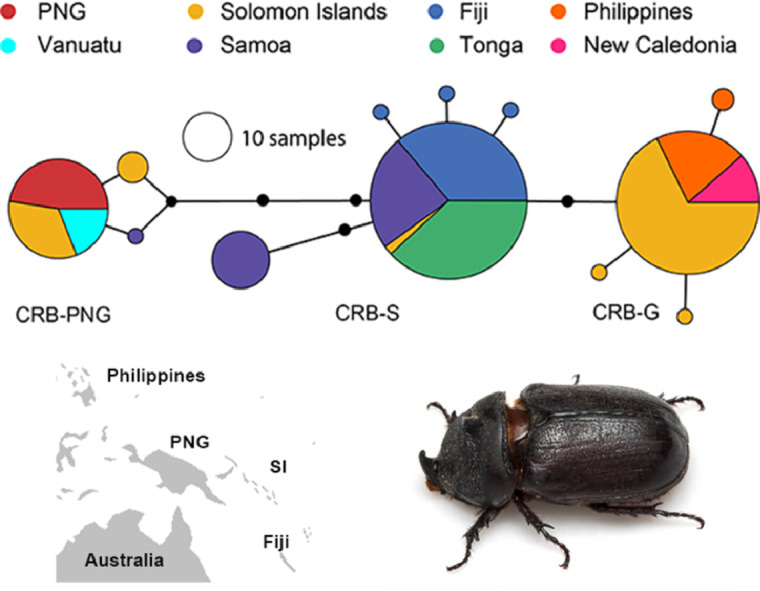
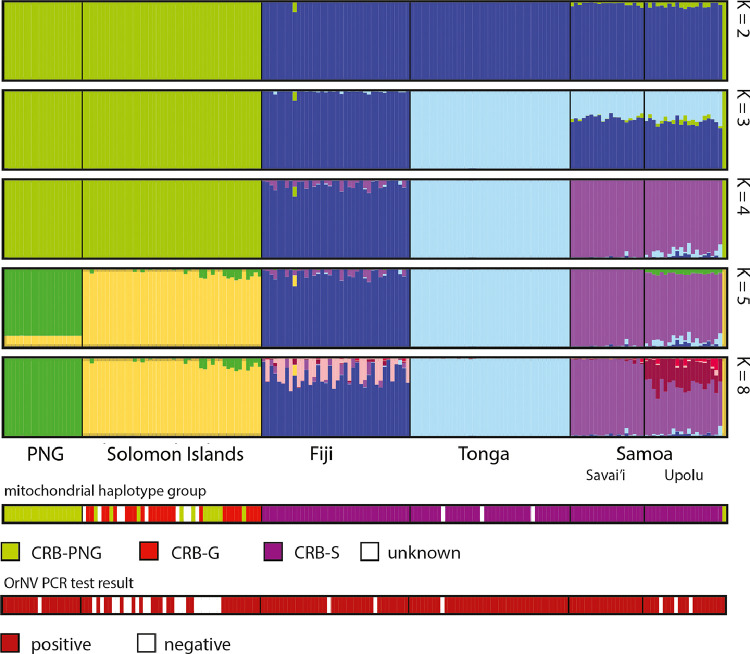
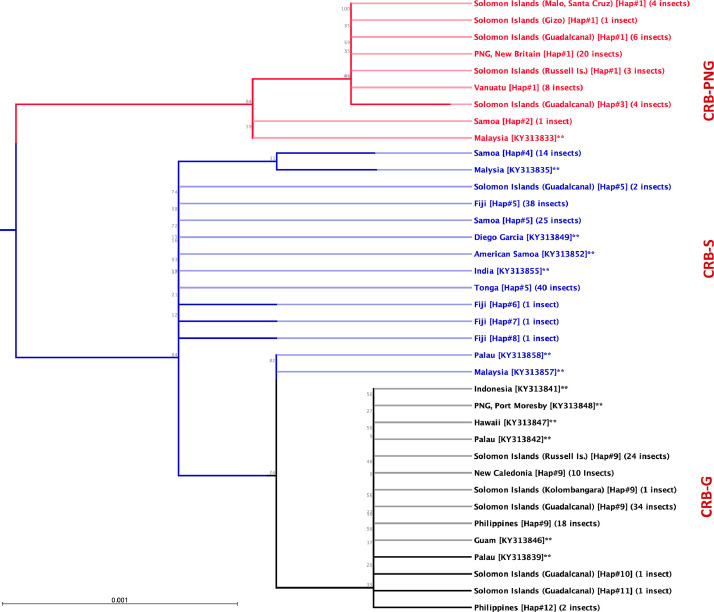
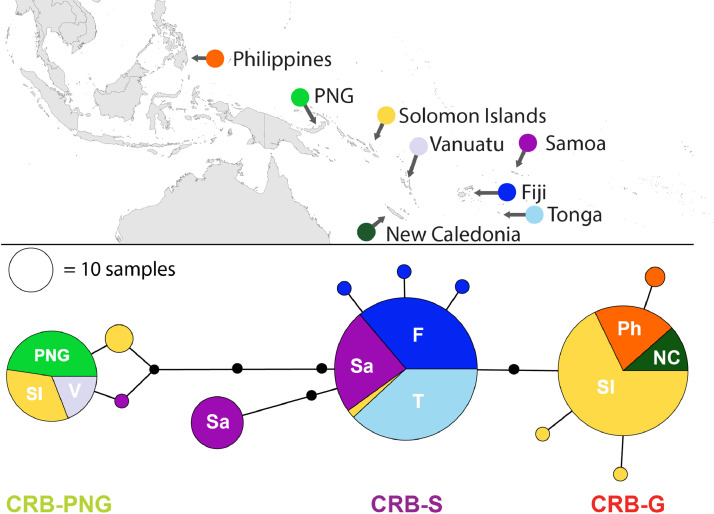
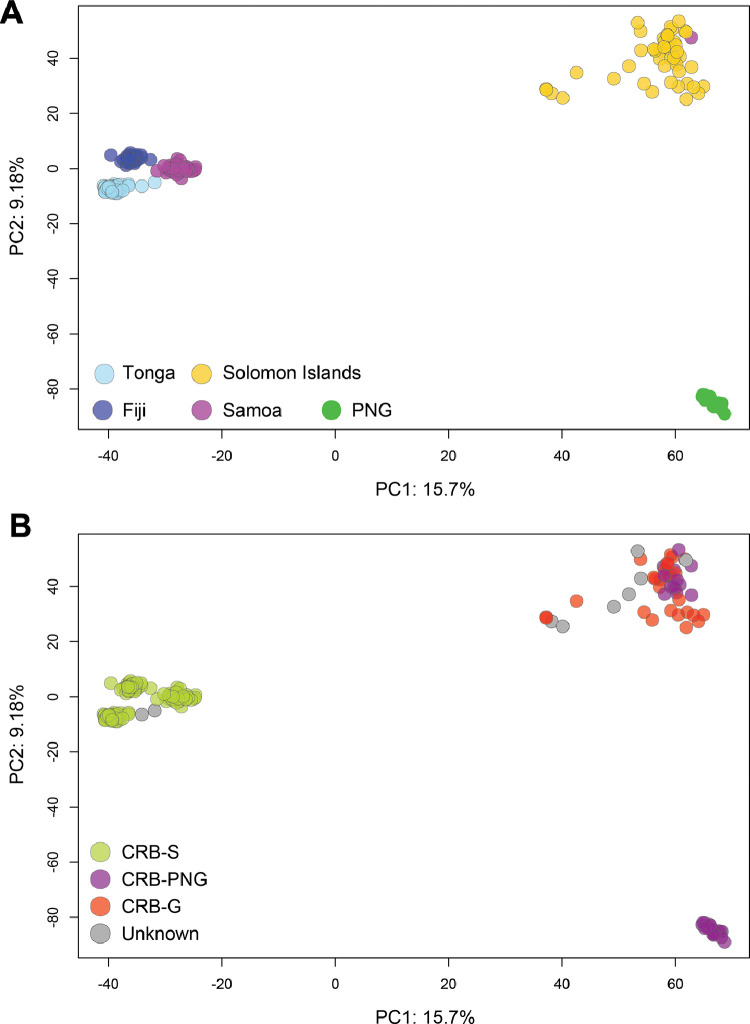
Recently, incursions of the Coconut rhinoceros beetle (CRB), , have been detected in south Pacific countries that were previously free of the pest. It has been suggested that this range expansion is related to an haplotype that is reported to show reduced susceptibility to the well-established classical biocontrol agent, Oryctes rhinoceros nudivirus (OrNV). We investigated population genetics and the OrNV status of specimens collected in Fiji, New Caledonia, Papua New Guinea (PNG), Samoa, Solomon Islands, Tonga, Vanuatu and the Philippines. Based on the sequence of the mitochondrial gene, we found three major mitochondrial haplotype groups (CRB-G, CRB-PNG and CRB-S) across the region. Haplotype diversity varied between and within countries and a high incidence of OrNV infection was detected in all haplotypes wherever they occurred. The population in some countries was monotypic and all individuals tested belonged to a single haplotype group. However, in Samoa we detected CRB-S and CRB-PNG and in Solomon Islands we detected all three haplotype groups. Genotyping-by-Sequencing (GBS) showed genetic differentiation in the nuclear genome across populations on different islands and provided evidence for gene flow, resulting in a well-mixed population, despite the presence of different haplotypes in Solomon Islands. Evidence of admixture was also detected on both islands of Samoa. The current based method is not a reliable diagnostic marker for phenotypic traits, especially in countries such as Solomon Islands where the mitochondrial haplotypes have come back into sympatry and are mixed. To identify possible mechanisms of resistance to OrNV, further molecular analyses in response to virus infection is required. To improve biological control of , such analyses will need to be combined with an improved understanding of the population genetics of the pest and the evolutionary history of OrNV in the region.
最近,在以前没有椰子犀牛甲虫(CRB)的南太平洋国家检测到了该害虫的入侵。有人认为,这种范围扩张与一种单倍型有关,据报道,该单倍型对成熟的经典生物防治剂犀牛金龟子浓核病毒(OrNV)的敏感性降低。我们调查了在斐济、新喀里多尼亚、巴布亚新几内亚(PNG)、萨摩亚、所罗门群岛、汤加、瓦努阿图和菲律宾收集的标本的种群遗传学和OrNV状况。基于线粒体基因的序列,我们在该地区发现了三个主要的线粒体单倍型组(CRB - G、CRB - PNG和CRB - S)。单倍型多样性在不同国家之间和国家内部有所不同,并且在所有出现的单倍型中都检测到了高发病率的OrNV感染。一些国家的CRB种群是单一型的,所有测试个体都属于单一的单倍型组。然而,在萨摩亚我们检测到了CRB - S和CRB - PNG,在所罗门群岛我们检测到了所有三个单倍型组。测序基因分型(GBS)显示不同岛屿上的种群在核基因组中存在遗传分化,并为基因流动提供了证据,尽管所罗门群岛存在不同的单倍型,但仍形成了一个充分混合的种群。在萨摩亚的两个岛屿上也检测到了混合的证据。目前基于线粒体的方法对于表型特征不是一个可靠的诊断标记,特别是在所罗门群岛这样的国家,线粒体单倍型已经重新同域分布并混合在一起。为了确定对OrNV的可能抗性机制,需要进一步进行针对病毒感染的分子分析。为了改进对CRB的生物防治,这种分析需要与对该害虫种群遗传学以及该地区OrNV进化历史的更好理解相结合。