IRL7266 Takuvik, CNRS (France)/ULaval (Canada), Pavillon Alexandre-Vachon, Université Laval, 1045, av. de la Médecine, Québec, QC G1V 0A6, Canada.
UMR6539 LEMAR-Laboratory of Environmental Marine Sciences, Institut Universitaire Européen de la Mer, CNRS, IRD, Ifremer, Université de Brest, 29280 Plouzané, France.
Mar Drugs. 2022 Jul 29;20(8):491. doi: 10.3390/md20080491.
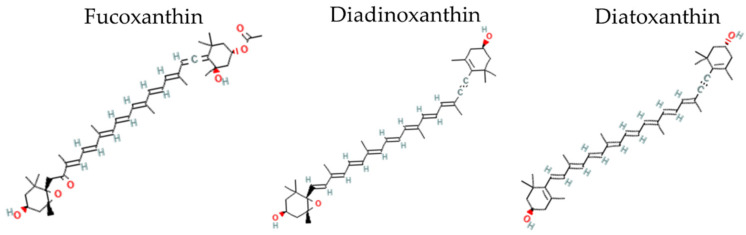
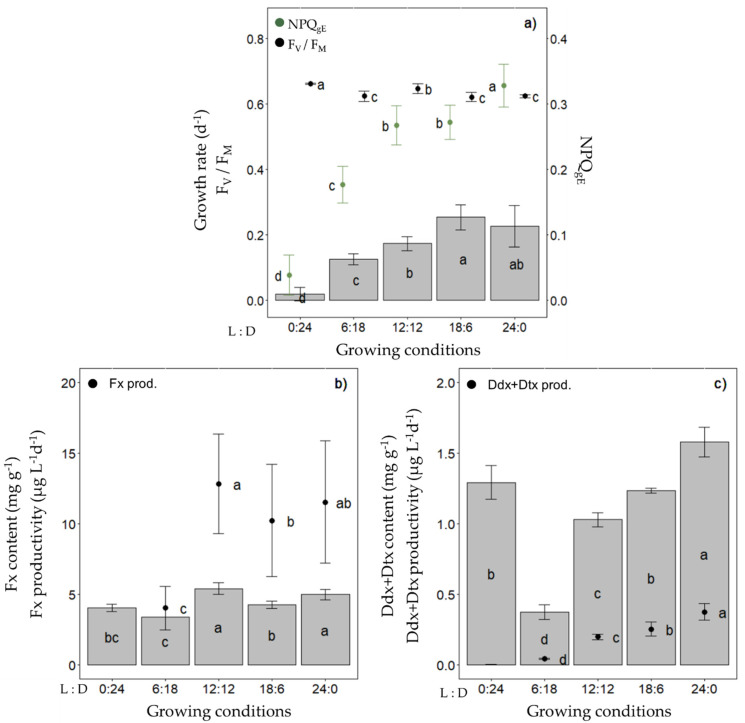
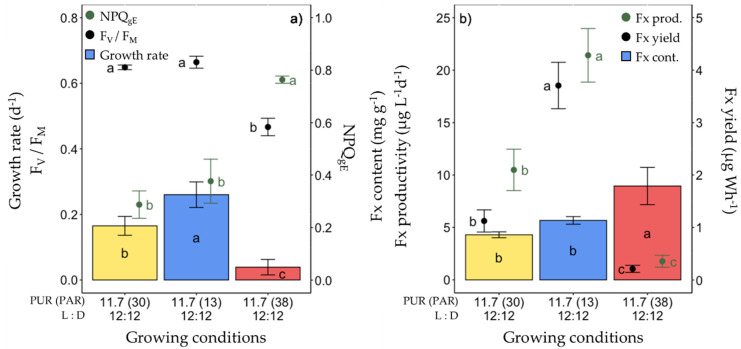
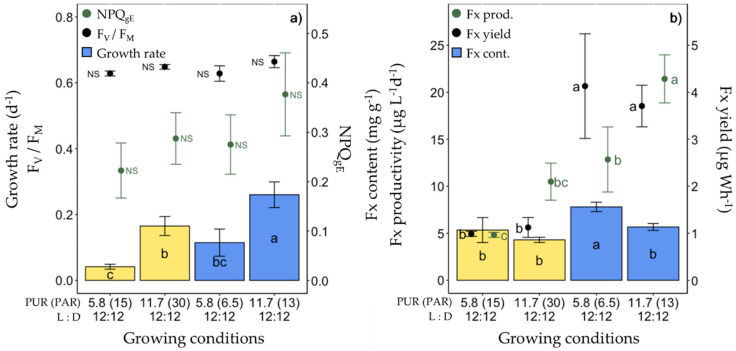
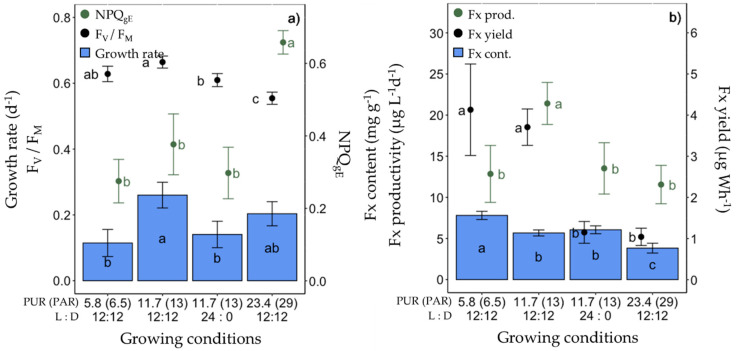
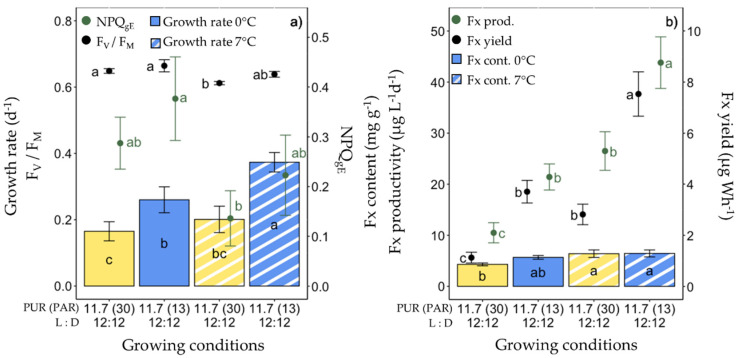
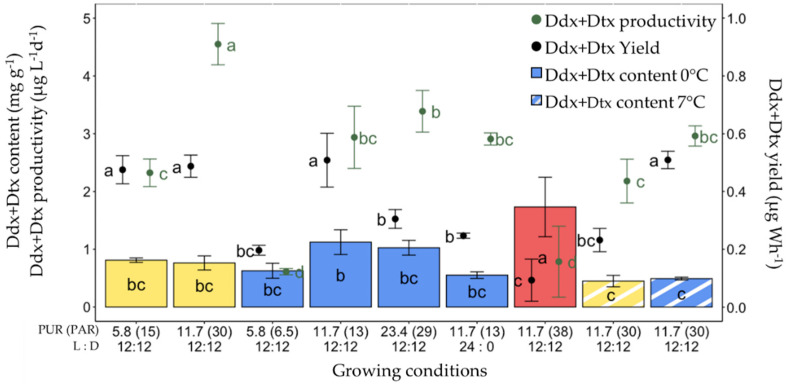
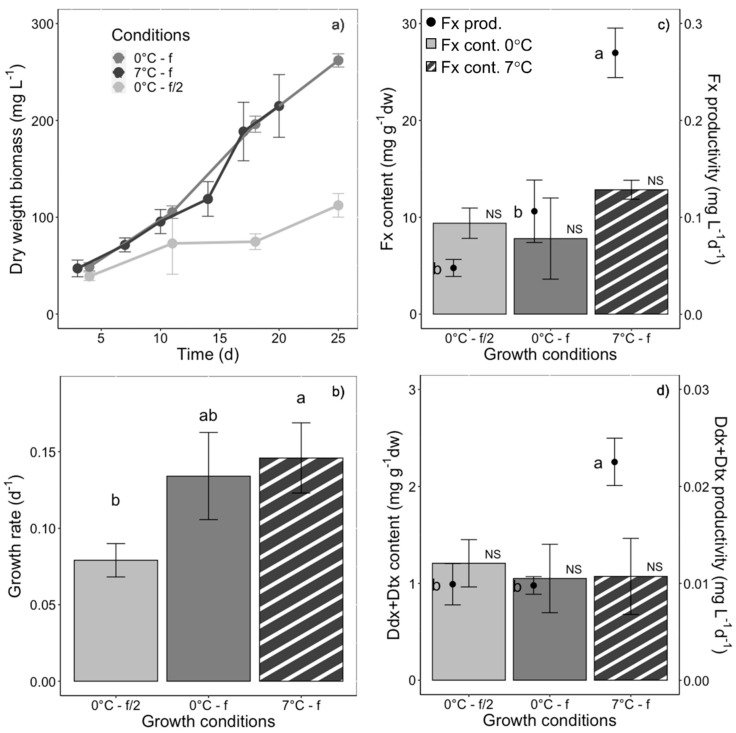
Carotenoid xanthophyll pigments are receiving growing interest in various industrial fields due to their broad and diverse bioactive and health beneficial properties. Fucoxanthin (Fx) and the inter-convertible couple diadinoxanthin-diatoxanthin (Ddx+Dtx) are acknowledged as some of the most promising xanthophylls; they are mainly synthesized by diatoms (Bacillariophyta). While temperate strains of diatoms have been widely investigated, recent years showed a growing interest in using polar strains, which are better adapted to the natural growth conditions of Nordic countries. The aim of the present study was to explore the potential of the polar diatom in producing Fx and Ddx+Dtx by means of the manipulation of the growth light climate (daylength, light intensity and spectrum) and temperature. We further compared its best capacity to the strongest xanthophyll production levels reported for temperate counterparts grown under comparable conditions. In our hands, the best growing conditions for were a semi-continuous growth at 7 °C and under a 12 h light:12 h dark photoperiod of monochromatic blue light (445 nm) at a PUR of 11.7 μmol photons m s. This allowed the highest Fx productivity of 43.80 µg L day and the highest Fx yield of 7.53 µg Wh, more than two times higher than under 'white' light. For Ddx+Dtx, the highest productivity (4.55 µg L day) was reached under the same conditions of 'white light' and at 0 °C. Our results show that , and potentially other polar diatom strains, are very well suited for Fx and Ddx+Dtx production under conditions of low temperature and light intensity, reaching similar productivity levels as model temperate counterparts such as . The present work supports the possibility of using polar diatoms as an efficient cold and low light-adapted bioresource for xanthophyll pigments, especially usable in Nordic countries.
类胡萝卜素叶黄素色素因其广泛多样的生物活性和有益健康的特性,在各个工业领域受到越来越多的关注。岩藻黄素 (Fx) 和可相互转化的二氢角黄素-硅藻黄素 (Ddx+Dtx) 被认为是最有前途的叶黄素之一;它们主要由硅藻(Bacillariophyta)合成。虽然已经广泛研究了温带硅藻菌株,但近年来人们对使用更能适应北欧国家自然生长条件的极地菌株越来越感兴趣。本研究旨在通过操纵生长光照条件(光照时间、光照强度和光谱)和温度,探索极地硅藻 生产 Fx 和 Ddx+Dtx 的潜力。我们还将其最佳生产能力与在可比条件下生长的温带同类物报告的最强叶黄素生产水平进行了比较。在我们的实验中, 的最佳生长条件是在 7°C 下进行半连续生长,并在 PUR 为 11.7 μmol 光子 m s 的单色蓝光(445nm)下进行 12 小时光照:12 小时黑暗的光周期。这使得 Fx 的最高生产力达到 43.80µg L day,Fx 的最高产率达到 7.53µg Wh,比白光下高出两倍多。对于 Ddx+Dtx,在相同的“白光”条件下和 0°C 下达到最高生产力(4.55µg L day)。我们的研究结果表明, 和潜在的其他极地硅藻菌株非常适合在低温和低光照条件下生产 Fx 和 Ddx+Dtx,达到与模型温带对应物如 相似的生产力水平。本研究支持将极地硅藻作为一种高效的冷光适应生物资源用于生产叶黄素色素的可能性,特别是在北欧国家具有可用性。