Shen Jing, Tao Yinjie, He Lei, Guan Hui, Zhen Hongnan, Liu Zhikai, Zhang Fuquan
Department of Radiation Oncology, Peking Union Medical College Hospital. Chinese Academy of Medical Sciences & Peking Union Medical College, NO.1 Shuaifuyuan Wangfujing, Dongcheng District, Beijing, 100730, People's Republic of China.
Discov Oncol. 2022 Aug 25;13(1):82. doi: 10.1007/s12672-022-00540-y.
With the advances of radiation technology, treatment of oligometastatic disease, with limited metastatic burden, have more chances to achieve long-term local control. Here we aim to evaluate the efficacy and safety of radiotherapy (RT) in oligometastatic ovarian cancer patients.
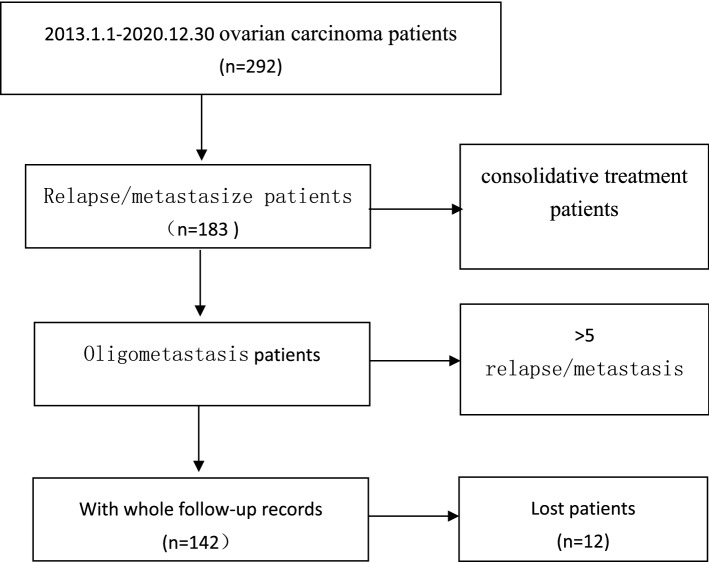
A retrospective analysis collecting 142 patients (189 lesions) with oligometastatic ovarian cancer were included in the study. All pateints received radiotherapy and the curative effect and response rate were evaluated by diagnostic imaging after 1-3 months of radiotherapy with RECIST. Endpoints were the rate of complete response (CR), chemotherapy-free interval (CFI), local control (LC) rate and overall survival (OS) rate. Toxicity was evaluated by the Radiation Therapy Oncology Group (RTOG). Logistic and Cox regression were used for the uni- and multivariate analysis of factors influencing survival outcomes.
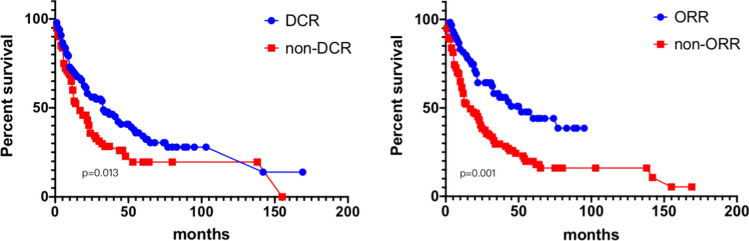
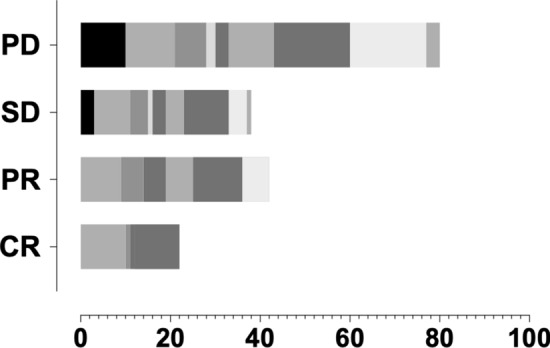
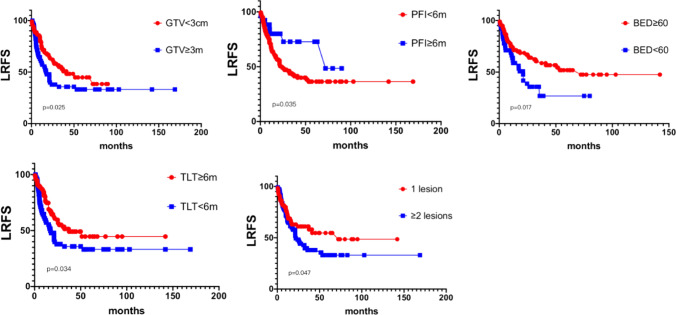
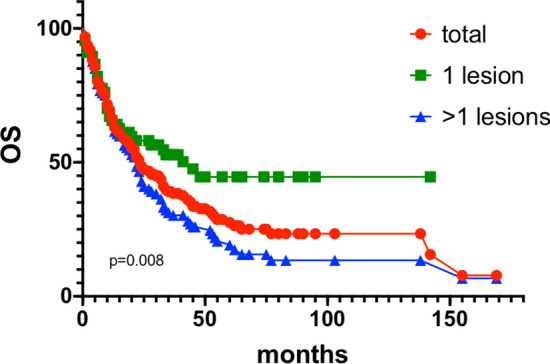
From 2013.1.1 to 2020.12.30, a total of 142 ovarian cancer patients (189 oligometastasis lesions) were included in the analysis. Prescribed doses to an average GTV of 3.10 cm were 1.8-8 Gy/fraction, median BED (28-115, a/b = 10 Gy), 5-28 fractions. For 179 evaluable lesions, the cases of CR, partial response (PR), stable disease (SD) and progressive disease (PD) after radiotherapy were 22,39,38 and 80 respectively. The disease control rate (DCR): CR + PR + SD was 55.31%, and the objective response rate (ORR): CR + PR was 34.08%. No patient developed grade 3 or higher side effect. The median CFI was 14 months (1-99 months), and the LC rate was 69.7%, 54.3% and 40.9% in 1 year, 2 years and 5 years respectively. GTV < 3 cm before treatment, platinum sensitivity, time from the last treatment ≥ 6 months, single lesion and BED(a/b = 10 Gy) ≥ 60 are the factors of good LC (p < 0.05). The total OS of 1 year, 2 years and 5 years were 67.1%, 52.6% and 30.3%, respectively. Single lesion (HR 0.598, 95%CI 0.405-0.884), DCR (HR 0.640, 95% CI 0.448-0.918) and ORR(HR 0.466, 95% CI 0.308-0.707) were the significant factors influencing 5-year OS.
For patients with oligometastatic ovarian cancer, radiotherapy has high LC, long chemotherapy-free interval, and survival benefits. Subgroup analysis shows that patients with single lesion and good local treatment results have higher overall survival rate, suggesting that active treatment is also beneficial for oligometastatic ovarian cancer patients.
随着放射技术的进步,转移性负担有限的寡转移疾病患者有更多机会实现长期局部控制。在此,我们旨在评估放疗(RT)在寡转移卵巢癌患者中的疗效和安全性。
本研究纳入了142例(189个病灶)寡转移卵巢癌患者的回顾性分析。所有患者均接受放疗,并在放疗1 - 3个月后采用RECIST标准通过诊断性影像学评估疗效和缓解率。观察终点为完全缓解(CR)率、无化疗间期(CFI)、局部控制(LC)率和总生存(OS)率。采用放射肿瘤学组(RTOG)标准评估毒性。使用逻辑回归和Cox回归对影响生存结局的因素进行单因素和多因素分析。
从2013年1月1日至2020年12月30日,共纳入142例卵巢癌患者(189个寡转移病灶)进行分析。平均GTV为3.10 cm时的处方剂量为1.8 - 8 Gy/分次,中位生物等效剂量(BED,28 - 115,a/b = 10 Gy),5 - 28分次。对于179个可评估病灶,放疗后CR、部分缓解(PR)、疾病稳定(SD)和疾病进展(PD)的病例分别为22、39、38和80例。疾病控制率(DCR):CR + PR + SD为55.31%,客观缓解率(ORR):CR + PR为34.08%。无患者出现3级或更高等级的副作用。中位CFI为14个月(1 - 99个月),1年、2年和5年的LC率分别为69.7%、54.3%和40.9%。治疗前GTV < 3 cm、铂类敏感性、距上次治疗时间≥6个月、单发病灶以及BED(a/b = 10 Gy)≥60是LC良好的因素(p < 0.05)。1年、2年和5年的总OS分别为67.1%、52.6%和30.3%。单发病灶(HR 0.598,95%CI 0.405 - 0.884)、DCR(HR 0.640,95%CI 0.448 - 0.918)和ORR(HR 0.466,95%CI 0.308 - 0.707)是影响5年OS的显著因素。
对于寡转移卵巢癌患者,放疗具有较高的LC率、较长的无化疗间期和生存获益。亚组分析显示,单发病灶且局部治疗效果良好的患者总生存率更高,提示积极治疗对寡转移卵巢癌患者也有益。