Silva-Migueis Helena, Martínez-Jiménez Eva María, Casado-Hernández Israel, Dias Adriano, Monteiro Ana Júlia, Martins Rodrigo B, Romero-Morales Carlos, López-López Daniel, Gómez-Salgado Juan
Research, Health and Podiatry Group, Department of Health Sciences, Faculty of Nursing and Podiatry, Industrial Campus of Ferrol, Universidade da Coruña, 15403 Ferrol, Spain.
Physiotherapy Department, Escola Superior de Saúde da Cruz Vermelha Portuguesa-Lisboa, 1300-125 Lisbon, Portugal.
Biology (Basel). 2022 Aug 5;11(8):1175. doi: 10.3390/biology11081175.
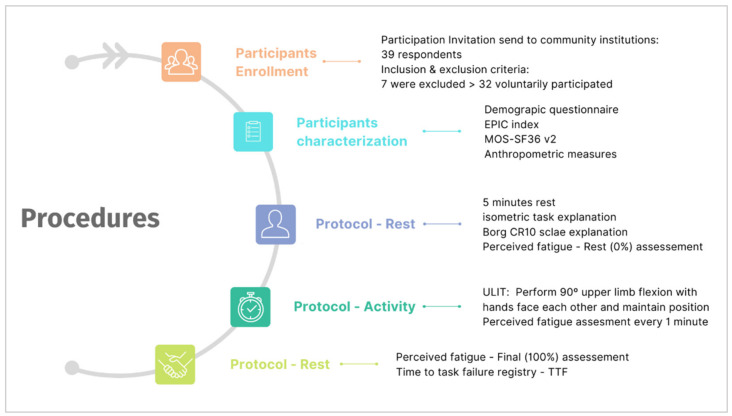
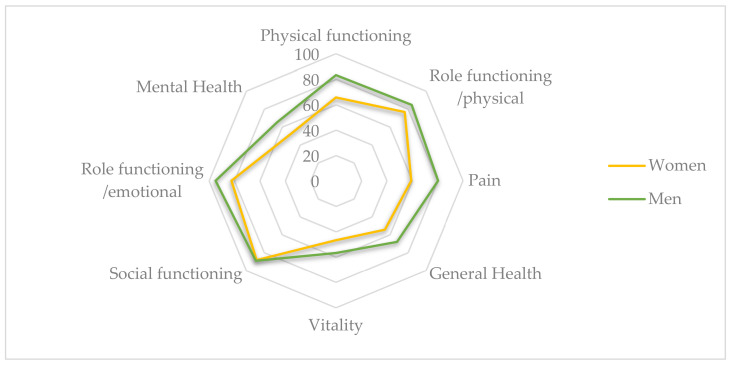
Isometric activity can be used as a strategy to improve health, fitness, and functional performance in the elderly population, but differences in fatigability may occur. This study aimed to understand fatigability behavior during an upper limb isometric task (ULIT) and the role of health status and physical activity in the fatigability of elderly participants. Thirty-two (32) elderly participants (72.5 ± 5.18 years) were instructed to perform ULIT. The Borg CR10 scale and task failure point (TTF) were used to measure perceived and performance fatigability. Self-reported measures were used to assess the quality of life and physical activity level. A significant relationship between perceived and performance fatigability was found only in the final phase of activity (p < 0.01). Significant correlations were found between perceived fatigability and the social functioning dimension (p < 0.05), and between performance fatigability (TTF) and BMI (p < 0.01), physical functioning (p < 0.01), and role functioning/physical (p < 0.05) dimensions. In conclusion, ULIT produces changes in fatigability of elderly people, which are positively related in the final stage of the activity. Changes in fatigability are negatively related to BMI. It is also negatively related to health, social functioning, physical functioning and role functioning/physical quality of life dimensions.
等长运动可作为一种改善老年人群健康、体能和功能表现的策略,但疲劳程度可能存在差异。本研究旨在了解上肢等长任务(ULIT)期间的疲劳行为,以及健康状况和身体活动在老年参与者疲劳方面所起的作用。32名老年参与者(72.5±5.18岁)被要求进行上肢等长任务。使用博格CR10量表和任务失败点(TTF)来测量主观疲劳感和表现性疲劳。采用自我报告的方式评估生活质量和身体活动水平。仅在活动的最后阶段发现主观疲劳感与表现性疲劳之间存在显著关系(p<0.01)。发现主观疲劳感与社会功能维度之间存在显著相关性(p<0.05),表现性疲劳(TTF)与体重指数(p<0.01)、身体功能(p<0.01)以及角色功能/身体(p<0.05)维度之间存在显著相关性。总之,上肢等长任务会使老年人的疲劳程度发生变化,在活动的最后阶段呈正相关。疲劳程度的变化与体重指数呈负相关。它还与健康、社会功能、身体功能以及角色功能/身体生活质量维度呈负相关。