Pinho Teresa, Rocha Duarte, Ribeiro Sofia, Monteiro Francisca, Pascoal Selma, Azevedo Rui
UNIPRO-Oral Pathology and Rehabilitation Research Unit, University Institute of Health Sciences (IUCS), Cooperativa de Ensino Superior Politécnico e Universitário (CESPU), 4585-116 Gandra, Portugal.
IBMC-Instituto Biologia Molecular e Celular, i3S-Instituto de Inovação e Investigação em Saúde, Universidade do Porto, 4200-135 Porto, Portugal.
Children (Basel). 2022 Aug 5;9(8):1176. doi: 10.3390/children9081176.
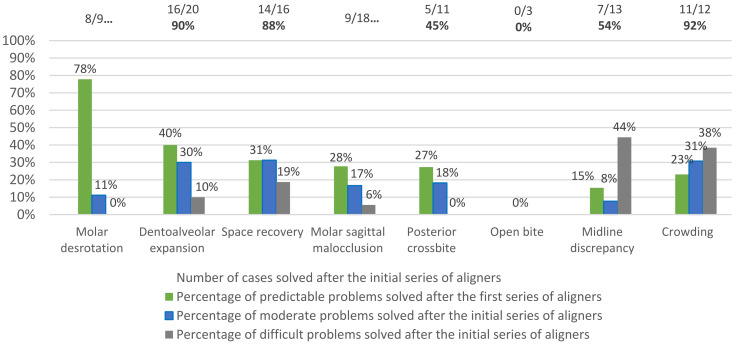
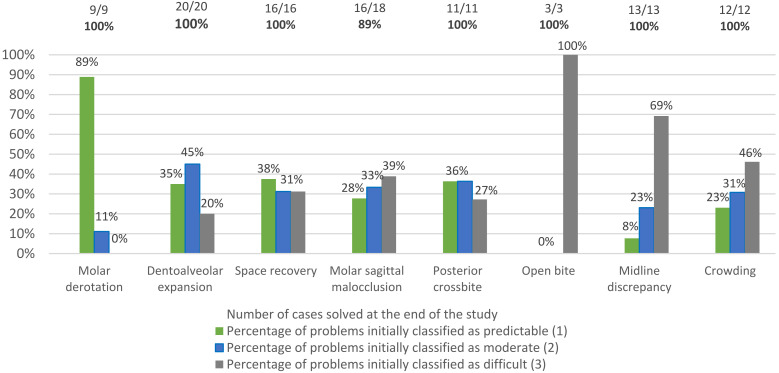
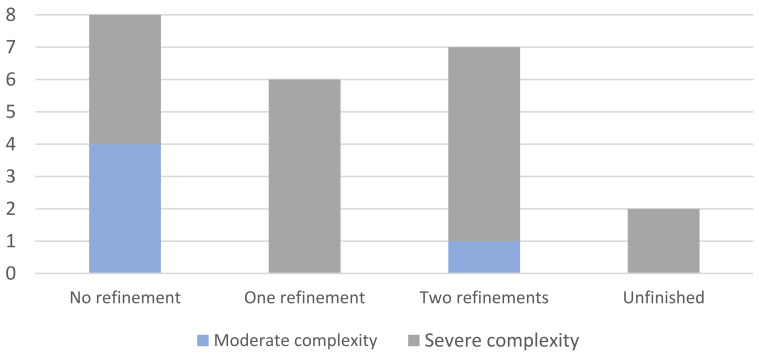
The increasing demand for more aesthetic/comfortable orthodontic alternatives fostered the utilization of clear aligners in recent years. However, the efficacy of clear aligners for treating complex malocclusions is often treated with scepticism. This case series aims to evaluate the predictability of the Invisalign First system in moderate and severe cases requiring interceptive orthodontic treatments in mixed dentition. A total of 23 patients with 102 interceptive orthodontic malocclusion traits were selected for orthodontic treatment with Invisalign First and were examined over 18 months (Phase 1). Clinical assessments included ClinCheck predictions, cephalometric measurements, and measuring tools commonly used to quantify tooth movement. Measurements taken at the beginning and end of the treatment were compared. The complexity degree of each case was established based on the set of problems presented by each patient. All treatment objectives were achieved within 18 months, except for two Class II cases, with 69% of them solved with the first set of aligners. Additional aligners were used in the remaining cases. Even though these 23 cases suggest that the Invisalign First (Phase 1) may be effective in most interceptive problems, controlled randomized clinical trials are required to evaluate movement predictability and how this relates to the problem complexity and additional aligners required.
近年来,对更美观/舒适的正畸替代方案的需求不断增加,这促进了透明矫治器的应用。然而,透明矫治器治疗复杂错牙合畸形的疗效常常受到质疑。本病例系列旨在评估隐适美First系统在混合牙列期需要进行阻断性正畸治疗的中度和重度病例中的可预测性。共有23例患者,具有102个阻断性正畸错牙合畸形特征,被选择使用隐适美First进行正畸治疗,并在18个月内(第一阶段)进行检查。临床评估包括ClinCheck预测、头影测量以及常用于量化牙齿移动的测量工具。比较治疗开始和结束时的测量结果。根据每位患者出现的一系列问题确定每个病例的复杂程度。除了两例二类病例外,所有治疗目标均在18个月内实现,其中69%的病例通过第一套矫治器得到解决。其余病例使用了额外的矫治器。尽管这23例病例表明隐适美First(第一阶段)在大多数阻断性问题中可能有效,但仍需要进行对照随机临床试验来评估移动的可预测性以及这与问题复杂性和所需额外矫治器之间的关系。