Chair and Department of Human Physiology, Medical University of Lublin, 11 Radziwillowska Str., 20-080 Lublin, Poland.
Department of Biochemical Diagnostics, Chair of Laboratory Diagnostics, Medical University of Lublin, 20-081 Lublin, Poland.
Cells. 2022 Aug 17;11(16):2554. doi: 10.3390/cells11162554.
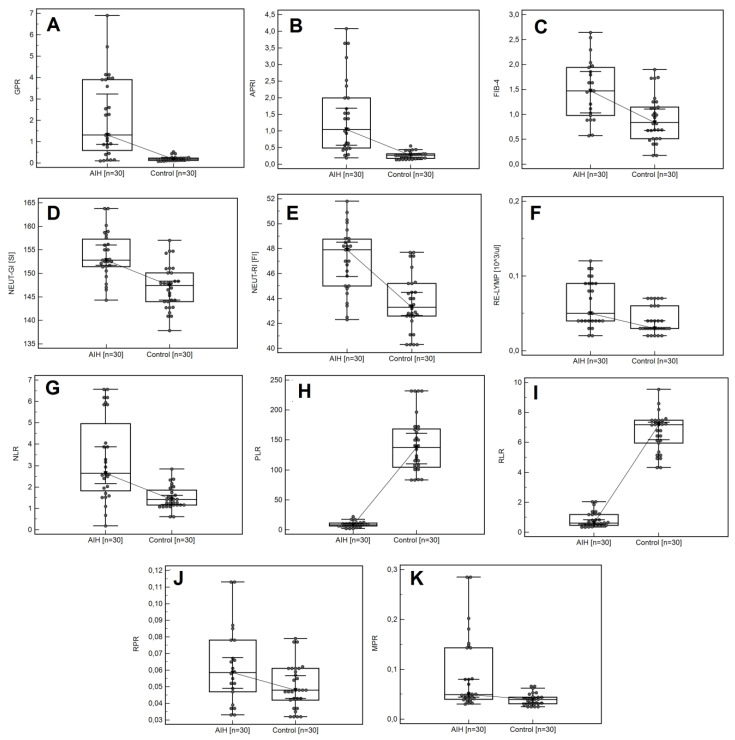
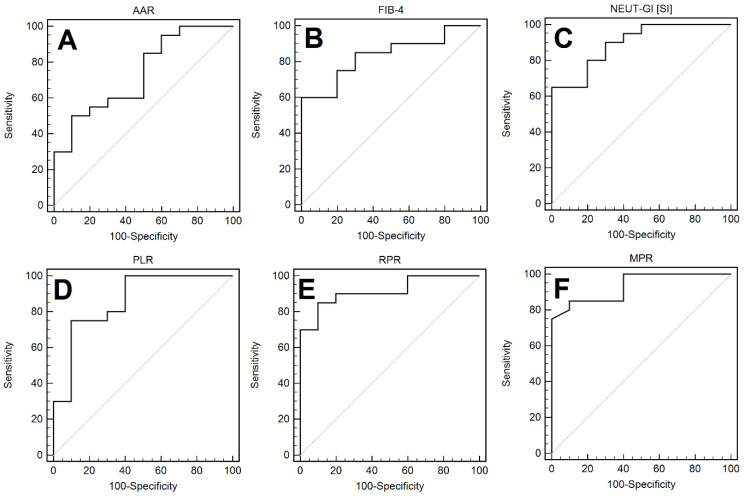
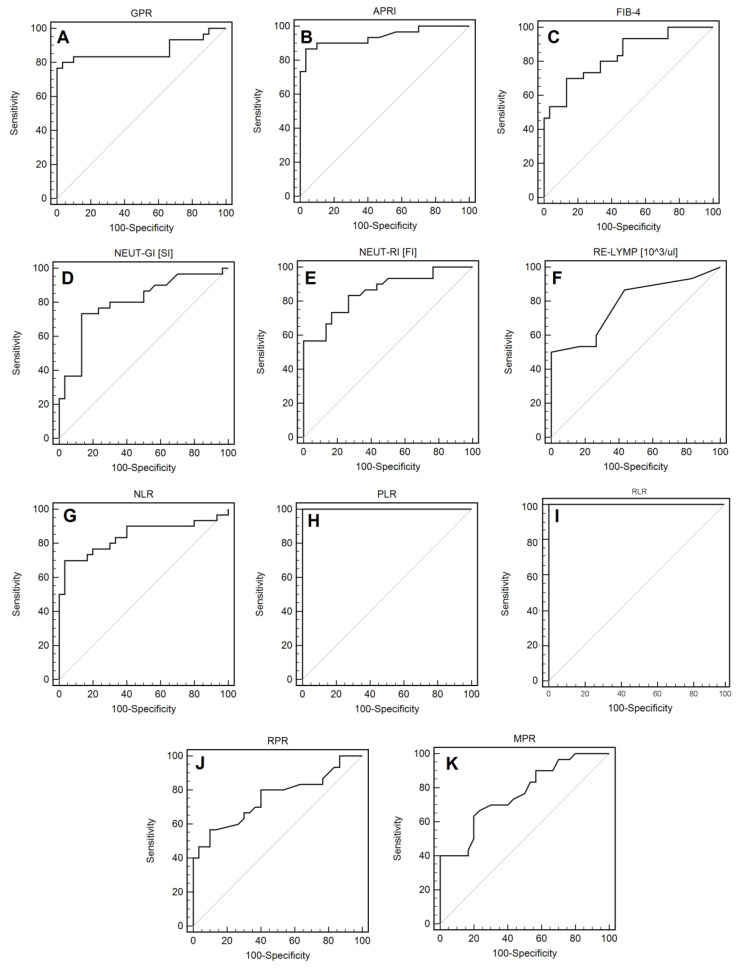
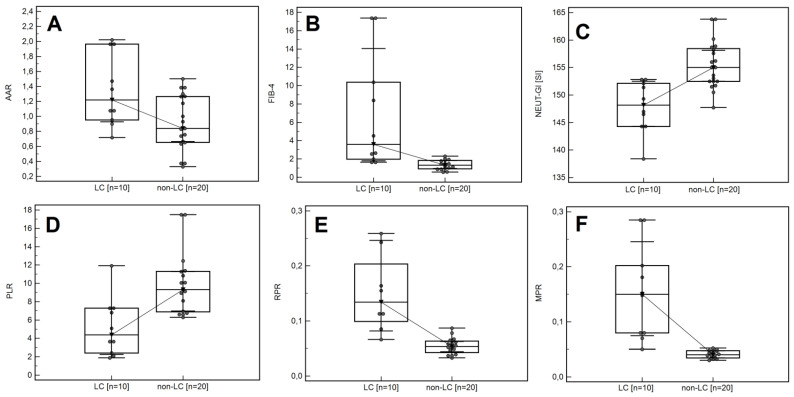
(1) Introduction: Autoimmune hepatitis (AIH) is a chronic disease. A persistent autoimmune reaction in the liver is significantly related to the systemic inflammatory response. Extended Inflammation Parameters (EIP) can be used to assess the activation of immune cells such as activated neutrophils (NEUT-RI and NEUT-GI) and activated lymphocytes (RE-LYMP and AS-LYMP) in the phase of active inflammation. The role of the systemic inflammatory response markers should also be emphasised, especially: NLR, PLR, and RLR, which have recently been widely studied as markers in autoimmune skin diseases or liver diseases. (2) Materials and Methods: The study included 30 patients with AIH and 30 healthy volunteers. The parameters of the EIP group (RE-LYMP, AS-LYMP, NEUT-RI, NEUT-GI), calculated haematological indices Red Blood Cell Distribution Width-to-Platelet Ratio (RPR), Mean Platelet Volume-to-Platelet Ratio (MPR), Neutrophil-to-Lymphocyte Ratio (NLR), Platelet-to-Lymphocyte Ratio (PLR), Red Blood Cell Distribution Width-to-Lymphocyte Ratio (RLR), and selected blood morphological and biochemical indices were analysed. The aim of the study was to assess the usefulness of the EIP and systemic inflammatory response markers in the diagnostics of AIH. (3) Results: Compared to the controls, the patients with AIH showed significantly higher EIP values: NEUT-RI (48.05 vs. 43.30), NEUT-GI (152.65 vs. 147.40), RE-LYMP (0.07 vs. 0.03), and the inflammatory response markers: MPR (0.05 vs. 0.04), RPR (0.07 vs. 0.05), and NLR (2.81 vs. 1.42. Among the examined markers, EIP has significant diagnostic potential: NEUT-RI (AUC = 0.86), NEUT-GI (AUC = 0.80), and RE-LYMP (AUC = 0.78), and so do calculated haematological indices, i.e., MPR (AUC = 0.75), PLR (AUC = 1.00), and RLR (AUC = 1.00) Moreover, the importance of NEUT-GI (AUC = 0.89), MPR (AUC = 0.93), PLR (AUC = 0.86), RPR (AUC = 0.91), and FIB-4 (AUC = 0.83) in the detection of liver fibrosis in the course of AIH has also been proven. (4) Conclusions: EIP and systemic inflammatory response markers may turn out to be useful in detecting AIH and in looking for features of already developed liver cirrhosis in its course.
(1) 介绍:自身免疫性肝炎 (AIH) 是一种慢性疾病。肝脏中持续的自身免疫反应与全身炎症反应密切相关。扩展炎症参数 (EIP) 可用于评估活跃炎症阶段中激活的免疫细胞(如活化中性粒细胞 (NEUT-RI 和 NEUT-GI) 和活化淋巴细胞 (RE-LYMP 和 AS-LYMP))的活性。也应强调全身炎症反应标志物的作用,特别是:中性粒细胞与淋巴细胞比值 (NLR)、血小板与淋巴细胞比值 (PLR) 和红细胞分布宽度与淋巴细胞比值 (RLR),这些标志物最近已被广泛研究用于自身免疫性皮肤病或肝病的标志物。
(2) 材料和方法:本研究纳入了 30 例 AIH 患者和 30 名健康志愿者。分析了 EIP 组(RE-LYMP、AS-LYMP、NEUT-RI、NEUT-GI)、计算的血液学参数红细胞分布宽度与血小板比值 (RPR)、平均血小板体积与血小板比值 (MPR)、中性粒细胞与淋巴细胞比值 (NLR)、血小板与淋巴细胞比值 (PLR)、红细胞分布宽度与淋巴细胞比值 (RLR),以及选定的血液形态学和生化指标。本研究的目的是评估 EIP 和全身炎症反应标志物在 AIH 诊断中的应用价值。
(3) 结果:与对照组相比,AIH 患者的 EIP 值显著升高:NEUT-RI(48.05 比 43.30)、NEUT-GI(152.65 比 147.40)、RE-LYMP(0.07 比 0.03)和炎症反应标志物:MPR(0.05 比 0.04)、RPR(0.07 比 0.05)和 NLR(2.81 比 1.42)。在检查的标志物中,EIP 具有显著的诊断潜力:NEUT-RI(AUC=0.86)、NEUT-GI(AUC=0.80)和 RE-LYMP(AUC=0.78),计算的血液学指标,即 MPR(AUC=0.75)、PLR(AUC=1.00)和 RLR(AUC=1.00)也具有诊断潜力。此外,还证明了 NEUT-GI(AUC=0.89)、MPR(AUC=0.93)、PLR(AUC=0.86)、RPR(AUC=0.91)和 FIB-4(AUC=0.83)在 AIH 病程中检测肝纤维化的重要性。
(4) 结论:EIP 和全身炎症反应标志物可能有助于检测 AIH 并寻找其病程中已发展为肝硬化的特征。