Department of Biotechnology, University of Kashmir, Srinagar 190006, India.
Department of Biochemistry, University of Kashmir, Srinagar 190006, India.
Genes (Basel). 2022 Aug 17;13(8):1463. doi: 10.3390/genes13081463.
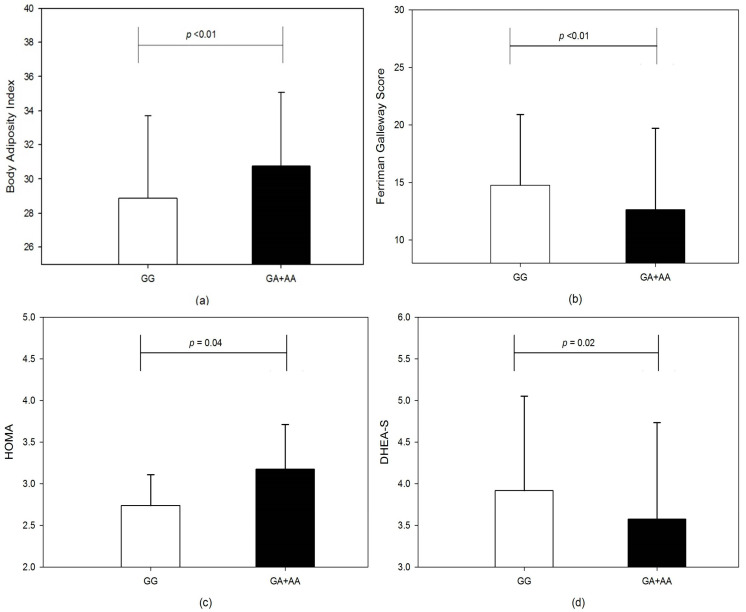
Background: Polycystic ovary syndrome (PCOS) is commonly associated with metabolic abnormalities such as hyperinsulinemia, insulin resistance and obesity. The genetic variants of genes regulating insulin action, expression and regulation are suggested as possible factors involved in development and severity of clinical manifestations in PCOS. Aim: We investigated whether IRS-1Gly972Arg (rs1801278) polymorphism is associated with increased risk of PCOS in Kashmiri women. The correlation of various clinical, metabolic and hormonal markers with rs1801278 single nucleotide polymorphism was analyzed. The genotypic−phenotypic association of clinical manifestations of PCOS with the tested genetic variant was also assessed. Results: There were no significant differences in allele frequency (OR = 0.87, CI = 0.59−1.29, χ2 = 0.456, p = 0.499) or genotypic distribution (χ2 = 3.73, p = 0.15) between PCOS women and controls. No significant association was also found in the dominant (OR = 1.63, χ2 = 0.377, p = 0.53), recessive (OR = 0.79, χ2 = 1.01, p = 0.31) or heterozygote vs. homozygote (OR = 1.34, χ2 = 1.53, p = 0.22) genotype model analysis. The genotype−phenotype correlation analysis showed that the Arg allele was significantly associated with increased central adiposity markers hip circumference (p = 0.012), and body adiposity index BAI (p = 0.002) in the recessive model in PCOS women. The two-hour glucose (p = 0.04) and insulin resistance marker HOMA (p = 0.44) were significantly higher in Arg allele carriers. The androgen excess markers dehydroepiandrosterone sulfate DHEAS (p = 0.02), Ferriman−Gallwey score (p = 0.012), prevalence of acne, alopecia and hirsutism (all p < 0.01) were significantly elevated in the wild-type GG genotype. Conclusions:IRS-1Gly972Arg genetic variant does not increase the risk of PCOS in Kashmiri women. However, this polymorphism is associated with clinical manifestations of insulin resistance, obesity and hyperandrogenism, suggesting its possible role in variable phenotypic manifestations of PCOS.
多囊卵巢综合征(PCOS)通常与代谢异常有关,如高胰岛素血症、胰岛素抵抗和肥胖。调节胰岛素作用、表达和调节的基因的遗传变异被认为是 PCOS 临床表型的发展和严重程度的可能因素。目的:我们研究了 IRS-1Gly972Arg(rs1801278)多态性是否与克什米尔妇女 PCOS 风险增加有关。分析了各种临床、代谢和激素标志物与 rs1801278 单核苷酸多态性的相关性。还评估了 PCOS 临床表现的基因型-表型相关性与测试遗传变异。结果:PCOS 女性与对照组之间的等位基因频率(OR=0.87,CI=0.59-1.29,χ2=0.456,p=0.499)或基因型分布(χ2=3.73,p=0.15)无显著差异。在显性(OR=1.63,χ2=0.377,p=0.53)、隐性(OR=0.79,χ2=1.01,p=0.31)或杂合子与纯合子(OR=1.34,χ2=1.53,p=0.22)基因型模型分析中也未发现显著相关性。基因型-表型相关性分析表明,Arg 等位基因与 PCOS 女性的中心性肥胖标志物臀围(p=0.012)和体脂指数 BAI(p=0.002)在隐性模型中显著相关。携带 Arg 等位基因的 2 小时血糖(p=0.04)和胰岛素抵抗标志物 HOMA(p=0.44)显著升高。雄激素过多标志物脱氢表雄酮硫酸盐 DHEAS(p=0.02)、Ferriman-Gallwey 评分(p=0.012)、痤疮、脱发和多毛的患病率(均 p<0.01)在野生型 GG 基因型中显著升高。结论:IRS-1Gly972Arg 遗传变异不会增加克什米尔妇女 PCOS 的风险。然而,这种多态性与胰岛素抵抗、肥胖和高雄激素血症的临床表现有关,表明其在 PCOS 的可变表型表现中可能发挥作用。