James Jasper E, Santhanam Jacinta, Zakaria Latiffah, Mamat Rusli Nuraini, Abu Bakar Mariahyati, Suetrong Satinee, Sakayaroj Jariya, Abdul Razak Mohd Fuat, Lamping Erwin, Cannon Richard D
Biomedical Science Programme, Faculty of Health Sciences, Universiti Kebangsaan Malaysia, Kuala Lumpur 50300, Malaysia.
School of Biological Sciences, Universiti Sains Malaysia, Gelugor 11800, Malaysia.
J Fungi (Basel). 2022 Aug 11;8(8):845. doi: 10.3390/jof8080845.
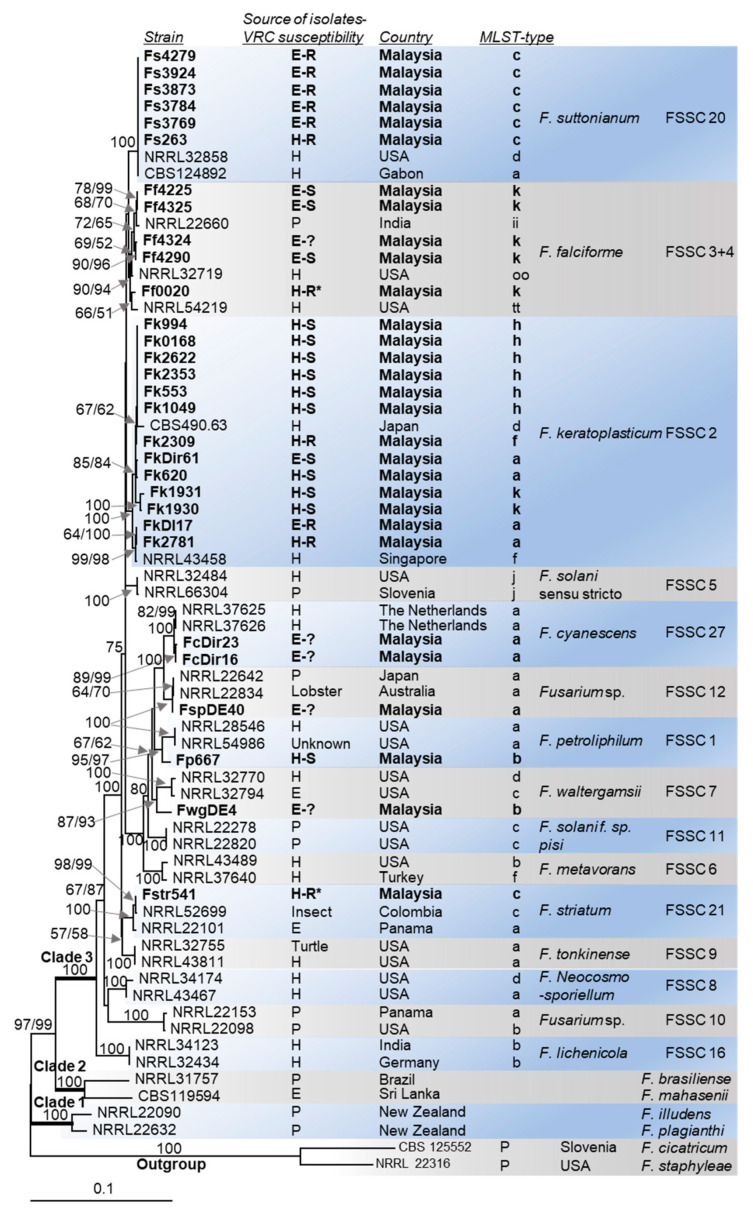
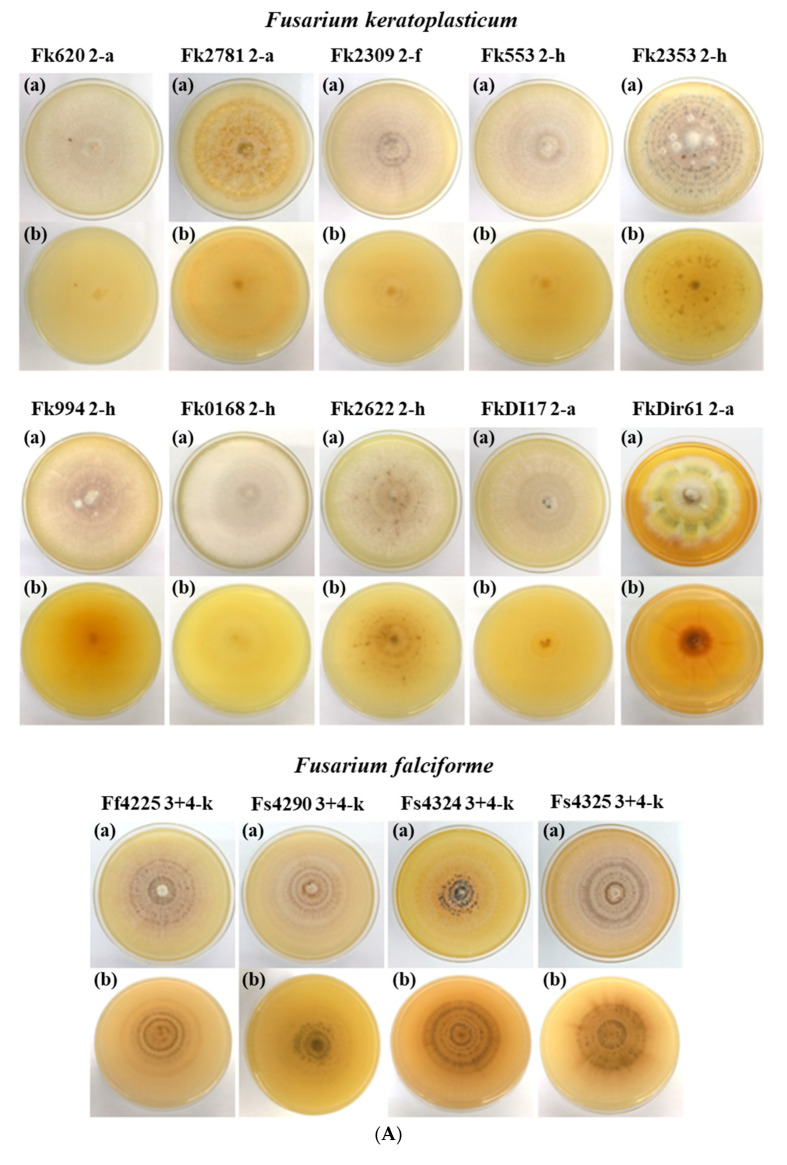
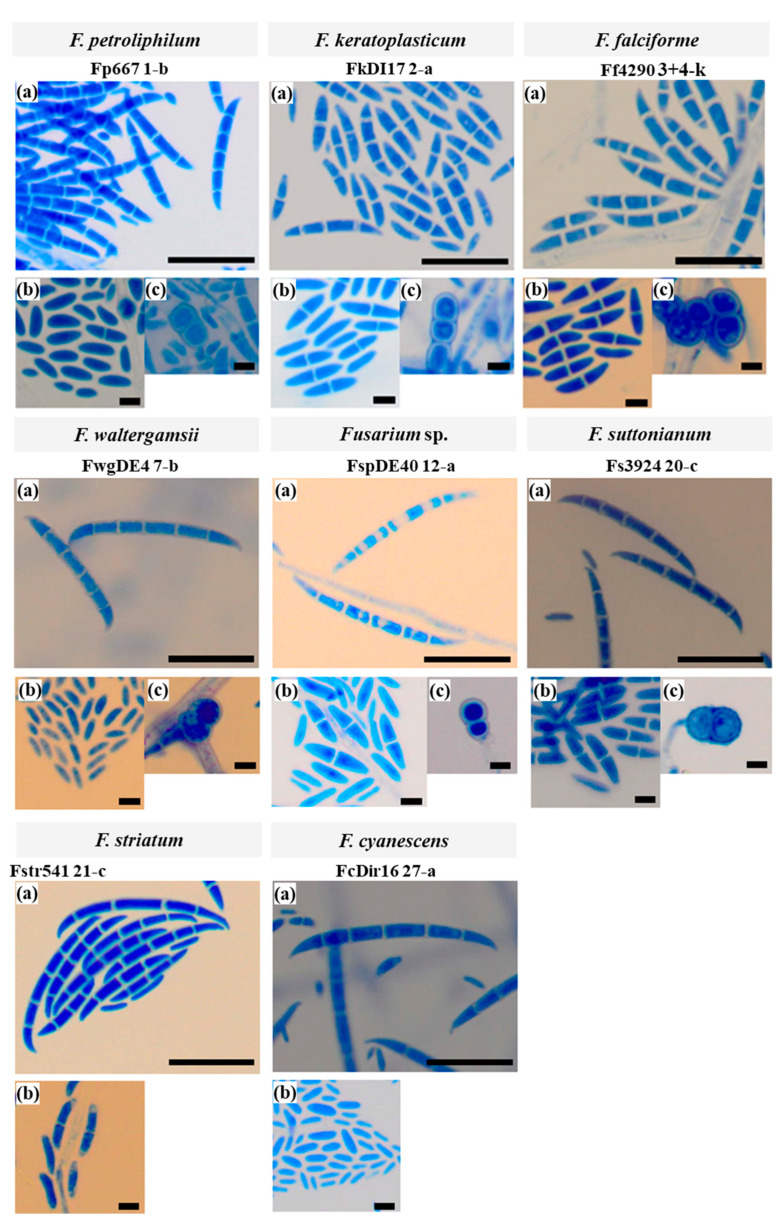
infections in humans (fusariosis) and in economically important plants involve species of several species complexes. Species of the species complex (FSSC) are the most frequent cause of human fusariosis. The FSSC comprises more than 60 closely related species that can be separated into three major clades by multi-locus sequence typing (MLST) using translation elongation factor 1-alpha () and RNA polymerase II () DNA sequences. The MLST nomenclature for clade 3 of the FSSC assigns numbers to species types (e.g., FSSC 2) and lowercase letters to identify unique haplotypes. The aim of this study was to analyse the genotypic and phenotypic characteristics of 15 environmental and 15 clinical FSSC isolates from Malaysia. MLST was used for the genotypic characterisation of FSSC isolates from various locations within Malaysia, which was complemented by their morphological characterisation on potato dextrose and carnation leaf agar. MLST identified eight different FSSC species: thirteen (i.e., FSSC 2), six (FSSC 20), five (FSSC 3+4), two (FSSC 27) and one each of (FSSC 1), (FSSC 7), sp. (FSSC 12), and (FSSC 21). Consistent with previous reports from Malaysia, most (11 of 15) clinical FSSC isolates were and the majority (9 of 15) of environmental isolates were (5) or (4) strains. The taxonomic relationships of the isolates were resolved phylogenetically. The eight species also showed distinct morphological characteristics, but these were less clearly defined and reached across species boundaries. Although and sequences were sufficient for the species identification of most FSSC isolates, a more precise MLST scheme needs to be established to reliably assign individual isolates of the species-rich FSSC to their geographically-, epidemiologically-, and host-associated sub-lineages.
人类感染(镰刀菌病)以及对经济具有重要意义的植物感染涉及多个物种复合体中的物种。镰刀菌物种复合体(FSSC)中的物种是人类镰刀菌病最常见的病因。FSSC包含60多个密切相关的物种,通过使用翻译延伸因子1-α()和RNA聚合酶II()DNA序列的多位点序列分型(MLST)可将其分为三个主要进化枝。FSSC进化枝3的MLST命名法为物种类型(如FSSC 2)指定数字,并使用小写字母来识别独特的单倍型。本研究的目的是分析来自马来西亚的15株环境和15株临床FSSC分离株的基因型和表型特征。MLST用于对来自马来西亚不同地点的FSSC分离株进行基因分型,同时通过在马铃薯葡萄糖和香石竹叶琼脂上的形态学特征对其进行补充。MLST鉴定出8种不同的FSSC物种:13株(即FSSC 2)、6株(FSSC 20)、5株(FSSC 3 + 4)、2株(FSSC 27)以及各1株(FSSC 1)、(FSSC 7)、(FSSC 12)和(FSSC 21)。与马来西亚之前的报告一致,大多数(15株中的11株)临床FSSC分离株为,大多数(15株中的9株)环境分离株为(5株)或(4株)菌株。通过系统发育分析确定了分离株的分类关系。这8种镰刀菌物种也表现出明显的形态特征,但这些特征定义不太明确且跨越物种界限。虽然和序列足以对大多数FSSC分离株进行物种鉴定,但需要建立更精确的MLST方案,以便将物种丰富的FSSC的各个分离株可靠地分配到与其地理、流行病学和宿主相关的亚谱系中。