Ullate Ane, Arance Ignacio, Virseda-Chamorro Miguel, Ruiz Sonia, Szczesniewski Juliusz, Téllez Carlos, Queissert Fabian, Dorado Juan F, Angulo Javier C
Clinical Department, Faculty of Biomedical Science, Universidad Europea, Carretera de Toledo, Km 12.500, Getafe, 28905 Madrid, Spain.
Department of Urology, Hospital Universitario de Getafe, Carretera de Toledo, Km 12.500, Getafe, 28905 Madrid, Spain.
J Clin Med. 2022 Aug 19;11(16):4882. doi: 10.3390/jcm11164882.
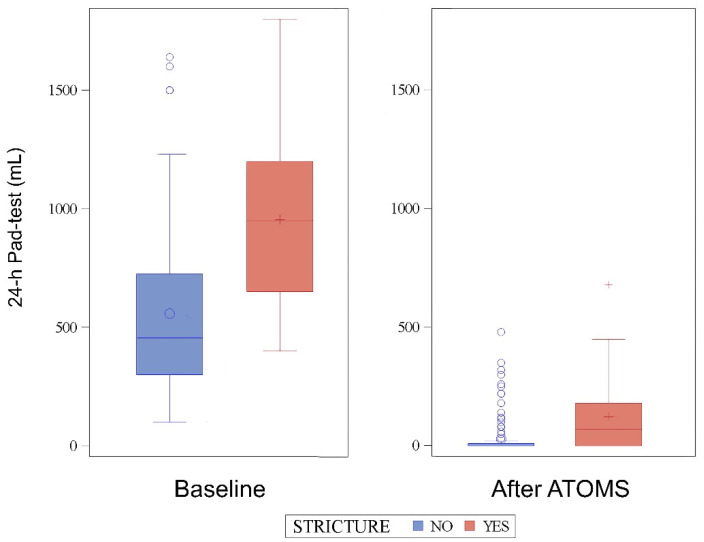
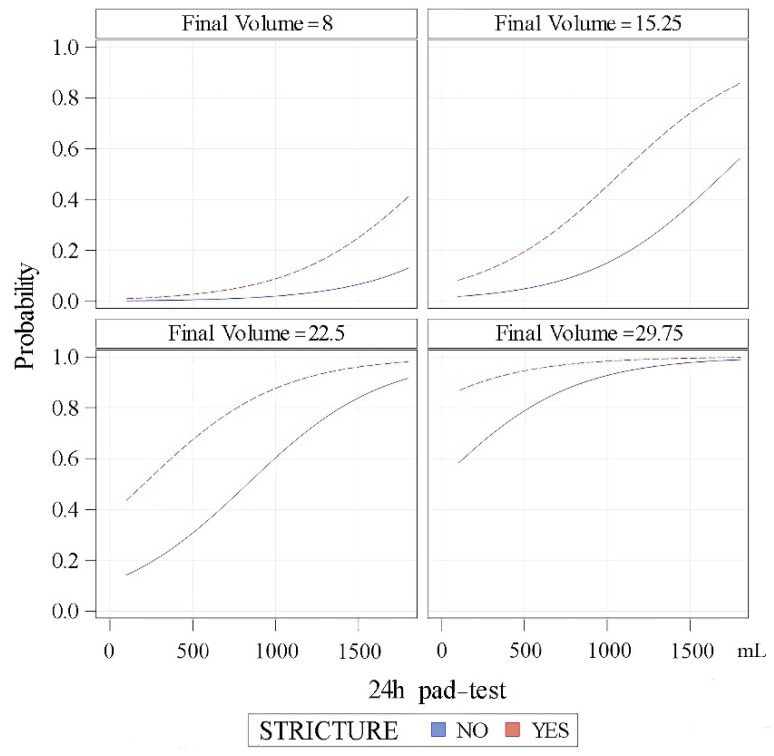
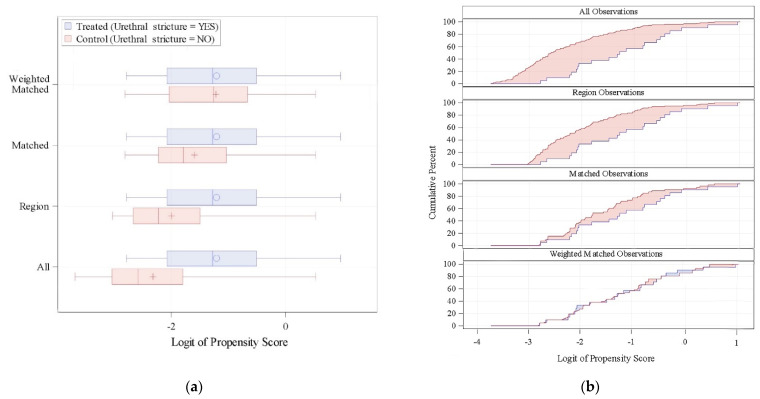
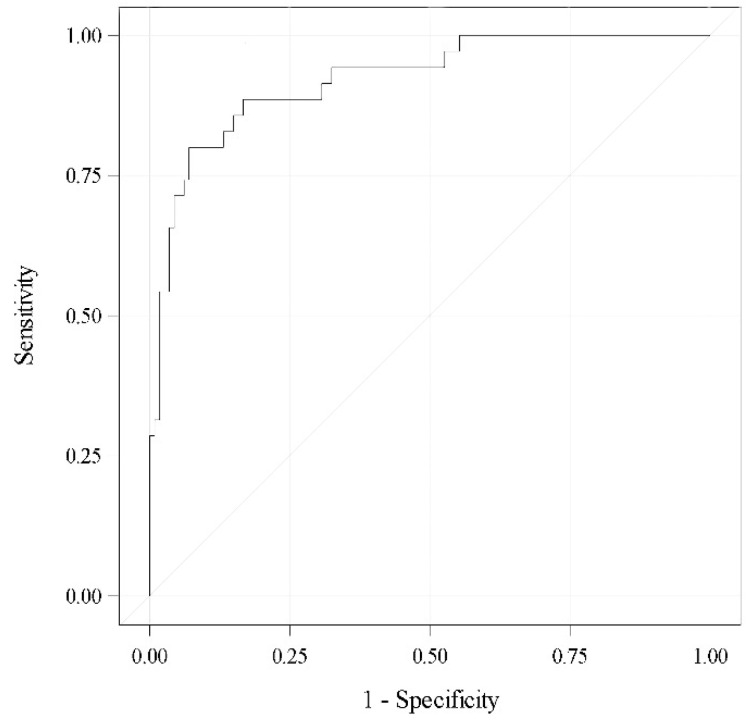
(1) Background: Male stress incontinence in patients with previously treated urethral or bladder neck stricture is a therapeutic challenge. The efficacy and safety of the adjustable trans-obturator male system (ATOMS) in these patients is unknown. (2) Methods: All patients with primary ATOMS implants in our institution between 2014 and 2021 were included. The outcomes of patients with previously treated urethral or bladder neck stricture (≥6 months before ATOMS implant) and stable 16Ch urethral caliber were compared to those without a history of stricture. The primary endpoint was the dry patient rate, defined as the pad test ≤ 20 mL/day, and complication rate, including device removal. The secondary variable was self-perceived satisfaction using the Patient Global Impression of Improvement (PGI-I) scale. Wilcoxon rank sum test, Fisher’s exact test and logistic regression were performed. (3) Results: One hundred and forty-nine consecutive patients were included, twenty-one (14%) previously treated for urethral or bladder neck stricture (seven urethroplasty, nine internal urethrotomy and five bladder neck incision). After ATOMS adjustment, 38% of the patients with treated stricture were continent compared to 83% of those without (p < 0.0001). After weighted matched observations using propensity score pairing, the proportion of continent patients without a previous stricture was 56% (p = 0.236). Complications occurred in 29% of the patients with stricture and in 20% of those without (p = 0.34). The severity of the complications was distributed evenly among the groups (p = 0.42). Regarding self-perceived satisfaction with the implant, 90% of the patients with stricture perceived the results satisfactorily (PGI-I 1−3) compared to 97% of the rest (p = 0.167). Stricture was associated with radiotherapy (p < 0.0001) and time from prostatectomy to implantation (p = 0.012). There was a moderate correlation between previous stricture and the severity of incontinence, both evaluated according to the 24-h pad test (Rho = 0.378; p < 0.0001) and the ICIQ-SF questionnaire (Rho = 0.351; p < 0.0001). Multivariate analysis for the factors predictive of failure after ATOMS adjustment revealed previous stricture (OR 4.66; 95% CI 1.2−18.87), baseline 24-h pad test (per 100 mL, OR 1.28; 95% CI 1.09−1.52) and final cushion volume (per mL, OR 1.34; 95% CI 1.19−1.55). This model predicted dryness with an AUC of 92%. After the PSMATCH procedure using a propensity score, the model remained unchanged, with the previous stricture (OR 8.05; 95% CI 1.08−110.83), baseline 24-h pad test (per 100 mL, OR 1.53; 95% CI 1.15−2.26) and final cushion volume (per mL, OR 1.45; 95% CI 1.17−2) being independent predictors and an AUC of 93%. (4) Conclusions: ATOMS can be used to treat male stress incontinence in patients with a history of stricture, although the effectiveness of the device is reduced. On the other hand, the security and perceived satisfaction were equivalent for both groups.
(1) 背景:既往接受过尿道或膀胱颈狭窄治疗的男性压力性尿失禁患者的治疗是一项挑战。可调式经闭孔男性系统(ATOMS)在这些患者中的疗效和安全性尚不清楚。(2) 方法:纳入2014年至2021年在我院首次植入ATOMS的所有患者。将既往接受过尿道或膀胱颈狭窄治疗(ATOMS植入前≥6个月)且尿道口径稳定在16Ch的患者的结局与无狭窄病史的患者进行比较。主要终点是干燥患者率,定义为护垫试验≤20 mL/天,以及并发症发生率,包括装置取出。次要变量是使用患者总体改善印象(PGI-I)量表的自我感知满意度。进行了Wilcoxon秩和检验、Fisher精确检验和逻辑回归分析。(3) 结果:共纳入149例连续患者,其中21例(14%)既往接受过尿道或膀胱颈狭窄治疗(7例行尿道成形术,9例行尿道内切开术,5例行膀胱颈切开术)。ATOMS调整后,接受过狭窄治疗的患者中有38%实现了控尿,而无狭窄患者中这一比例为83%(p<0.0001)。使用倾向得分配对进行加权匹配观察后,既往无狭窄的控尿患者比例为56%(p = 0.236)。狭窄患者中有29%发生并发症,无狭窄患者中有20%发生并发症(p = 0.34)。并发症的严重程度在两组中分布均匀(p = 0.42)。关于对植入物的自我感知满意度,90%的狭窄患者对结果感到满意(PGI-I 1-3),而其余患者中这一比例为97%(p = 0.167)。狭窄与放疗(p<0.0001)以及前列腺切除术后至植入的时间(p = 0.012)相关。既往狭窄与尿失禁严重程度之间存在中度相关性,两者均根据24小时护垫试验(Rho = 0.378;p<0.0001)和ICIQ-SF问卷(Rho = 0.351;p<0.00)进行评估。对ATOMS调整后失败的预测因素进行多变量分析,结果显示既往狭窄(OR 4.66;95%CI 1.2-18.87)、基线24小时护垫试验(每100 mL,OR 1.28;95%CI 1.09-1.52)和最终缓冲液体积(每mL,OR 1.34;95%CI 1.19-1.55)。该模型预测干燥的AUC为92%。使用倾向得分进行PSMATCH程序后,模型保持不变,既往狭窄(OR 8.05;95%CI 1.08-110.83)、基线24小时护垫试验(每100 mL,OR 1.53;95%CI 1.15-2.26)和最终缓冲液体积(每mL,OR 1.45;95%CI 1.17-2)为独立预测因素,AUC为93%。(4) 结论:ATOMS可用于治疗有狭窄病史的男性压力性尿失禁,尽管该装置的有效性有所降低。另一方面,两组的安全性和自我感知满意度相当。