
缺陷的产生与迁移对多量子阱InGaN/GaN基发光二极管光学退化的影响
Impact of Generation and Relocation of Defects on Optical Degradation of Multi-Quantum-Well InGaN/GaN-Based Light-Emitting Diode.
作者信息
Casu Claudia, Buffolo Matteo, Caria Alessandro, De Santi Carlo, Zanoni Enrico, Meneghesso Gaudenzio, Meneghini Matteo
机构信息
Department of Information Engineering, University of Padova, 35131 Padova, Italy.
出版信息
Micromachines (Basel). 2022 Aug 6;13(8):1266. doi: 10.3390/mi13081266.
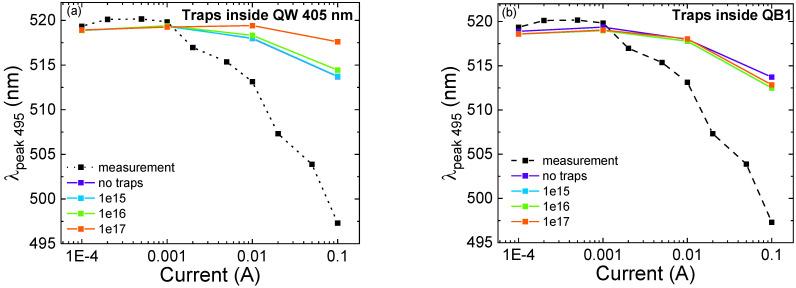
The defectiveness of InGaN-based quantum wells increases with low indium contents, due to the compressive strain induced by the lattice mismatch between the InGaN and GaN layers, and to the stronger incorporation of defects favored by the presence of indium. Such defects can limit the performance and the reliability of LEDs, since they can act as non-radiative recombination centers, and favor the degradation of neighboring semiconductor layers. To investigate the location of the layers mostly subjected to degradation, we designed a color-coded structure with two quantum wells having different indium contents. By leveraging on numerical simulations, we explained the experimental results in respect of the ratio between the emissions of the two main peaks as a function of current. In addition, to evaluate the mechanisms that limit the reliability of this type of LED, we performed a constant-current stress test at high temperature, during which we monitored the variation in the optical characteristics induced by degradation. By comparing experimental and simulated results, we found that degradation can be ascribed to an increment of traps in the active region. This process occurs in two different phases, with different rates for the two quantum wells. The first phase mainly occurs in the quantum well closer to the p-contact, due to an increment of defectiveness. Degradation follows an exponential trend, and saturates during the second phase, while the quantum well close to the n-side is still degrading, supporting the hypothesis of the presence of a diffusive front that is moving from the p-side towards the n-side. The stronger degradation could be related to a lowering of the injection efficiency, or an increment of SRH recombination driven by a recombination-enhanced defect generation process.
基于氮化铟镓的量子阱的缺陷率会随着铟含量的降低而增加,这是由于氮化铟镓层与氮化镓层之间的晶格失配所引起的压应变,以及铟的存在有利于更强地引入缺陷。这些缺陷会限制发光二极管的性能和可靠性,因为它们可以作为非辐射复合中心,并促进相邻半导体层的退化。为了研究最容易发生退化的层的位置,我们设计了一种颜色编码结构,其中包含两个铟含量不同的量子阱。通过利用数值模拟,我们解释了两个主峰发射率之比随电流变化的实验结果。此外,为了评估限制这类发光二极管可靠性的机制,我们在高温下进行了恒流应力测试,在此期间监测了退化引起的光学特性变化。通过比较实验结果和模拟结果,我们发现退化可归因于有源区陷阱的增加。这个过程分两个不同阶段发生,两个量子阱的速率不同。第一阶段主要发生在更靠近p型接触的量子阱中,这是由于缺陷率的增加。退化遵循指数趋势,并在第二阶段达到饱和,而靠近n型侧的量子阱仍在退化,这支持了存在从p型侧向n型侧移动的扩散前沿的假设。更强的退化可能与注入效率的降低或由复合增强缺陷生成过程驱动的SRH复合的增加有关。




 Zotero 插件