School of Biological and Health Sciences, Technological University Dublin, D08 NF82 Dublin, Ireland.
Department of Respiratory and Sleep Medicine, Connolly Hospital Dublin, D15 X40D Dublin, Ireland.
Nutrients. 2022 Aug 9;14(16):3252. doi: 10.3390/nu14163252.
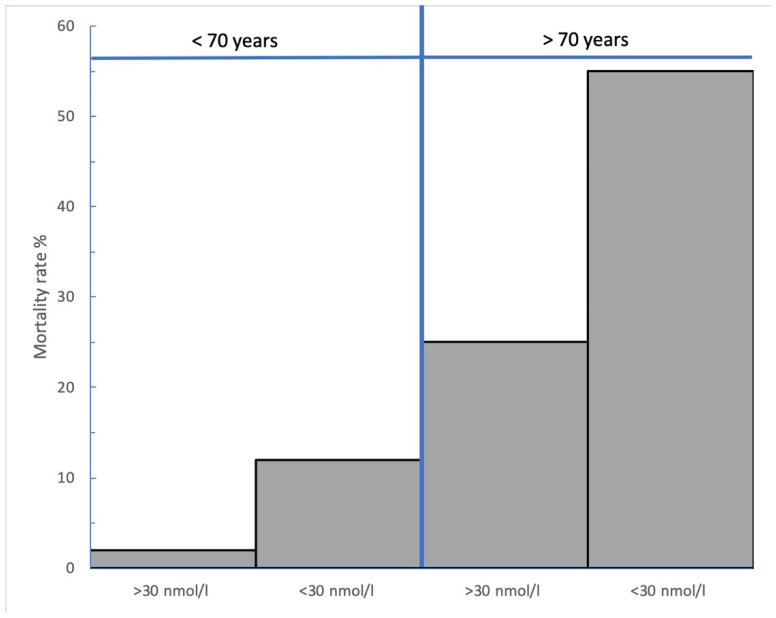
COVID-19 and a low vitamin D state share common risk factors, which might explain why vitamin D deficiency has been linked with higher COVID-19 mortality. Moreover, measures of serum vitamin D may become lower during systemic inflammatory responses, further confounding the association via reverse causality. In this prospective study (recruited over 12 months), we examined whether the association between a low vitamin D state and in-hospital mortality due to SARS-CoV-2 pneumonia in unvaccinated subjects is explained by (i) the presence of shared risk factors (e.g., obesity, advanced age) or (ii) a reduction in serum 25(OH)D due to COVID-19 (i.e., reverse causality). In this cohort of 232 (mean age = 56 years) patients (all had SARS-CoV-2 diagnosed via PCR AND required supplemental oxygen therapy), we failed to find an association between serum vitamin D and levels of CRP, or other inflammatory markers. However, the hazard ratio for mortality for subjects over 70 years of age (13.2) and for subjects with a serum 25(OH)D level less than 30 nmol·L−1 (4.6) remained significantly elevated even after adjustment for gender, obesity and the presence of diabetes mellitus. Subjects <70 years and >70 years had significantly higher mortality with a serum 25(OH)D less than 30 nmol·L−1 (11.8% and 55%), than with a serum 25(OH)D greater than 30 nmol·L−1 (2.2% and 25%). Unvaccinated Caucasian adults with a low vitamin D state have higher mortality due to SARS CoV-2 pneumonia, which is not explained by confounders and is not closely linked with elevated serum CRP.
COVID-19 和维生素 D 缺乏状态有共同的危险因素,这可能解释了为什么维生素 D 缺乏与更高的 COVID-19 死亡率有关。此外,在全身炎症反应期间,血清维生素 D 水平可能会降低,这通过反向因果关系进一步混淆了这种关联。在这项前瞻性研究(招募时间超过 12 个月)中,我们研究了在未接种疫苗的受试者中,维生素 D 缺乏状态与因 SARS-CoV-2 肺炎导致的住院死亡率之间的关联是否可以通过以下两种方式来解释:(i)存在共同的危险因素(例如肥胖、高龄)或(ii)由于 COVID-19 导致血清 25(OH)D 减少(即反向因果关系)。在这项包含 232 名(平均年龄为 56 岁)患者的队列研究中(所有患者均通过 PCR 确诊为 SARS-CoV-2,并且需要补充氧气治疗),我们未发现血清维生素 D 与 CRP 或其他炎症标志物之间存在关联。然而,对于年龄超过 70 岁的受试者(危险比为 13.2)和血清 25(OH)D 水平低于 30 nmol·L-1 的受试者(危险比为 4.6),即使在调整了性别、肥胖和糖尿病的存在后,其死亡风险比仍然显著升高。年龄<70 岁和>70 岁的受试者中,血清 25(OH)D 水平低于 30 nmol·L-1 的死亡率明显高于血清 25(OH)D 水平大于 30 nmol·L-1 的死亡率(分别为 11.8%和 55%,而 2.2%和 25%)。未接种疫苗的白种成年人因 SARS CoV-2 肺炎导致的死亡率较高,且这与低维生素 D 状态有关,与混杂因素无关,与升高的血清 CRP 也无密切关联。