Ontawong Atcharaporn, Duangjai Acharaporn, Sukpondma Yaowapa, Tadpetch Kwanruthai, Muanprasat Chatchai, Rukachaisirikul Vatcharin, Inchai Jakkapong, Vaddhanaphuti Chutima S
Division of Physiology, School of Medical Sciences, University of Phayao, Phayao 56000, Thailand.
Division of Physical Science and Center of Excellence for Innovation in Chemistry, Faculty of Science, Prince of Songkla University, Songkhla 90112, Thailand.
Pharmaceuticals (Basel). 2022 Jul 31;15(8):955. doi: 10.3390/ph15080955.
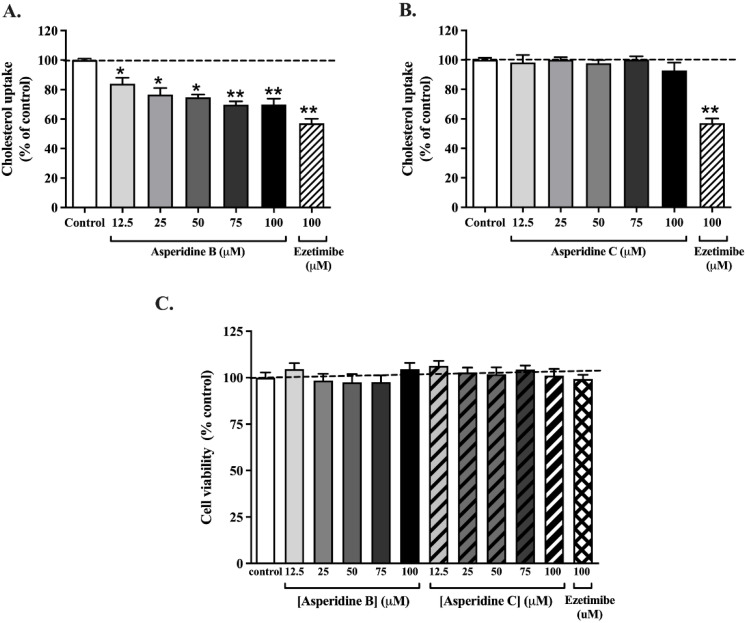
Isolated secondary metabolites asperidine B (preussin) and asperidine C, produced by the soil-derived fungus PSU-RSPG178, were found to exhibit inhibitory effects against 3-hydroxy-3-methyl-glutaryl-coenzyme A reductase and oxidative stress in an in vitro assay. Whether or not the known pyrrolidine asperidine B and the recently isolated piperidine asperidine C have lipid-lowering effects remains unknown. Thus, this study aimed to investigate the hypocholesterolemic effects of asperidines B and C and identify the mechanisms involved in using in vitro, ex vivo, and in vivo models. The results show that both compounds interfered with cholesterol micelle formation by increasing bile acid binding capacity, similar to the action of the bile acid sequestrant drug cholestyramine. However, only asperidine B, but not asperidine C, was found to inhibit cholesterol uptake in Caco-2 cells by up-regulating LXRα without changing cholesterol transporter NPC1L1 protein expression. Likewise, reduced cholesterol absorption via asperidine-B-mediated activation of LXRα was also observed in isolated rat jejunal loops. Asperidine B consistently decreases plasma cholesterol absorption, similar to the effect of ezetimibe in rats. Therefore, asperidine B, the pyrrolidine derivative, has therapeutic potential to be developed into a type of cholesterol absorption inhibitor for the treatment of hypercholesterolemia.
从土壤来源的真菌PSU-RSPG178中分离出的次生代谢产物asperidine B(preussin)和asperidine C,在体外试验中被发现对3-羟基-3-甲基戊二酰辅酶A还原酶和氧化应激具有抑制作用。已知的吡咯烷类asperidine B和最近分离出的哌啶类asperidine C是否具有降血脂作用尚不清楚。因此,本研究旨在探讨asperidines B和C的降胆固醇作用,并确定在体外、离体和体内模型中涉及的机制。结果表明,这两种化合物都通过增加胆汁酸结合能力来干扰胆固醇微胶粒的形成,类似于胆汁酸螯合剂药物考来烯胺的作用。然而,仅发现asperidine B而非asperidine C通过上调LXRα来抑制Caco-2细胞中的胆固醇摄取,而不改变胆固醇转运蛋白NPC1L1的蛋白表达。同样,在分离的大鼠空肠肠袢中也观察到通过asperidine B介导的LXRα激活而降低的胆固醇吸收。Asperidine B持续降低血浆胆固醇吸收,类似于依泽替米贝对大鼠的作用。因此,吡咯烷衍生物asperidine B具有开发成为一种用于治疗高胆固醇血症的胆固醇吸收抑制剂的治疗潜力。