Villalobos-Manzo Rocío, Ríos-Castro Emmanuel, Hernández-Hernández José Manuel, Oza Goldie, Medina Mauricio A, Tapia-Ramírez José
Departamento de Genética y Biología Molecular, Cinvestav-IPN, Ciudad de México 07360, Mexico.
Unidad de Genómica, Proteómica y Metabolómica (UGPM), LaNSE, Cinvestav-IPN, Ciudad de México 07360, Mexico.
Pharmaceutics. 2022 Aug 17;14(8):1715. doi: 10.3390/pharmaceutics14081715.
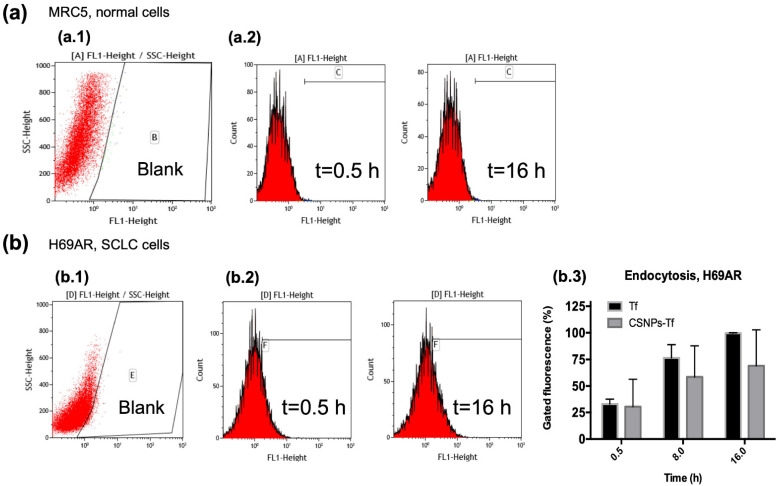
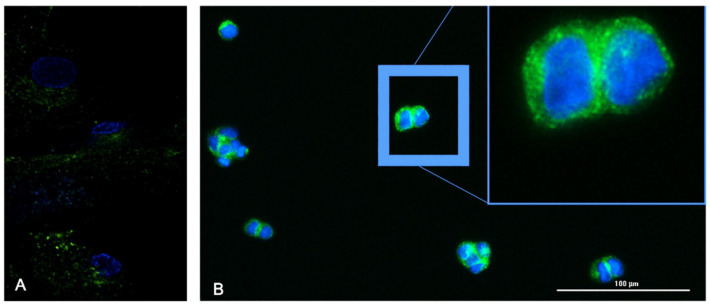
Lung cancer is, currently, one of the main malignancies causing deaths worldwide. To date, early prognostic and diagnostic markers for small cell lung cancer (SCLC) have not been systematically and clearly identified, so most patients receive standard treatment. In the present study, we combine quantitative proteomics studies and the use of magnetic core-shell nanoparticles (mCSNP's), first to identify a marker for lung cancer, and second to functionalize the nanoparticles and their possible application for early and timely diagnosis of this and other types of cancer. In the present study, we used label-free mass spectrometry in combination with an ion-mobility approach to identify 220 proteins with increased abundance in small cell lung cancer (SCLC) cell lines. Our attention was focused on cell receptors for their potential application as mCSNP's targets; in this work, we report the overexpression of Transferrin Receptor (TfR1) protein, also known as Cluster of Differentiation 71 (CD71) up to a 30-fold increase with respect to the control cell. The kinetics of endocytosis, evaluated by a flow cytometry methodology based on fluorescence quantification, demonstrated that receptors were properly activated with the transferrin supported on the magnetic core-shell nanoparticles. Our results are important in obtaining essential information for monitoring the disease and/or choosing better treatments, and this finding will pave the way for future synthesis of nanoparticles including chemotherapeutic drugs for lung cancer treatments.
肺癌是目前全球主要的致死性恶性肿瘤之一。迄今为止,小细胞肺癌(SCLC)的早期预后和诊断标志物尚未得到系统且明确的鉴定,因此大多数患者接受标准治疗。在本研究中,我们结合了定量蛋白质组学研究和磁性核壳纳米颗粒(mCSNP)的应用,一是为了鉴定肺癌标志物,二是使纳米颗粒功能化及其在早期及时诊断此类及其他类型癌症中的可能应用。在本研究中,我们使用无标记质谱结合离子淌度方法来鉴定在小细胞肺癌(SCLC)细胞系中丰度增加的220种蛋白质。我们将注意力集中在细胞受体上,因为它们有可能作为mCSNP的靶点;在这项工作中,我们报告了转铁蛋白受体(TfR1)蛋白(也称为分化簇71,即CD71)的过表达,相对于对照细胞增加了30倍。通过基于荧光定量的流式细胞术方法评估的内吞作用动力学表明,受体被磁性核壳纳米颗粒上负载的转铁蛋白正确激活。我们的结果对于获取监测疾病和/或选择更好治疗方法的重要信息具有重要意义,这一发现将为未来合成包括用于肺癌治疗的化疗药物在内的纳米颗粒铺平道路。