Muscoli Saverio, Barillà Francesco, Tajmir Rojin, Meloni Marco, Della Morte David, Bellia Alfonso, Di Daniele Nicola, Lauro Davide, Andreadi Aikaterini
Division of Cardiology, Fondazione Policlinico "Tor Vergata", 00133 Rome, Italy.
Department of Systems Medicine, University of Rome "Tor Vergata", 00133 Rome, Italy.
Pharmaceutics. 2022 Aug 18;14(8):1730. doi: 10.3390/pharmaceutics14081730.
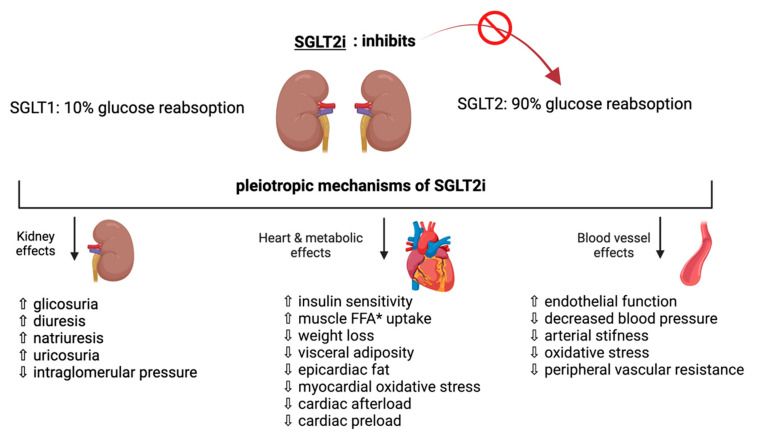
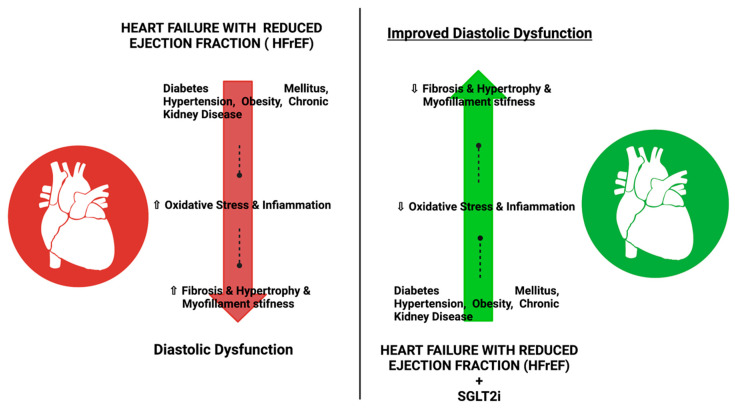
The sodium-glucose transporter 2 inhibitors (SGLT2i) are a relatively new class of medication used in the management of type 2 diabetes. Recent clinical trials and research have demonstrated this class's effectiveness in treating heart failure, since they reduce the risk of cardiovascular events, hospitalization, and mortality. The mechanism by which they do so is unclear; however, SGLT2i inhibit the tubular reabsorption of glucose, lowering the interstitial volume. This mechanism leads to a reduction in blood pressure and an improvement of endothelial function. As a result, improvements in hospitalization and mortality rate have been shown. In this review, we focus on the primary outcome of the clinical trials designed to investigate the effect of SGLT2i in heart failure, regardless of patients' diabetic status. Furthermore, we compare the various SGLT2i regarding their risk reduction to investigate their potential as a treatment option for patients with reduced ejection fraction and preserved ejection fraction.
钠-葡萄糖协同转运蛋白2抑制剂(SGLT2i)是用于治疗2型糖尿病的一类相对较新的药物。近期的临床试验和研究表明,这类药物在治疗心力衰竭方面有效,因为它们可降低心血管事件、住院率和死亡率。其作用机制尚不清楚;然而,SGLT2i可抑制肾小管对葡萄糖的重吸收,降低间质容积。这一机制导致血压降低和内皮功能改善。结果显示住院率和死亡率有所改善。在本综述中,我们关注旨在研究SGLT2i对心力衰竭影响的临床试验的主要结果,而不考虑患者的糖尿病状态。此外,我们比较了各种SGLT2i在降低风险方面的情况,以研究它们作为射血分数降低和射血分数保留患者治疗选择的潜力。