Hartono Rudi, Iswanto Apri Heri, Herawati Evalina, Suramana Reski Eka, Sutiawan Jajang, Amin Yusup, Sumardi Ihak
Department of Forest Products, Faculty of Forestry, Universitas Sumatera Utara, Medan 20155, Indonesia.
Research Center for Biomass and Bioproducts, National Research and Innovation Agency, Cibinong 16911, Indonesia.
Polymers (Basel). 2022 Aug 16;14(16):3330. doi: 10.3390/polym14163330.
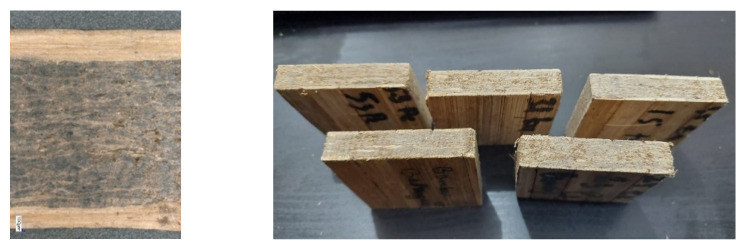
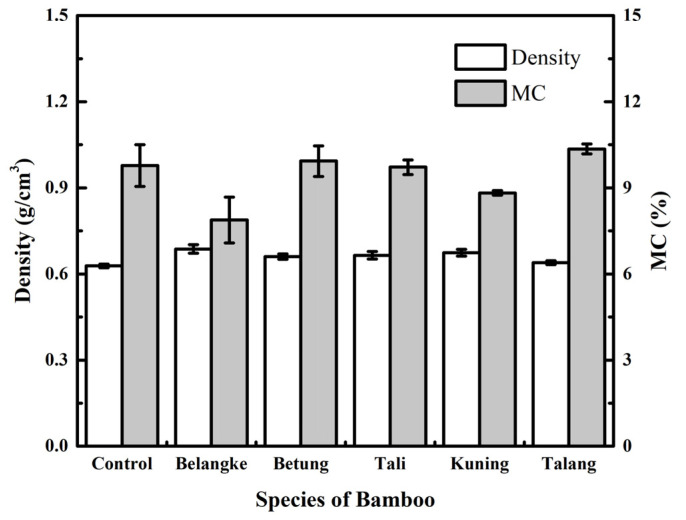
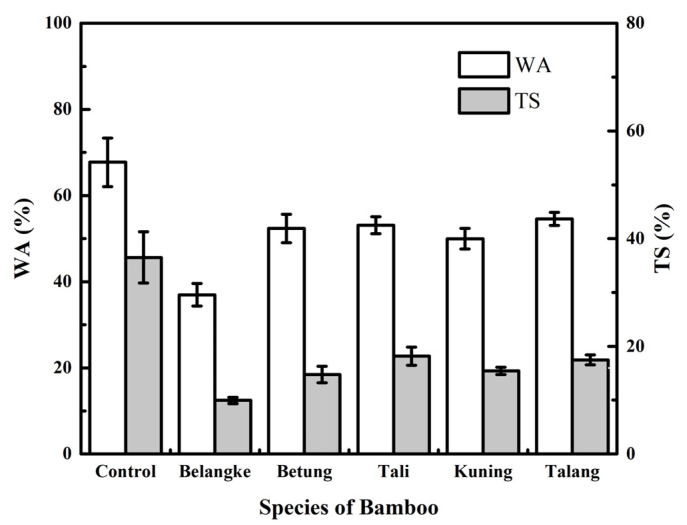
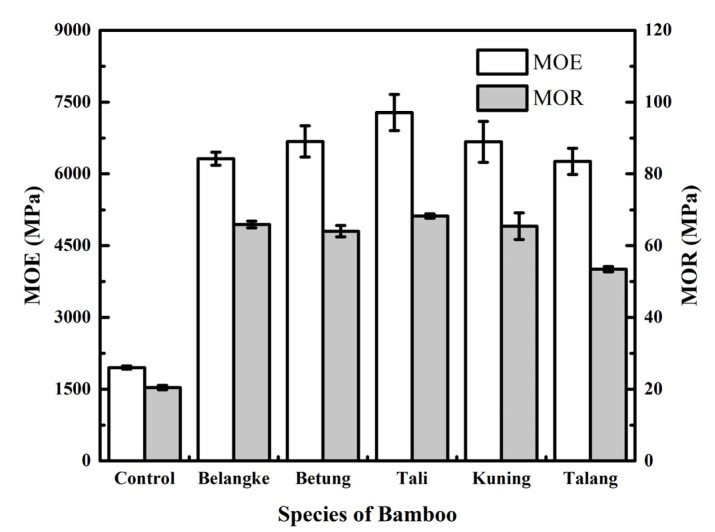
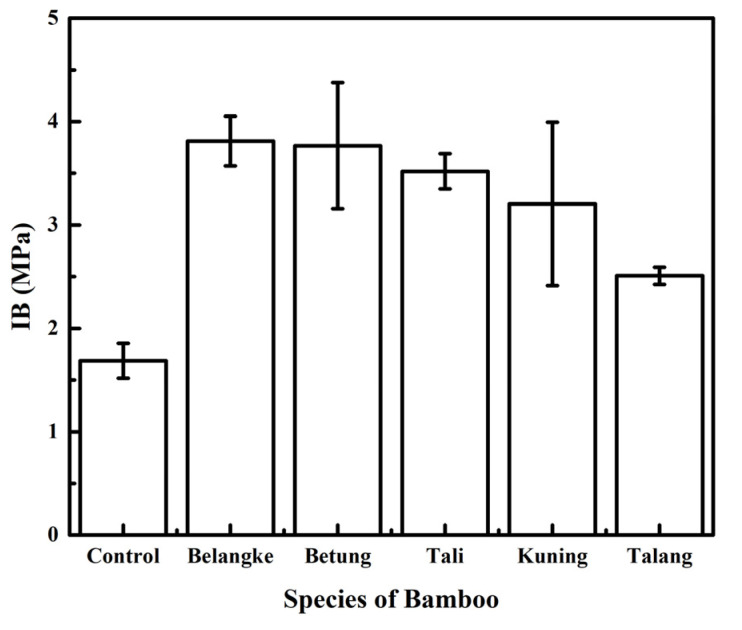
The use of natural fibers or particles as alternative raw materials for particleboard production is essential due to the shrinking forest area. Currently, dung waste from the Sumatran elephant () is being used as a raw material for particleboard due to its high fiber content. Although the product still has inferior mechanical and physical characteristics, it can be improved by layering bamboo. Therefore, this study aimed to enhance the mechanical and physical qualities of elephant dung particleboard by adding layers of bamboo. The particleboard constructed had three layers; namely, the face and back in the form of a bamboo layers, as well as the core, which was in the form of elephant dung. The elephant dung was evenly mixed with isocyanate adhesive using a spray gun, and the bamboo layers were coated with adhesive on one side of the surface. The sample was subjected to a hot press at a temperature of 150 °C and 30 kg/cm pressure for 10 min. Generally, JIS A 5908-2003 is the specification used to test the physical and mechanical properties of particleboard. During the experiment, the characteristics examined include density, moisture content, water absorption, thickness swelling, modulus of elasticity, modulus of rupture, and internal bonding, which were enhanced by using layers of bamboo. The results showed that the physical properties of the particleboard with bamboo layers were a density of 0.62-0.69 g/cm, a moisture content of 7.87-10.35%, water absorption of 38.27-68.58%, and a thickness swelling of 10.87-30.00%, which met the minimum standards of JIS A 5908-2003. The mechanical characteristics had values for the modulus of elasticity of 1952-7282 MPa, the modulus of rupture of 20.44-68.27 MPa, and the internal bonding of 0.16-0.38 MPa, which met the JIS A 5908-2003 standard. Based on these results, the particleboard with Belangke bamboo layers was the best in this study.
由于森林面积不断缩小,使用天然纤维或颗粒作为刨花板生产的替代原材料至关重要。目前,苏门答腊象的粪便因其高纤维含量而被用作刨花板的原材料。尽管该产品的机械和物理特性仍较差,但可通过添加竹层来改善。因此,本研究旨在通过添加竹层来提高象粪刨花板的机械和物理性能。所制作的刨花板有三层;即,面层和背板为竹层形式,芯层为象粪形式。使用喷枪将象粪与异氰酸酯胶粘剂均匀混合,竹层在表面的一侧涂有胶粘剂。样品在150℃温度和30kg/cm压力下热压10分钟。一般来说,JIS A 5908 - 2003是用于测试刨花板物理和机械性能的规范。在实验过程中,所检测的特性包括密度、水分含量、吸水性、厚度膨胀率、弹性模量、抗弯强度和内结合强度,通过使用竹层这些特性得到了提高。结果表明,带有竹层的刨花板的物理性能为密度0.62 - 0.69g/cm、水分含量7.87 - 10.35%、吸水性38.27 - 68.58%、厚度膨胀率10.87 - 30.00%,符合JIS A 5908 - 2003的最低标准。机械特性方面,弹性模量为1952 - 7282MPa、抗弯强度为20.44 - 68.27MPa、内结合强度为0.16 - 0.38MPa,符合JIS A 5908 - 2003标准。基于这些结果,带有贝朗克竹层的刨花板在本研究中是最佳的。