Teixeira Franciane Mouradian Emidio, Oliveira Luana de Mendonça, Pietrobon Anna Julia, Salles Érika Machado de, D'Império Lima Maria Regina, Viana Isabelle Freire Tabosa, Lins Roberto Dias, Rigato Paula Ordonhez, Marques Ernesto Torres de Azevedo, da Silva Duarte Alberto José, Sato Maria Notomi
Laboratory of Dermatology and Immunodeficiencies, LIM-56, Department of Dermatology, Tropical Medicine Institute of São Paulo, University of São Paulo Medical School, São Paulo 05403000, Brazil.
Department of Immunology, Institute of Biomedical Sciences, University of São Paulo, São Paulo 05508000, Brazil.
Vaccines (Basel). 2022 Aug 3;10(8):1246. doi: 10.3390/vaccines10081246.
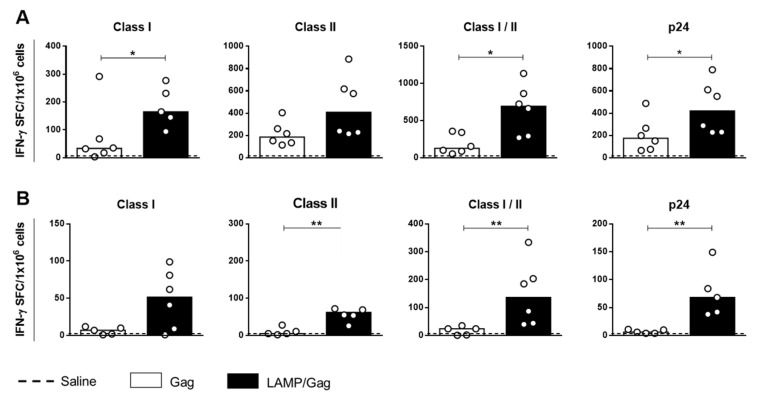
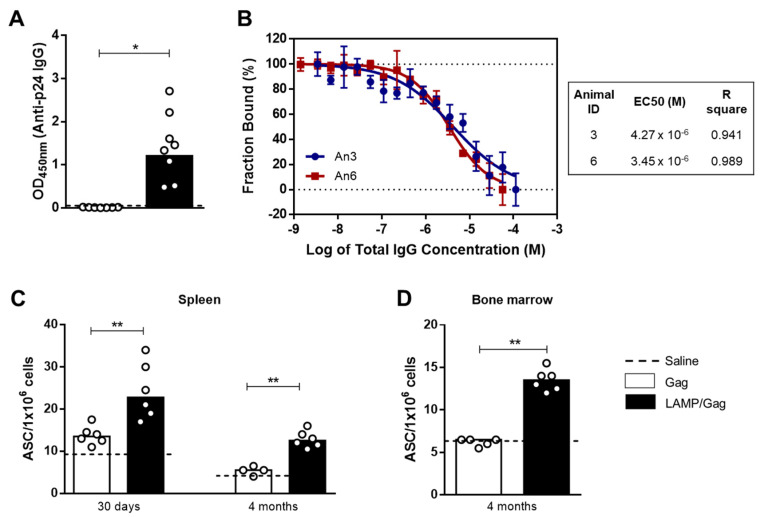
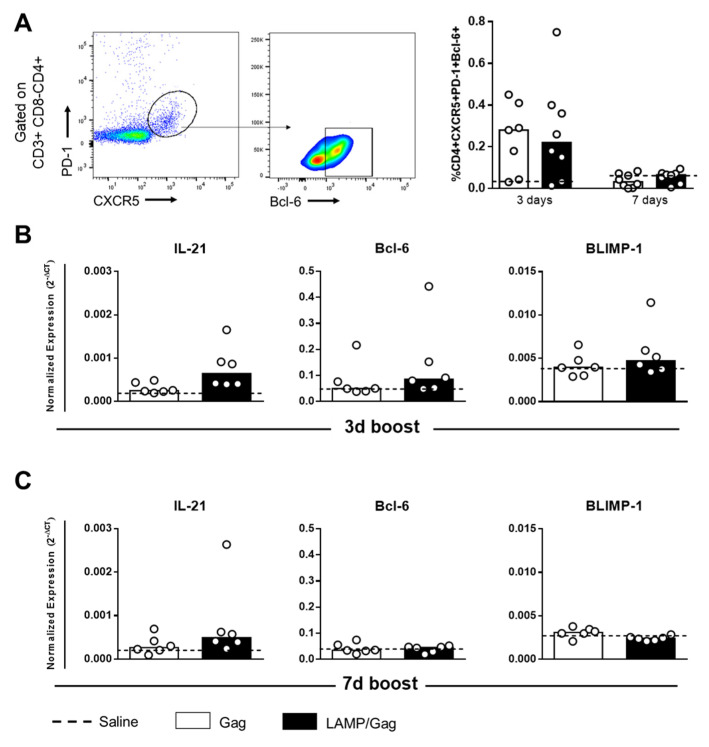
Neonates have a limited adaptive response of plasma cells, germinal center (GC) B cells, and T follicular helper cells (T). As neonatal vaccination can be an important tool for AIDS prevention, these limitations need to be overcome. Chimeric DNA vaccine encoding p55Gag HIV-1 protein conjugated with lysosomal-associated membrane protein 1 (LAMP-1) has been described as immunogenic in the neonate period. Herein, we investigated the immunologic mechanisms involved in neonatal immunization with a LAMP-1/p55Gag () DNA vaccine in a C57BL/6 mouse background. Neonatal vaccination induced strong Gag-specific T-cell response until adulthood and elevated levels of anti-Gag IgG antibodies. We also demonstrated for the first time that the immunogenicity of the neonatal period with is due to the induction of high-affinity anti-p24 IgG antibodies and long-term plasma cells. Together with that, there is the generation of early T cells and the formation of GC sites with the upregulation of activation-induced cytidine deaminase (AID) enzyme mRNA and protein expression in draining lymph nodes after neonatal vaccination. These findings underscore that the LAMP-1 strategy in the chimeric vaccine could be useful to enhance antibody production even in the face of neonatal immaturity, and they contribute to the development of new vaccine approaches for other emerging pathogens at an early stage of life.
新生儿的浆细胞、生发中心(GC)B细胞和滤泡辅助性T细胞(T)的适应性反应有限。由于新生儿疫苗接种可能是预防艾滋病的一项重要工具,这些局限性需要被克服。编码与溶酶体相关膜蛋白1(LAMP-1)缀合的p55Gag HIV-1蛋白的嵌合DNA疫苗已被描述为在新生儿期具有免疫原性。在此,我们在C57BL/6小鼠背景下研究了用LAMP-1/p55Gag()DNA疫苗进行新生儿免疫所涉及的免疫机制。新生儿接种疫苗诱导了强烈的Gag特异性T细胞反应直至成年,并提高了抗Gag IgG抗体水平。我们还首次证明,新生儿期接种疫苗的免疫原性归因于高亲和力抗p24 IgG抗体和长期浆细胞的诱导。与此同时,新生儿接种疫苗后,引流淋巴结中会产生早期T细胞,并形成GC位点,同时激活诱导的胞苷脱氨酶(AID)酶的mRNA和蛋白表达上调。这些发现强调,即使面对新生儿的免疫不成熟,嵌合疫苗中的LAMP-1策略也可能有助于增强抗体产生,并且它们有助于在生命早期开发针对其他新出现病原体的新疫苗方法。