
白人多发性骨髓瘤死亡预测模型的建立与验证
Establishment and Validation for Predicting the Death of Multiple Myeloma among Whites.
作者信息
Tao Jian, Wang Ling, Zhang Liyu, Gu Zheyun, Zhou Xiaodan
机构信息
Department of Hematology, The Second Affiliated Hospital of Nantong University, Nantong 226001, Jiangsu, China.
出版信息
Evid Based Complement Alternat Med. 2022 Aug 16;2022:3050199. doi: 10.1155/2022/3050199. eCollection 2022.
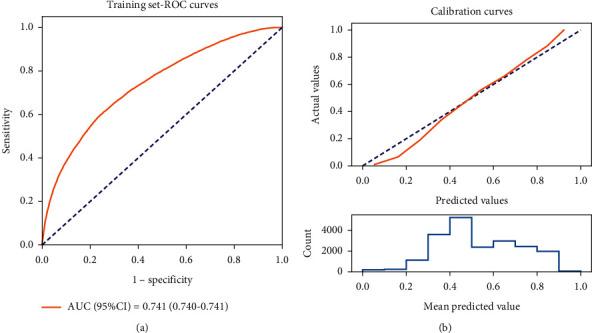
The prognosis of multiple myeloma (MM) patients was poor in white-American patients as compared to black-American patients. This study aimed to predict the death of MM patients in whites based on the National Cancer Institute's Surveillance, Epidemiology, and End Results (SEER) database. A total of 28,912 white MM patients were included in this study. Data were randomly divided into a training set and a test set (7 : 3). The random forest and 5-fold cross-validation were used for developing a prediction model. The performance of the model was determined by calculating the area under the curve (AUC) with 95% confidence interval (CI). MM patients in the death group had older age, higher proportion of tumor distant metastasis, bone marrow as the disease site, receiving radiotherapy, and lower proportion of receiving chemotherapy than that in the survival group (all < 0.001). The AUC of the random forest model in the training set and testing set was 0.741 (95% CI, 0.740-0.741) and 0.703 (95% CI, 0.703-0.704), respectively. In addition, the AUC of the age-based model was 0.688 (95% CI, 0.688-0.689) in the testing set. The results of the DeLong test indicated that the random forest model had better predictive effect than the age-based model ( = 7.023, < 0.001). Further validation was performed based on age and marital status. The results presented that the random forest model was robust in different age and marital status. The random forest model had a good performance to predict the death risk of MM patients in whites.
与美国黑人多发性骨髓瘤(MM)患者相比,美国白人患者的预后较差。本研究旨在基于美国国立癌症研究所的监测、流行病学和最终结果(SEER)数据库预测白人MM患者的死亡情况。本研究共纳入28912例白人MM患者。数据被随机分为训练集和测试集(7∶3)。采用随机森林和5折交叉验证来建立预测模型。通过计算95%置信区间(CI)的曲线下面积(AUC)来确定模型的性能。死亡组的MM患者比生存组年龄更大,肿瘤远处转移比例更高,疾病部位为骨髓,接受放疗,接受化疗的比例更低(均P<0.001)。训练集和测试集中随机森林模型的AUC分别为0.741(95%CI,0.7400.741)和0.703(95%CI,0.7030.704)。此外,测试集中基于年龄的模型的AUC为0.688(95%CI,0.688~0.689)。DeLong检验结果表明,随机森林模型比基于年龄的模型具有更好的预测效果(Z=7.023,P<0.001)。基于年龄和婚姻状况进行了进一步验证。结果表明,随机森林模型在不同年龄和婚姻状况下均具有稳健性。随机森林模型在预测白人MM患者的死亡风险方面表现良好。


 Zotero 插件