Miura Takayuki, Kadoya Syun-Suke, Takino Hiroyuki, Sano Daisuke, Akiba Michihiro
Department of Environmental Health, National Institute of Public Health, Wako, Japan.
Department of Civil and Environmental Engineering, Tohoku University, Sendai, Japan.
Front Microbiol. 2022 Aug 9;13:912147. doi: 10.3389/fmicb.2022.912147. eCollection 2022.
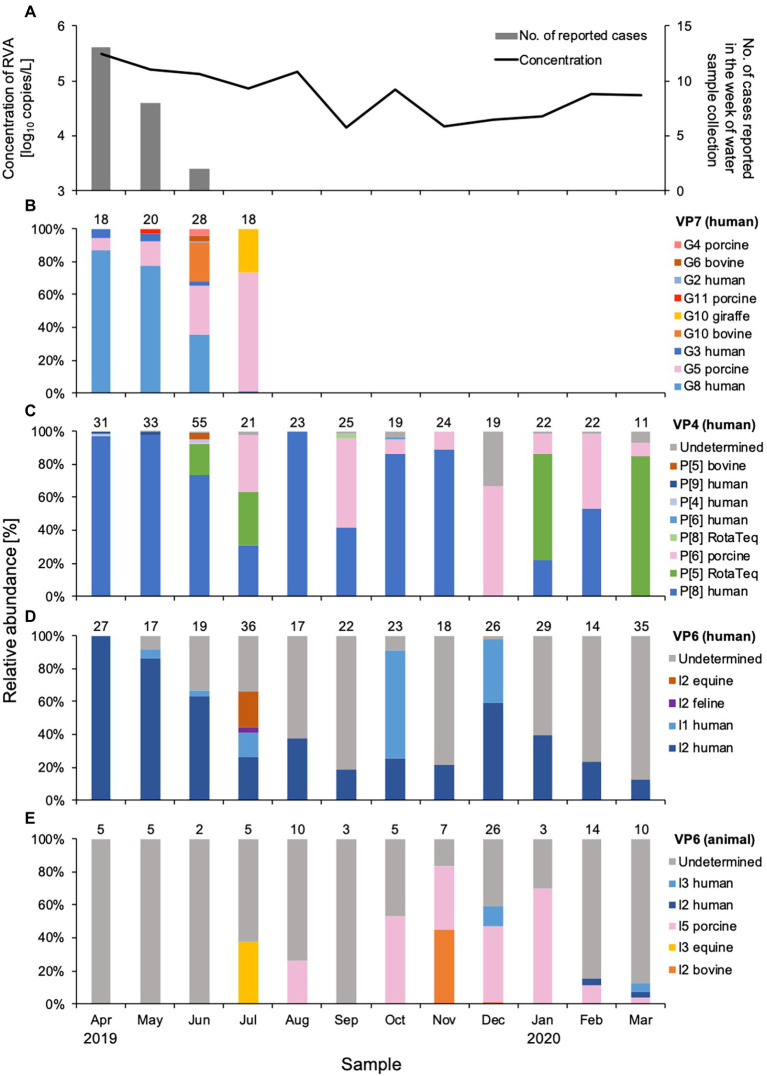
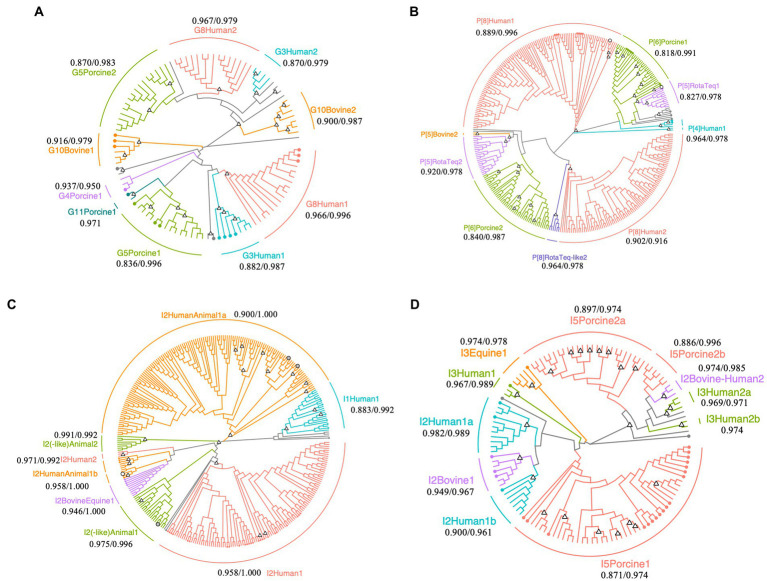
Rotavirus is a major cause of gastroenteritis among infants and children. In this study, nested PCR assays were developed to amplify partial regions of the VP7, VP4, and VP6 genes of (RVA) for amplicon-based Illumina MiSeq sequencing to investigate RVA genotypes in environmental water samples. Eight sets of inner primers were first designed and screened for use in the nested PCR assays, and four sets of them could produce amplicons. Six sets of outer primers were then designed and combined with the four sets of inner primers that worked. The assays were evaluated for sensitivity using raw water samples collected from one drinking water treatment plant between April 2019 and March 2020 (Sample Set 1; = 12) and seven DWTPs between 2018 and 2020 (Sample Set 2; = 18). In total, 43 amplicons from Set 1 were sequenced and diverse sequences from human, porcine, bovine, equine, and feline RVA were observed. Human G8, G3, and G2 genotypes were obtained, with G8 predominant (relative abundance, 36-87%) in samples taken during the rotavirus epidemic season between April and June. Porcine G5, G11, and G4, and bovine G10 and G6 genotypes were also detected. VP4 sequence analysis revealed that the human P[8] genotype was present throughout the year, whereas P[4] and P[9] were present only in the epidemic season. The vaccine strains P[5] and P[8] (RotaTeq) were also detected. Our approach enables the identification of prevalent human and animal RVA genotypes and their host species that potentially caused fecal contamination in water sources.
轮状病毒是婴幼儿肠胃炎的主要病因。在本研究中,开发了巢式聚合酶链反应(PCR)检测方法,用于扩增轮状病毒A组(RVA)的VP7、VP4和VP6基因的部分区域,以便基于扩增子的Illumina MiSeq测序,从而研究环境水样中的RVA基因型。首先设计并筛选了八组内部引物用于巢式PCR检测,其中四组能够产生扩增子。然后设计了六组外部引物,并与四组有效的内部引物组合。使用2019年4月至2020年3月期间从一个饮用水处理厂采集的原水样本(样本集1;n = 12)以及2018年至2020年期间从七个饮用水处理厂采集的样本(样本集2;n = 18)对检测方法的灵敏度进行了评估。总共对样本集1的43个扩增子进行了测序,观察到来自人、猪、牛、马和猫RVA的多种序列。获得了人G8、G3和G2基因型,在4月至6月的轮状病毒流行季节采集的样本中,G8占主导地位(相对丰度为36 - 87%)。还检测到猪G5、G11和G4基因型以及牛G10和G6基因型。VP4序列分析表明,人P[8]基因型全年都存在,而P[4]和P[9]仅在流行季节出现。还检测到了疫苗株P[5]和P[8](Rotateq)。我们的方法能够识别可能导致水源粪便污染的流行人类和动物RVA基因型及其宿主物种。