Keeler Andrea M, Rafferty Nicole E
Department of Evolution, Ecology, and Organismal Biology University of California, Riverside Riverside California USA.
Rocky Mountain Biological Laboratory Crested Butte Colorado USA.
Ecol Evol. 2022 Aug 23;12(8):e9186. doi: 10.1002/ece3.9186. eCollection 2022 Aug.
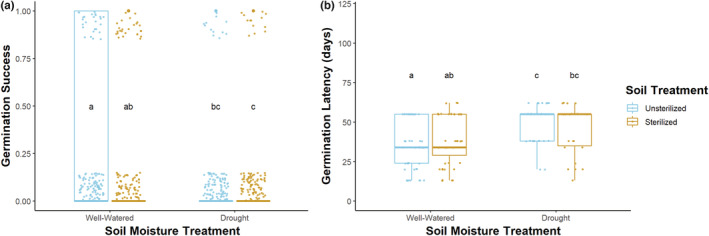
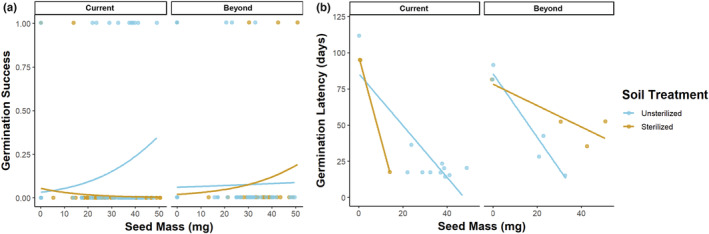
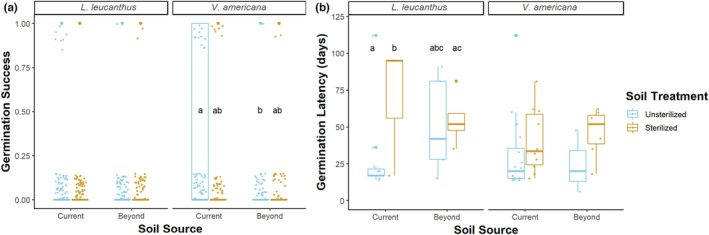
Climate change is affecting species and their mutualists and can lead to the weakening or loss of important interspecific interactions. Through independent shifts in partner phenology and distribution, climatic stress can separate mutualists temporally or spatially, leading to alterations in partner functional traits and fitness. Here, we explored the effects of the loss of microbial mutualists on legume germination success and phenology. In particular, we assessed the effects of mutualism loss via soil sterilization, increased drought, and introduction to novel soils found beyond the current distributions of two focal legume species in subalpine environments. Through common garden experiments in controlled environments, we found evidence that soil sterilization (and consequent microbial absence) and dry soils caused species-specific phenological delays of 2-5 weeks in germination, likely as a result of interaction loss between legumes and specialized germination-promoting soil microbes, such as mutualistic rhizobia. Delays in germination caused by a mismatch between legumes and beneficial microbes could negatively affect legume fitness through increased plant-plant competition later in the season. Additionally, we found evidence of the presence of beneficial microbes beyond the current elevational range of one of our focal legumes, which may allow for expansion of the leading edge, although harsh abiotic factors in the alpine may hinder this. Alterations in the strength of soil microbe-legume mutualisms may lead to reduced fitness and altered demography for both soil microbes and legumes.
气候变化正在影响物种及其共生伙伴,并可能导致重要种间相互作用的减弱或丧失。通过共生伙伴物候和分布的独立变化,气候压力可在时间或空间上使共生伙伴分离,导致伙伴功能性状和适合度发生改变。在此,我们探究了微生物共生伙伴丧失对豆科植物种子萌发成功率和物候的影响。具体而言,我们评估了通过土壤灭菌、干旱加剧以及将植物引入到两种重点豆科植物当前亚高山分布范围以外的新土壤中所造成的共生关系丧失的影响。通过在可控环境中进行的共同园圃实验,我们发现有证据表明,土壤灭菌(以及随之而来的微生物缺失)和干旱土壤导致种子萌发出现了2-5周的种特异性物候延迟,这可能是豆科植物与促进种子萌发的特殊土壤微生物(如共生根瘤菌)之间相互作用丧失的结果。豆科植物与有益微生物不匹配所导致的种子萌发延迟,可能会在季节后期通过加剧植物间竞争而对豆科植物的适合度产生负面影响。此外,我们发现有证据表明,在我们所研究的一种重点豆科植物当前海拔范围以外存在有益微生物,这可能会使植物分布前沿得以扩展,尽管高山地区恶劣的非生物因素可能会对此形成阻碍。土壤微生物与豆科植物共生关系强度的改变,可能会导致土壤微生物和豆科植物的适合度降低以及种群统计学特征发生改变。