Department of Internal Medicine, Radboud Institute of Molecular Life Sciences (RIMLS) and Radboudumc Center for Infectious Diseases (RCI), Radboud University Medical Center, Nijmegen, Netherlands.
Department of Medicine, University of Colorado, Aurora, CO, United States.
Front Immunol. 2022 Aug 9;13:964365. doi: 10.3389/fimmu.2022.964365. eCollection 2022.
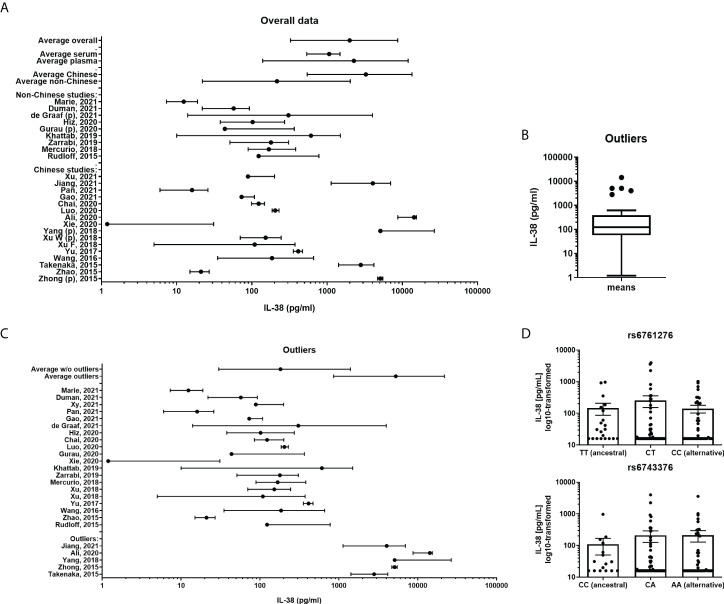
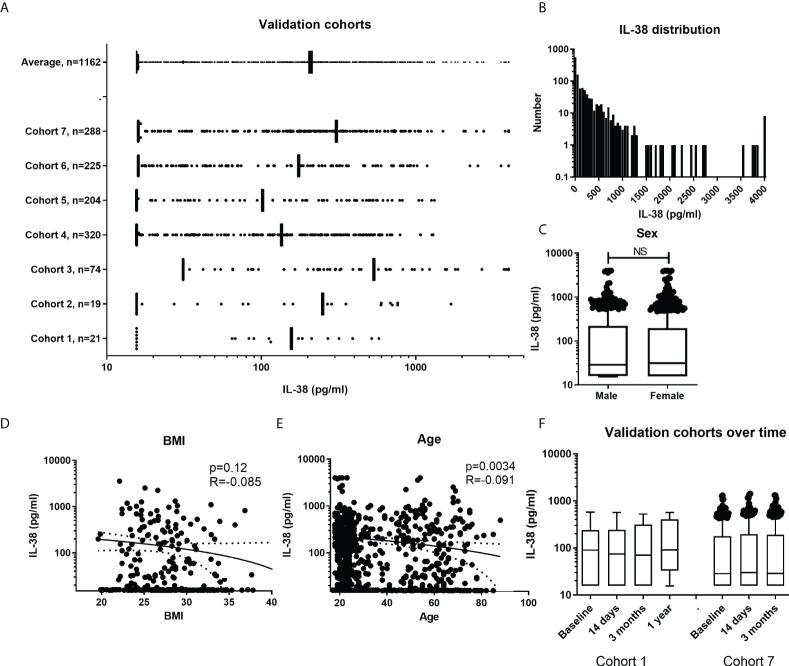
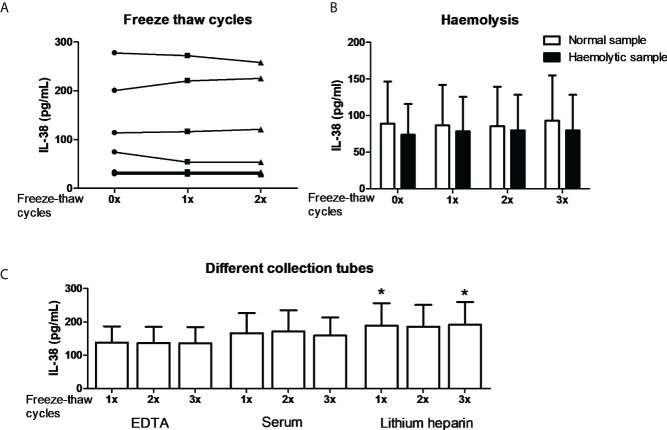
Interleukin (IL)-38 is the latest discovered member of the interleukin-1 family, which has anti-inflammatory properties similar to IL-36Ra. Several studies compared circulating IL-38 concentrations in healthy and diseased populations to characterize its role in both auto-immune and inflammatory pathologies, with both higher and lower concentrations being associated with certain diseases. However, in order to use IL-38 as a biomarker, a reference range in healthy adults is needed. To establish a reference IL-38 circulating concentration, accessible data from 25 eligible studies with IL-38 concentrations in healthy adults was collected. To validate the values found in literature, we measured IL-38 concentrations by enzyme-linked immunosorbent assay (ELISA) in several cohorts from our own institute. Additionally, the effect of blood collection techniques, freeze thawing cycles, and hemolysis on IL-38 measurements was assessed. To evaluate the importance of the genetic background of individuals as confounding factor of IL-38 synthesis, we used publicly available eQTL databases with matched data on allele frequencies in individuals of different ethnicities. Mean IL-38 concentrations in the various studies were weighted by their corresponding sample size, resulting in a weighted mean, and weighted upper and lower limits were calculated by mean ± 2 SD. Differences of over 10.000-fold were found in the weighted means between studies, which could not be attributed to the blood collection method or assessment of IL-38 in plasma or serum. Although IL-38 concentrations were markedly higher in Chinese then in European population studies, we could not show an association with the genetic background. From our analysis, a reference range for circulating IL-38 in healthy adults could thus not yet be established.
白细胞介素 (IL)-38 是白细胞介素-1 家族中最新发现的成员,具有与 IL-36Ra 相似的抗炎特性。几项研究比较了健康人群和患病人群中循环 IL-38 浓度,以表征其在自身免疫和炎症性病理中的作用,较高和较低的浓度与某些疾病有关。然而,为了将 IL-38 用作生物标志物,需要在健康成年人中建立参考范围。为了建立参考的 IL-38 循环浓度,我们收集了 25 项符合条件的研究中关于健康成年人 IL-38 浓度的可用数据。为了验证文献中发现的值,我们使用酶联免疫吸附测定 (ELISA) 在我们自己研究所的几个队列中测量了 IL-38 浓度。此外,还评估了血液采集技术、冻融循环和溶血对 IL-38 测量的影响。为了评估个体的遗传背景作为 IL-38 合成的混杂因素的重要性,我们使用了具有不同种族个体等位基因频率匹配数据的公开可用的 eQTL 数据库。根据相应的样本量对各项研究中的平均 IL-38 浓度进行加权,得出加权平均值,并通过均值 ± 2 SD 计算加权上限和下限。研究之间的加权平均值存在超过 10000 倍的差异,这不能归因于血液采集方法或对血浆或血清中 IL-38 的评估。尽管 IL-38 浓度在中国人群研究中明显高于欧洲人群研究,但我们无法显示其与遗传背景的关联。因此,我们的分析无法为健康成年人的循环 IL-38 建立参考范围。