Luo Yuan, Zhou Wenhao, Li Ruixin, Limbu Samwel M, Qiao Fang, Chen Liqiao, Zhang Meiling, Du Zhen-Yu
LANEH, School of Life Sciences, East China Normal University, Shanghai 200241, China.
University of Dar Es Salaam, Department of Aquaculture Technology, Dar Es Salaam 60091, Tanzania.
Anim Nutr. 2022 Jun 24;11:25-37. doi: 10.1016/j.aninu.2022.06.011. eCollection 2022 Dec.
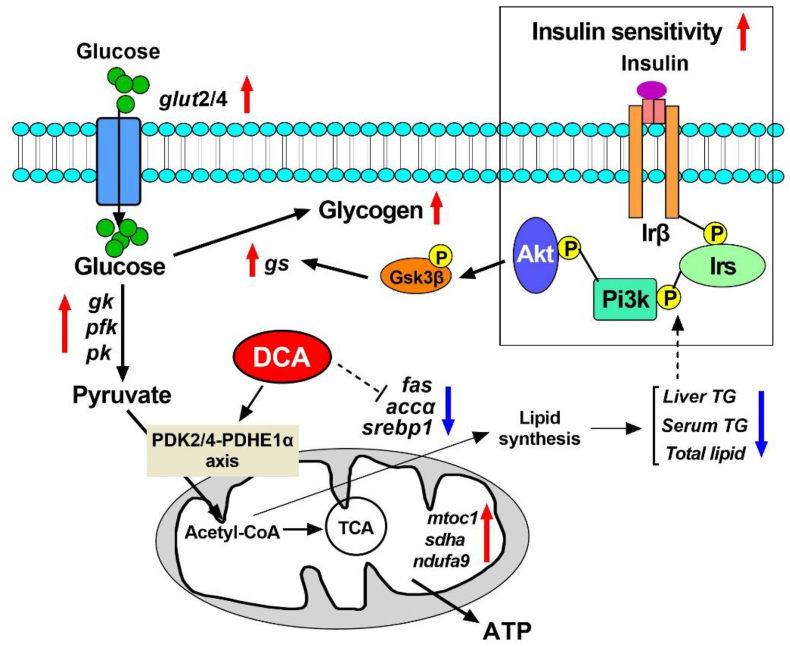
Pyruvate dehydrogenase kinases (PDKs)-pyruvate dehydrogenase E1α subunit (PDHE1α) axis plays an important role in regulating glucose metabolism in mammals. However, the regulatory function of PDKs-PDHE1α axis in the glucose metabolism of fish is not well known. This study determined whether PDKs inhibition could enhance PDHE1α activity, and improve glucose catabolism in fish. Nile tilapia fingerlings (1.90 ± 0.11 g) were randomly divided into 4 treatments in triplicate (30 fish each) and fed control diet without dichloroacetate (DCA) (38% protein, 7% lipid and 45% corn starch) and the control diet supplemented with DCA, which inhibits PDKs through binding the allosteric sites, at 3.75 (DCA3.75), 7.50 (DCA7.50) and 11.25 g/kg (DCA11.25), for 6 wk. The results showed that DCA3.75, DCA7.50 and DCA11.25 significantly increased weight gain, carcass ratio and protein efficiency ratio ( < 0.05) and reduced feed efficiency ( < 0.05) of Nile tilapia. To investigate the effects of DCA on growth performance of Nile tilapia, we selected the lowest dose DCA3.75 for subsequent analysis. Nile tilapia fed on DCA3.75 significantly reduced the mesenteric fat index, serum and liver triglyceride concentration and total lipid content in whole fish, and down-regulated the expressions of genes related to lipogenesis ( < 0.05) compared to the control. The DCA3.75 treatment significantly improved glucose oxidative catabolism and glycogen synthesis in the liver, but significantly reduced the conversion of glucose to lipid ( < 0.05). Furthermore, the DCA3.75 treatment significantly decreased the PDK2/4 gene and protein expressions ( < 0.05), accordingly stimulated PDHE1α activity by decreasing the phosphorylated PDHE1α protein level. In addition, DCA3.75 treatment significantly increased the phosphorylated levels of key proteins involved in insulin signaling pathway and glycogen synthase kinase 3β ( < 0.05). Taken together, the present study demonstrates that PDK2/4 inhibition by using DCA promotes glucose utilization in Nile tilapia by activating PDHE1α and improving insulin sensitivity. Our study helps to understand the regulatory mechanism of glucose metabolism for improving dietary carbohydrate utilization in farmed fish.
丙酮酸脱氢酶激酶(PDKs)-丙酮酸脱氢酶E1α亚基(PDHE1α)轴在调节哺乳动物葡萄糖代谢中起重要作用。然而,PDKs-PDHE1α轴在鱼类葡萄糖代谢中的调节功能尚不清楚。本研究确定了抑制PDKs是否能增强PDHE1α活性,并改善鱼类的葡萄糖分解代谢。尼罗罗非鱼幼鱼(1.90±0.11克)随机分为4组,每组3个重复(每组30尾鱼),分别投喂不含二氯乙酸(DCA)的对照饲料(38%蛋白质、7%脂质和45%玉米淀粉)以及添加DCA的对照饲料,DCA通过结合变构位点抑制PDKs,添加量分别为3.75(DCA3.75)、7.50(DCA7.50)和11.25克/千克(DCA11.25),持续6周。结果表明,DCA3.75、DCA7.50和DCA11.25显著提高了尼罗罗非鱼的体重增加、胴体率和蛋白质效率(P<0.05),并降低了饲料效率(P<0.05)。为了研究DCA对尼罗罗非鱼生长性能的影响,我们选择最低剂量的DCA3.75进行后续分析。与对照组相比,投喂DCA3.75的尼罗罗非鱼显著降低了肠系膜脂肪指数、血清和肝脏甘油三酯浓度以及全鱼总脂质含量,并下调了与脂肪生成相关基因的表达(P<0.05)。DCA3.75处理显著改善了肝脏中的葡萄糖氧化分解代谢和糖原合成,但显著降低了葡萄糖向脂质的转化(P<0.05)。此外,DCA3.75处理显著降低了PDK2/4基因和蛋白表达(P<0.05),从而通过降低磷酸化的PDHE1α蛋白水平刺激了PDHE1α活性。此外,DCA3.75处理显著提高了胰岛素信号通路关键蛋白和糖原合酶激酶3β的磷酸化水平(P<0.05)。综上所述,本研究表明,使用DCA抑制PDK2/4可通过激活PDHE1α和提高胰岛素敏感性促进尼罗罗非鱼的葡萄糖利用。我们的研究有助于了解葡萄糖代谢的调节机制,以提高养殖鱼类对饲料碳水化合物的利用率。