Melbourne Dental School, Faculty of Medicine, Dentistry and Health Sciences, University of Melbourne, Carlton, Australia.
Department of Biotechnological and Applied Clinical Sciences, University of L'Aquila, L'Aquila, Italy.
Clin Exp Dent Res. 2022 Dec;8(6):1456-1466. doi: 10.1002/cre2.642. Epub 2022 Aug 26.
Operating time is one of the main advantages attributed from the literature to the use of self-ligating brackets (SLB). The aim of this study is to investigate the time needed for a complete archwire change procedure with conventional brackets (CB) and SLBs in a standardized in vitro research setting, comparing operators with different expertise.
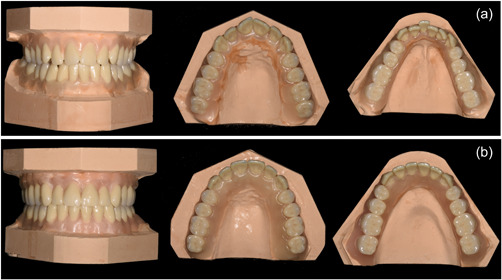
Thirty-three participants were divided into three equal groups: undergraduate students, postgraduate students, and orthodontists. Three sets of typodonts bonded with three types of brackets, including passive SLBs, active SLBs, and CBs using both steel and elastic ligatures were investigated. Operators had to insert, ligate, deligate, and remove wires in sets of typodonts representing an actual dentition before and after orthodontic treatment, mounted in phantoms. Archwire change procedure times were compared between the different bracket/ligation systems, between the before- and after-treatment typodonts, and between operators.
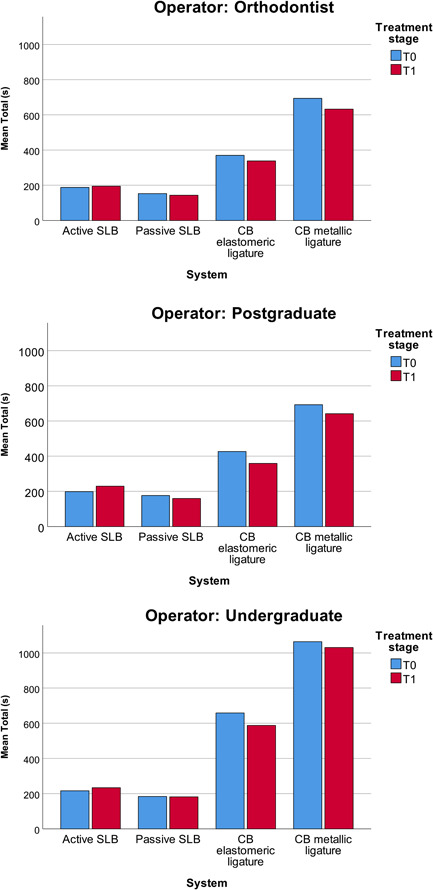
There were significant differences between SLBs and CBs, the greatest difference being 11 min 16 s between passive SLBs and CBs ligated with metallic ligatures at T0, for the total archwire change procedure by the operators overall. For all the operators, there was a statistically significant difference in total archwire change procedure time between the systems. The undergraduate students were the slowest when using CBs, but they showed no significant difference compared to the other users when using SLBs.
SLBs can offer a significant operating time reduction compared to CBs, and time saving is not dependent on the operator's experience and training.
手术时间是文献中提到使用自锁托槽(SLB)的主要优势之一。本研究旨在调查在标准化的体外研究环境中,使用传统托槽(CB)和 SLB 更换完全弓丝所需的时间,并比较不同专业水平的操作人员。
33 名参与者被分为三组:本科生、研究生和正畸医生。研究了三种类型的牙模,分别用被动 SLB、主动 SLB 和 CB 固定,其中 CB 又分别使用了钢结扎丝和弹性结扎丝。操作人员必须在正畸治疗前后的牙模上插入、结扎、松解和移除弓丝,牙模代表实际的牙列。比较了不同托槽/结扎系统之间、治疗前后牙模之间以及操作人员之间的弓丝更换程序时间。
SLB 和 CB 之间存在显著差异,在 T0 时,被动 SLB 和 CB 之间的结扎丝使用金属结扎丝时,总弓丝更换程序的最大差异为 11 分 16 秒。对于所有操作人员,系统之间的总弓丝更换程序时间存在统计学上的显著差异。本科生在使用 CB 时速度最慢,但与使用 SLB 时相比,与其他使用者没有显著差异。
与 CB 相比,SLB 可以显著缩短手术时间,而且节省时间并不依赖于操作人员的经验和培训。