Division of Cardiovascular Sciences, Department of Medicine, University of South Florida, Tampa, Florida.
Division of Cardiovascular Disease, Department of Medicine, The University of Alabama at Birmingham, Birmingham, Alabama.
Am J Physiol Heart Circ Physiol. 2022 Oct 1;323(4):H721-H737. doi: 10.1152/ajpheart.00115.2022. Epub 2022 Aug 26.
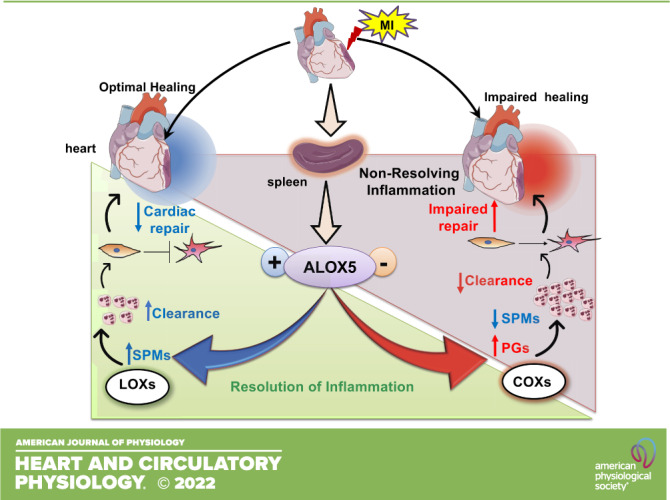
Arachidonate 5-lipoxygenase (ALOX5)-derived leukotrienes are primary signals of leukocyte activation and inflammation in response to ischemic cardiac injury (MI; myocardial infarction). Using risk-free male C57BL/6J and ALOX5-null mice (8-12 wk), we quantitated leukocytes and ALOX5-derived bioactive lipids of the infarcted left ventricle (LV) and spleen to measure the physiological inflammation and cardiac repair. Our results showed that ALOX5 endogenously generates specialized pro-resolving mediators (SPMs) that facilitate cardiac repair post-MI. Deficiency of ALOX5 leads to increase in cyclooxygenase gene expression, 6-keto prostaglandin F1α, and delayed neutrophil clearance with signs of unresolved inflammation post-MI. Consequently, ALOX5 deficiency impaired the resolution of inflammation and cardiac repair, including increased myocardium rupture post-MI in acute heart failure. On-time ALOX5 activation is critical for leukocyte clearance from the infarcted heart, indicating an essential role of ALOX5 in the resolution of inflammation. In addition, to balance the inflammatory responses, ALOX5 is also necessary for fibroblast signaling, as the ALOX5-deficient fibroblast are prone to fibroblast-to-myofibroblast differentiation leading to defective scar formation in post-MI cardiac repair. Consistent with these findings, ALOX5-null mice showed an overly inflammatory response, defective fibrotic signaling, and unresolved inflammation. These findings are indicative of a critical role of ALOX5 in myocardium healing, inflammation-resolution signaling, cardiac repair, and fibroblast pathophysiology. Arachidonate 5-lipoxygenase (ALOX5) is critical in synthesizing specialized pro-resolving mediators that facilitate cardiac repair after cardiac injury. Thus, ALOX5 orchestrates the overlapping phases of inflammation and resolution to facilitate myocardium healing in cardiac repair postmyocardial infarction.
花生四烯酸 5-脂氧合酶(ALOX5)衍生的白三烯是白细胞激活和对缺血性心脏损伤(MI;心肌梗死)炎症反应的主要信号。使用无风险的雄性 C57BL/6J 和 ALOX5 缺失小鼠(8-12 周),我们定量分析了梗死左心室(LV)和脾脏中的白细胞和 ALOX5 衍生的生物活性脂质,以测量生理炎症和心脏修复。我们的结果表明,ALOX5 内源性产生有助于 MI 后心脏修复的特殊促解决介质(SPM)。ALOX5 缺失导致环氧合酶基因表达增加、6-酮前列腺素 F1α 增加以及 MI 后中性粒细胞清除延迟和未解决炎症的迹象。因此,ALOX5 缺失会损害炎症和心脏修复的解决,包括 MI 后急性心力衰竭时心肌破裂增加。ALOX5 的适时激活对于从梗死心脏清除白细胞至关重要,这表明 ALOX5 在炎症解决中起关键作用。此外,为了平衡炎症反应,ALOX5 对于成纤维细胞信号也很有必要,因为 ALOX5 缺失的成纤维细胞容易向成纤维细胞-肌成纤维细胞分化,导致 MI 后心脏修复中疤痕形成缺陷。与这些发现一致,ALOX5 缺失小鼠表现出过度的炎症反应、缺陷的纤维化信号和未解决的炎症。这些发现表明 ALOX5 在心肌愈合、炎症解决信号、心脏修复和成纤维细胞病理生理学中起着关键作用。花生四烯酸 5-脂氧合酶(ALOX5)在合成有助于心脏损伤后心脏修复的特殊促解决介质方面起着关键作用。因此,ALOX5 协调炎症和解决的重叠阶段,以促进 MI 后心脏修复中的心肌愈合。