Infectious Diseases Unit, IRCCS Azienda Ospedaliero-Universitaria di Bologna, Policlinico di Sant'Orsola, Bologna, Italy; Department of Medical and Surgical Sciences, Alma Mater Studiorum University of Bologna, Bologna, Italy.
Department of Infectious Diseases and Clinical Microbiology, Faculty of Medicine, Başkent University, Ankara, Turkey.
Clin Microbiol Infect. 2022 Dec;28(12):1578-1590. doi: 10.1016/j.cmi.2022.08.013. Epub 2022 Aug 24.
Despite the large availability of vaccines, coronavirus disease 2019 (COVID-19), induced by severe acute respiratory syndrome coronavirus 2, continues to be a major threat for health-care providers and fragile people. A number of options are now available for outpatients with mild-to-moderate COVID-19 at the risk of disease progression for the prevention of deaths or hospitalization.
A European Society of Clinical Microbiology and Infectious Diseases COVID-19 guidelines task force was established by the European Society of Clinical Microbiology and Infectious Diseases Executive Committee. A small group was established, half appointed by the chair and the remaining selected based on an open call. Each panel met virtually once a week. For all decisions, a simple majority vote was used. A long list of clinical questions using the population, intervention, comparison, outcome format was developed at the beginning of the process. For each population, intervention, comparison, outcome, two panel members performed a literature search, with a third panelist involved in case of inconsistent results. Voting was based on the Grading of Recommendations Assessment, Development and Evaluation (GRADE) approach.
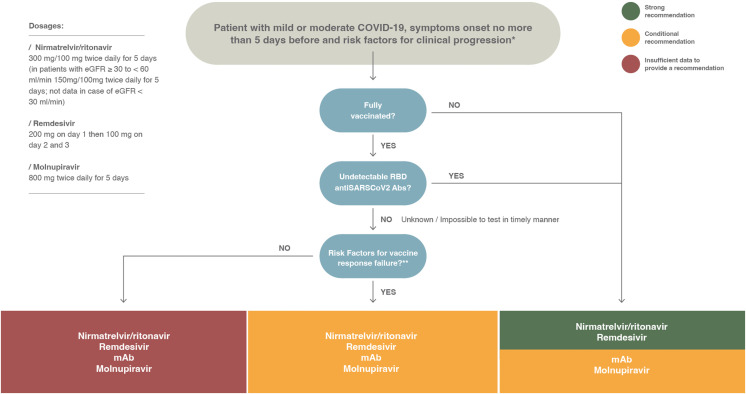
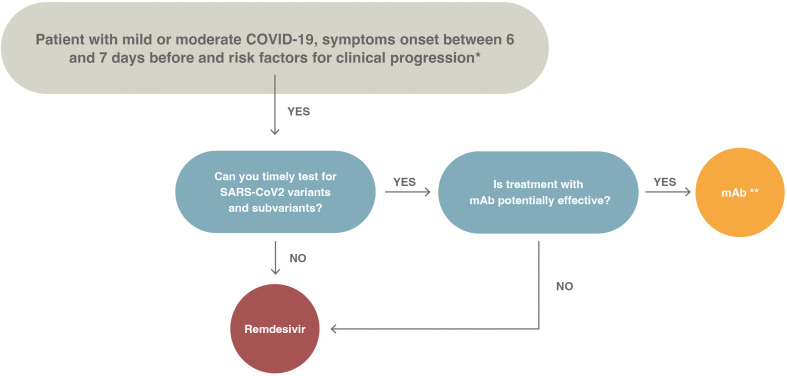
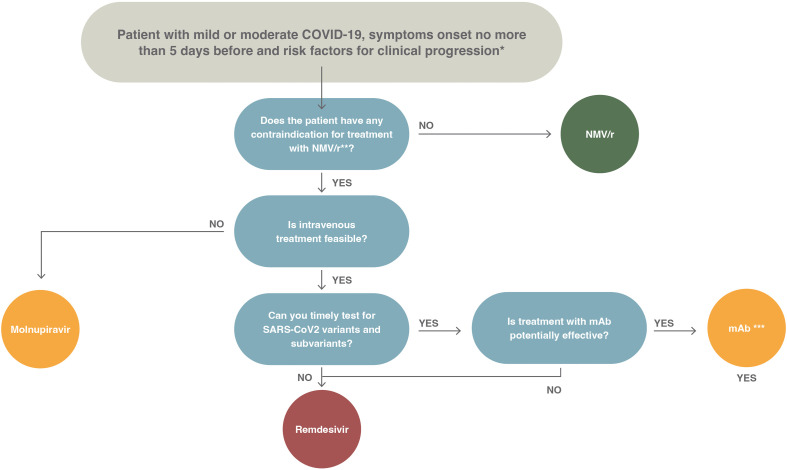
In this update, we focus on anti-viral agents, monoclonal antibodies (mAbs) and other treatment options proposed for patients with mild or moderate COVID-19 who are at the risk of hospitalization or death. Although the use of anti-virals is recommended, especially nirmatrelvir/ritonavir and remdesivir or, alternatively, molnupirarvir, the administration of mAbs against the spike protein strictly depends on circulating variants or the ability to test timely for variants and sub-variants. At the time of writing (April-June 2022), the only active mAb was tixagevimab/cilgavimab given the predominance of the Omicron BA.2, BA.3, BA.4 and BA.5 sub-lineages in Europe. However, considering that the epidemiological scenario is extremely dynamic, constant monitoring of variants of concern is mandatory.
尽管有大量疫苗可供使用,但由严重急性呼吸系统综合征冠状病毒 2 引起的 2019 年冠状病毒病(COVID-19)仍然是医疗保健提供者和脆弱人群的主要威胁。对于有疾病进展风险的轻度至中度 COVID-19 门诊患者,有许多选择可用于预防死亡或住院。
欧洲临床微生物学和传染病学会(ESCMID)执行委员会成立了一个由 ESCMID 制定的 COVID-19 指南工作组。成立了一个小团体,一半由主席任命,其余根据公开呼吁选出。每个小组每周虚拟开会一次。对于所有决定,使用简单多数票。在流程开始时,使用人群、干预、比较、结果格式制定了一份长长的临床问题清单。对于每个人群、干预、比较、结果,两名小组成员进行文献检索,如果结果不一致,则由第三名小组成员参与。投票基于推荐评估、制定和评估(GRADE)方法。
在本次更新中,我们重点关注抗病毒药物、单克隆抗体(mAbs)和其他用于有住院或死亡风险的轻度或中度 COVID-19 患者的治疗选择。虽然建议使用抗病毒药物,尤其是奈玛特韦/利托那韦和瑞德西韦,或者莫努匹拉韦,但针对刺突蛋白的 mAbs 的给药严格取决于循环变体或及时测试变体和亚变体的能力。在撰写本文时(2022 年 4 月至 6 月),由于欧洲奥密克戎 BA.2、BA.3、BA.4 和 BA.5 亚谱系的主导地位,唯一有效的 mAb 是替沙吉韦/西加韦单抗。然而,考虑到流行病学情况非常动态,必须对关注的变体进行持续监测。