Elisabeth Raab Neurofibromatosis Clinic, Toronto General Hospital, University of Toronto, 200 Elizabeth St. 5EC Room 334, Toronto, ON, M5G 2C4, Canada.
Institute of Health Policy, Management and Evaluation, University of Toronto, Toronto, Canada.
Orphanet J Rare Dis. 2022 Aug 26;17(1):321. doi: 10.1186/s13023-022-02493-5.
There is limited population-based data on Neurofibromatosis type 1 (NF1) in North America. We aimed to develop and validate algorithms using administrative health data and electronic medical records (EMRs) to identify individuals with NF1 in Ontario, Canada.
We conducted an electronic free-text search of 15 commonly-used terms related to NF1 in the Electronic Medical Records Primary Care Database. Records were reviewed by two trained abstractors who classified them as confirmed, possible, and not NF1. An investigator with clinical expertise performed final NF1 classification. Patients were classified as confirmed if there was a documented diagnosis, meeting NIH criteria. Patients were classified as possible if (1) NF1 was recorded in the cumulative patient profile, but no clinical information to support the diagnosis; (2) only one criterion for diagnosis (e.g. child of confirmed case) but no further data to confirm or rule out. We tested different combinations of outpatient and inpatient billing codes, and applied a free-text search algorithm to identify NF1 cases in administrative data and EMRs, respectively.
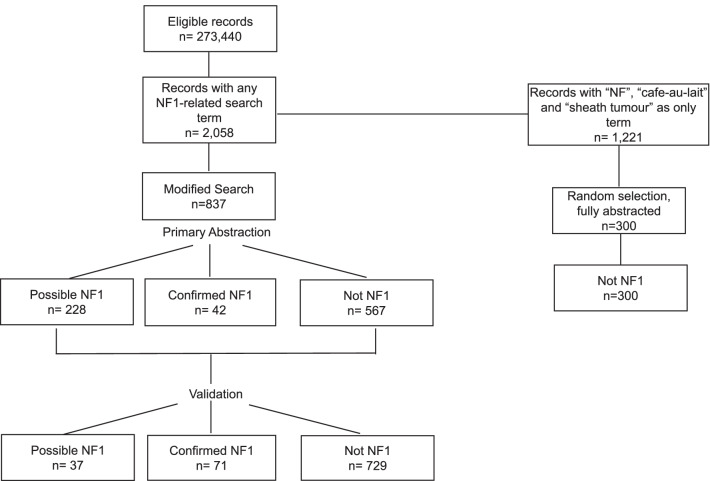
Of 273,440 eligible patients, 2,058 had one or more NF1 terms in their medical records. The terms "NF", "café-au-lait", or "sheath tumour" were constrained to appear in combination with another NF1 term. This resulted in 837 patients: 37 with possible and 71 with confirmed NF1. The population prevalence ranged from 1 in 3851 (confirmed NF1) to 1 in 2532 (possible and confirmed NF1). Billing code algorithms had poor performance, with overall low PPV (highest being 71%). The accuracy of the free-text EMR algorithm in identifying patients with NF1 was: sensitivity 85% (95% CI 74-92%), specificity 100% (95% CI 100-100%), positive predictive value 80% (95% CI 69-88%), negative predictive value 100% (95% CI 100-100%), and false positive rate 20% (95% CI 11-33%). Of false positives, 53% were possible NF1.
A free-text search algorithm within the EMR had high sensitivity, specificity and predictive values. Algorithms using billing codes had poor performance, likely due to the lack of NF-specific codes for outpatient visits. While NF1 ICD-9 and 10 codes are used for hospital admissions, only ~ 30% of confirmed NF1 cases had a hospitalization associated with an NF1 code.
北美地区针对神经纤维瘤病 1 型(NF1)的人群数据有限。我们旨在利用医疗保健管理数据和电子病历(EMR)开发和验证算法,以确定安大略省的 NF1 患者。
我们对电子病历初级保健数据库中的 15 个与 NF1 相关的常用术语进行了电子自由文本搜索。记录由两名经过培训的摘要员进行审查,他们将其归类为确诊、可能和非 NF1。一名具有临床专业知识的调查员对 NF1 进行了最终分类。如果有记录的诊断符合 NIH 标准,则将患者归类为确诊。如果患者属于可能的情况,则(1)NF1 记录在累积患者档案中,但没有支持诊断的临床信息;(2)只有一个诊断标准(例如确诊病例的子女),但没有进一步的数据来确认或排除。我们测试了门诊和住院计费代码的不同组合,并分别在管理数据和 EMR 中应用自由文本搜索算法来识别 NF1 病例。
在 273440 名符合条件的患者中,有 2058 名患者的医疗记录中有一个或多个 NF1 术语。术语“NF”、“牛奶咖啡斑”或“鞘瘤”必须与另一个 NF1 术语结合使用。这导致了 837 名患者:37 名患有可能的 NF1,71 名患有确诊的 NF1。人群患病率范围为每 3851 例(确诊的 NF1)至每 2532 例(可能的和确诊的 NF1)。计费代码算法的性能较差,总体阳性预测值(PPV)较低(最高为 71%)。EMR 中自由文本算法识别 NF1 患者的准确性为:敏感性 85%(95%CI 74-92%),特异性 100%(95%CI 100-100%),阳性预测值 80%(95%CI 69-88%),阴性预测值 100%(95%CI 100-100%),假阳性率 20%(95%CI 11-33%)。假阳性中有 53%是可能的 NF1。
EMR 中的自由文本搜索算法具有较高的敏感性、特异性和预测值。使用计费代码的算法性能较差,可能是由于缺乏针对门诊就诊的 NF 特定代码。虽然 NF1 ICD-9 和 10 代码用于住院治疗,但只有约 30%的确诊 NF1 病例与 NF1 代码相关的住院治疗。