Division of Orthodontics, University Clinics of Dental Medicine, Geneva, Switzerland.
Swiss Dental Clinics Group, Ardentis Clinique Dentaire Lausanne, Lausanne, Switzerland.
Clin Exp Dent Res. 2022 Oct;8(5):1109-1116. doi: 10.1002/cre2.629. Epub 2022 Aug 27.
To assess the vertical discrepancy between implant-supported crowns and adjacent teeth in the maxillary anterior region at least 8 years after implant placement and to evaluate the influence of this discrepancy on the level of aesthetic awareness of patients.
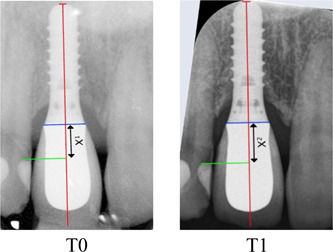
The sample consisted of 23 adult individuals evaluated at least 8 years after placement of an implant-supported central or lateral single tooth-fixed partial denture. Patients had their crowns delivered at a mean age of 47.8 years (range: 18.9-65.8). The vertical discrepancy was measured by comparing initial and follow-up periapical radiographs using the implant as a stable structure. The patients' satisfaction with their anterior teeth condition and awareness of the possible vertical problem were evaluated using a questionnaire. The aesthetic outcome and patient awareness were related to the objective measurement of the vertical discrepancy.
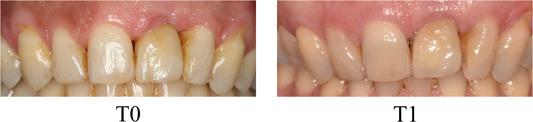
The implant showed a mean infraocclusion of 0.62 mm (range: 0.15-1.63 mm). The vertical discrepancy was not associated with the patient's gender, age at implant placement, and duration between initial and recall radiograph. Patients were generally satisfied with the long-term aesthetic outcome of their smile (mean: 3.9 on a 1-5 scale, 1 unsatisfied, and 5 completely satisfied). Out of 23 patients, 8 noticed the implant infraocclusion and 4 of them found the problem severe enough to be willing to improve the situation. The amount of vertical discrepancy was not associated with the patient's perception of the discrepancy and the pink aesthetic score.
Implant-supported crowns in the anterior region may suffer infraocclusion over the long term. The amount of vertical discrepancy was not dependent on the gender and age of the patient. Patients were generally satisfied with the aesthetic result of the restoration. The amount of vertical discrepancy, at least in the range we have measured, was not perceived by the patients as a complication.
评估上颌前牙区种植体支持的牙冠与相邻牙齿在种植体植入后至少 8 年的垂直差异,并评估这种差异对患者美学意识水平的影响。
该样本由 23 名成年个体组成,这些个体在植入体支持的中央或侧方单牙固定局部义齿植入后至少 8 年进行了评估。患者在平均年龄为 47.8 岁(范围:18.9-65.8 岁)时获得了牙冠。通过将种植体作为稳定结构,比较初始和随访根尖片来测量垂直差异。使用问卷评估患者对前牙状况的满意度和对可能存在的垂直问题的意识。美学效果和患者意识与垂直差异的客观测量相关。
种植体显示平均下覆盖 0.62mm(范围:0.15-1.63mm)。垂直差异与患者的性别、种植体植入时的年龄以及初始和复查根尖片之间的时间间隔无关。患者对他们微笑的长期美学效果普遍感到满意(平均为 1-5 分制中的 3.9 分,1 分不满意,5 分完全满意)。在 23 名患者中,有 8 名注意到种植体下覆盖,其中 4 名认为问题严重到足以愿意改善这种情况。垂直差异的量与患者对差异的感知和粉红色美学评分无关。
上颌前牙区的种植体支持牙冠可能会在长期内遭受下覆盖。垂直差异的量与患者的性别和年龄无关。患者对修复体的美学效果普遍满意。至少在我们测量的范围内,垂直差异的量没有被患者视为并发症。