Institute of Health Economics and Health Care Management, Helmholtz Zentrum München - German Research Centre for Environmental Health (GmbH), Neuherberg, Germany.
Pettenkofer School of Public Health, Munich, Germany.
Respir Res. 2022 Aug 27;23(1):220. doi: 10.1186/s12931-022-02143-1.
Early appropriate diagnosis and treatment of interstitial lung diseases (ILD) is crucial to slow disease progression and improve survival. Yet it is unknown whether initial management in an expert centre is associated with improved outcomes. Therefore, we assessed mortality, hospitalisations and health care costs of ILD patients initially diagnosed and managed in specialised ILD centres versus non-specialised centres and explored differences in pharmaceutical treatment patterns.
An epidemiological claims data analysis was performed, including patients with different ILD subtypes in Germany between 2013 and 2018. Classification of specialised centres was based on the number of ILD patients managed and procedures performed, as defined by the European Network on Rare Lung Diseases. Inverse probability of treatment weighting was used to adjust for covariates. Mortality and hospitalisations were examined via weighted Cox models, cost differences by weighted gamma regression models and differences in treatment patterns with weighted logistic regressions.
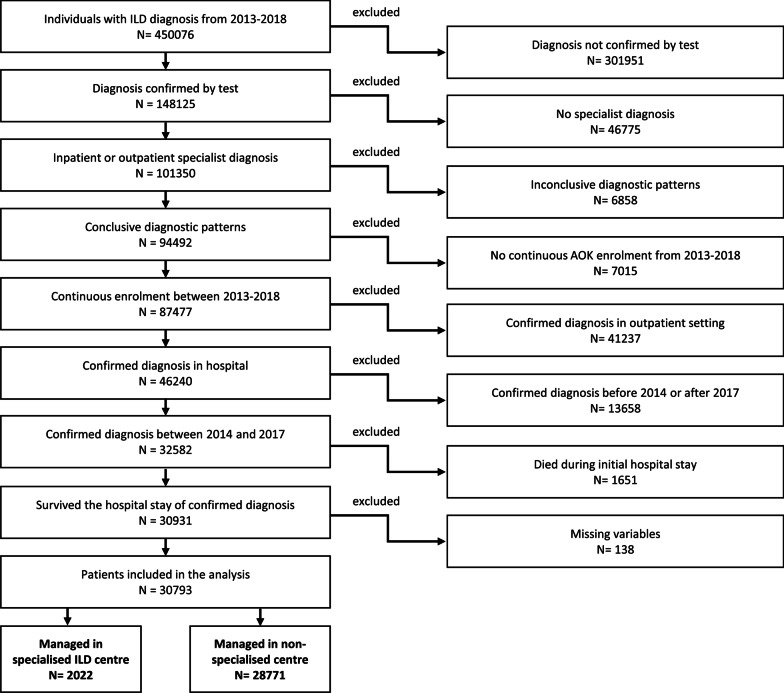
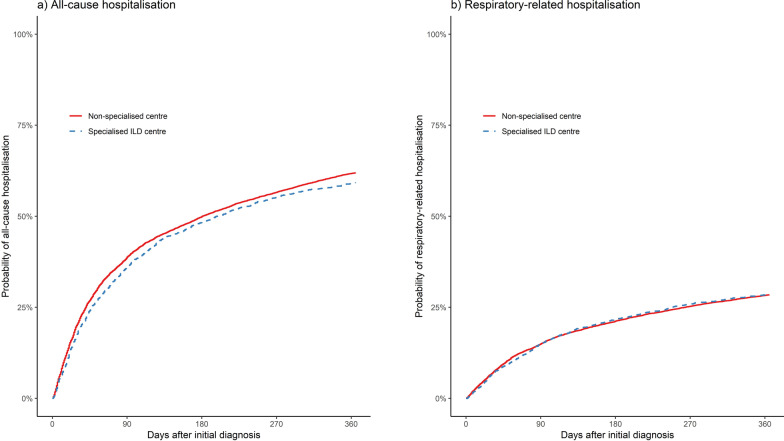
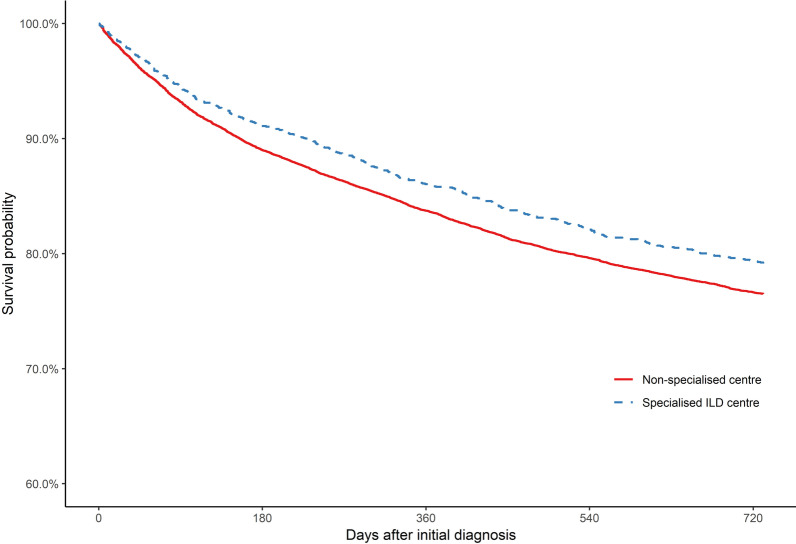
We compared 2022 patients managed in seven specialised ILD centres with 28,771 patients managed in 1156 non-specialised centres. Specialised ILD centre management was associated with lower mortality (HR: 0.87, 95% CI 0.78; 0.96), lower all-cause hospitalisation (HR: 0.93, 95% CI 0.87; 0.98) and higher respiratory-related costs (€669, 95% CI €219; €1156). Although risk of respiratory-related hospitalisations (HR: 1.00, 95% CI 0.92; 1.10) and overall costs (€- 872, 95% CI €- 75; €1817) did not differ significantly, differences in treatment patterns were observed.
Initial management in specialised ILD centres is associated with improved mortality and lower all-cause hospitalisations, potentially due to more differentiated diagnostic approaches linked with more appropriate ILD subtype-adjusted therapy.
早期适当诊断和治疗间质性肺病(ILD)对于减缓疾病进展和提高生存率至关重要。然而,目前尚不清楚在专家中心进行初始管理是否与改善预后相关。因此,我们评估了在专门的ILD 中心和非专门中心最初诊断和管理的ILD 患者的死亡率、住院率和医疗保健费用,并探讨了药物治疗模式的差异。
进行了一项流行病学索赔数据分析,包括德国在 2013 年至 2018 年间患有不同ILD 亚型的患者。专门中心的分类是根据管理和实施的ILD 患者数量以及欧洲罕见肺病网络定义的程序来确定的。使用逆概率治疗加权来调整协变量。通过加权 Cox 模型检查死亡率和住院率,通过加权伽马回归模型检查成本差异,通过加权逻辑回归模型检查治疗模式差异。
我们比较了在 7 家专门的ILD 中心管理的 2022 名患者和在 1156 家非专门中心管理的 28771 名患者。专门的ILD 中心管理与较低的死亡率相关(HR:0.87,95%CI:0.78;0.96)、较低的全因住院率(HR:0.93,95%CI:0.87;0.98)和较高的呼吸道相关费用(€669,95%CI:€219;€1156)。尽管呼吸道相关住院率(HR:1.00,95%CI:0.92;1.10)和总体费用(€-872,95%CI:€-75;€1817)没有显著差异,但治疗模式存在差异。
在专门的ILD 中心进行初始管理与改善死亡率和降低全因住院率相关,这可能是由于更具差异化的诊断方法与更适当的ILD 亚型调整治疗相关。