Sanaria, Inc, 9800 Medical Center Drive, Suite A209, Rockville, MD, 20850, USA.
Department of Laboratory Medicine and Pathology, University of Washington, Seattle, WA, USA.
Malar J. 2022 Aug 27;21(1):247. doi: 10.1186/s12936-022-04261-z.
Plasmodium falciparum (Pf) sporozoite (SPZ) vaccines are the only candidate malaria vaccines that induce > 90% vaccine efficacy (VE) against controlled human malaria infection and the only malaria vaccines to have achieved reproducible VE against malaria in adults in Africa. The goal is to increase the impact and reduce the cost of PfSPZ vaccines by optimizing vaccine potency and manufacturing, which will benefit from identification of immunological responses contributing to protection in humans. Currently, there is no authentic animal challenge model for assessing P. falciparum malaria VE. Alternatively, Plasmodium knowlesi (Pk), which infects humans and non-human primates (NHPs) in nature, can be used to experimentally infect rhesus macaques (Macaca mulatta) to assess VE.
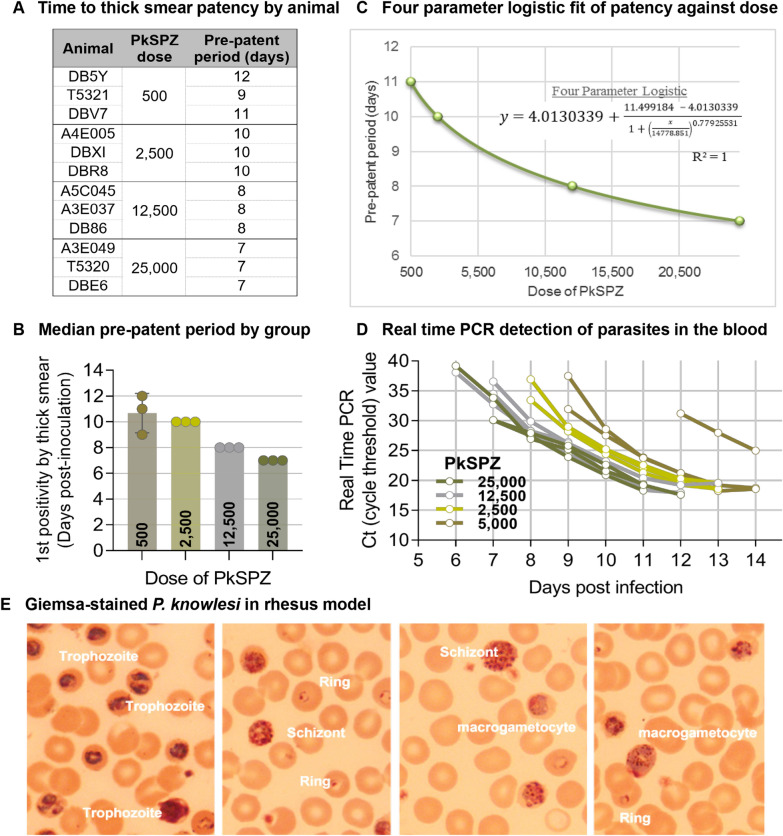
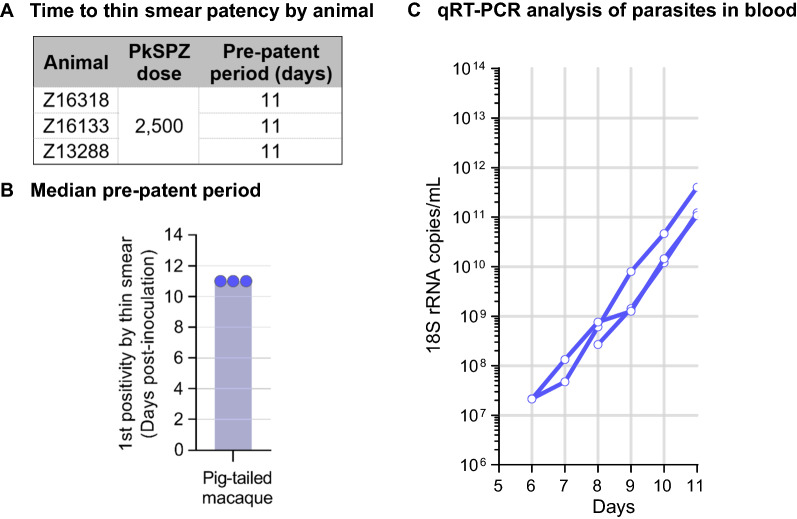
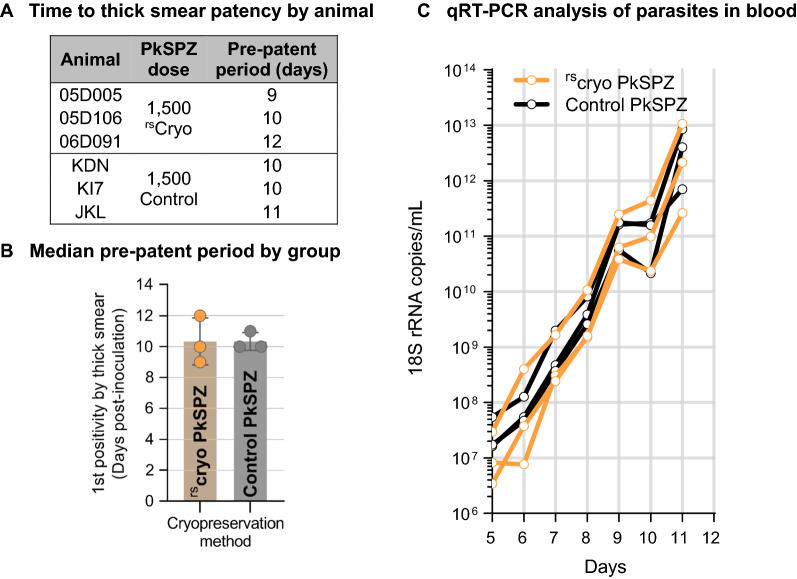
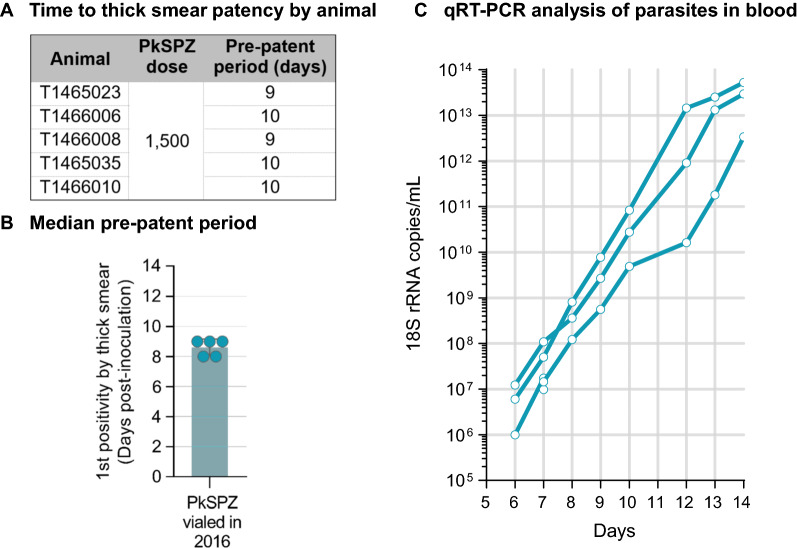
Sanaria has, therefore, produced purified, vialed, cryopreserved PkSPZ and conducted challenge studies in several naïve NHP cohorts. In the first cohort, groups of three rhesus macaques each received doses of 5 × 10, 2.5 × 10, 1.25 × 10 and 2.5 × 10 PkSPZ administered by direct venous inoculation. The infectivity of 1.5 × 10 PkSPZ cryopreserved with an altered method and of 1.5 × 10 PkSPZ cryopreserved for four years was tested in a second and third cohort of rhesus NHPs. The lastly, three pig-tailed macaques (Macaca nemestrina), a natural P. knowlesi host, were challenged with 2.5 × 10 PkSPZ cryopreserved six years earlier.
In the first cohort, all 12 animals developed P. knowlesi parasitaemia by thick blood smear, and the time to positivity (prepatent period) followed a non-linear 4-parameter logistic sigmoidal model with a median of 11, 10, 8, and 7 days, respectively (r = 1). PkSPZ cryopreserved using a modified rapid-scalable method infected rhesus with a pre-patent period of 10 days, as did PkSPZ cryopreserved four years prior to infection, similar to the control group. Cryopreserved PkSPZ infected pig-tailed macaques with median time to positivity by thin smear, of 11 days.
This study establishes the capacity to consistently infect NHPs with purified, vialed, cryopreserved PkSPZ, providing a foundation for future studies to probe protective immunological mechanisms elicited by PfSPZ vaccines that cannot be established in humans.
恶性疟原虫(Pf)子孢子(SPZ)疫苗是唯一能诱导对人体疟疾感染产生>90%疫苗有效性(VE)的候选疟疾疫苗,也是唯一能在非洲成年人中产生可重复疟疾 VE 的疟疾疫苗。目标是通过优化疫苗效力和制造来提高 PfSPZ 疫苗的影响力和降低成本,这将受益于鉴定对人类保护有贡献的免疫反应。目前,尚无用于评估 Pf 疟原虫 VE 的真实动物挑战模型。相反,在自然界中感染人类和非人类灵长类动物(NHPs)的疟原虫 knowlesi(Pk)可用于通过实验感染恒河猴(Macaca mulatta)来评估 VE。
因此,Sanaria 生产了纯化、装瓶、冷冻保存的 PkSPZ,并在多个未感染的 NHP 队列中进行了挑战研究。在第一队列中,每组三只恒河猴分别接受 5×10、2.5×10、1.25×10 和 2.5×10 PkSPZ 的剂量,通过直接静脉接种。使用改良方法冷冻保存的 1.5×10 PkSPZ 和冷冻保存四年的 1.5×10 PkSPZ 的感染性在第二和第三队列的恒河猴 NHP 中进行了测试。最后,三只长尾猕猴(Macaca nemestrina),天然的 P. knowlesi 宿主,用冷冻保存了六年的 2.5×10 PkSPZ 进行了挑战。
在第一队列中,所有 12 只动物均通过厚血涂片检测到疟原虫 knowlesi 寄生虫血症,阳性前时间(潜育期)遵循非线性 4-参数逻辑 sigmoidal 模型,中位数分别为 11、10、8 和 7 天(r=1)。使用改良的快速可扩展方法冷冻保存的 PkSPZ 感染恒河猴的潜育期为 10 天,与感染前四年冷冻保存的 PkSPZ 以及对照组相似。冷冻保存的 PkSPZ 通过薄涂片感染长尾猕猴,阳性前时间的中位数为 11 天。
本研究确立了用纯化、装瓶、冷冻保存的 PkSPZ 持续感染 NHP 的能力,为未来研究 PfSPZ 疫苗诱导的保护性免疫机制提供了基础,这些机制在人体中无法建立。