Amsterdam UMC location University of Amsterdam, Heart Center, Department of Cardiology, Amsterdam Cardiovascular Sciences Heart failure & Arrhythmias, Meibergdreef 9, 1105 AZ Amsterdam, the Netherlands.
Department of Cardiology, Isala Heart Centre, Zwolle, The Netherlands.
Eur Heart J. 2022 Dec 14;43(47):4872-4883. doi: 10.1093/eurheartj/ehac496.
The subcutaneous implantable cardioverter-defibrillator (S-ICD) is developed to overcome lead-related complications and systemic infections, inherent to transvenous ICD (TV-ICD) therapy. The PRAETORIAN trial demonstrated that the S-ICD is non-inferior to the TV-ICD with regard to the combined primary endpoint of inappropriate shocks and complications. This prespecified secondary analysis evaluates all complications in the PRAETORIAN trial.
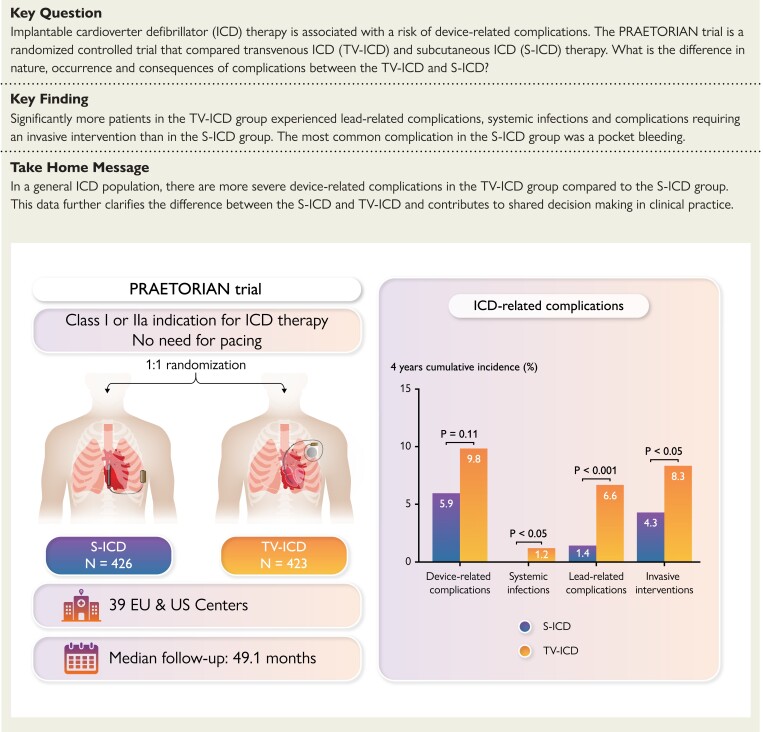
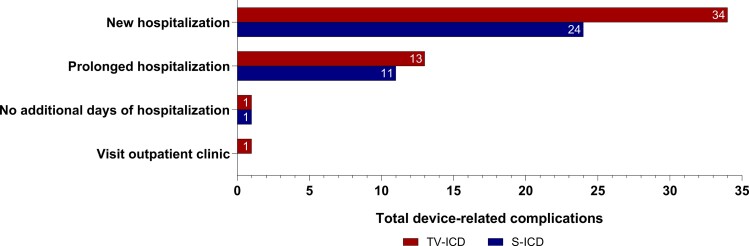
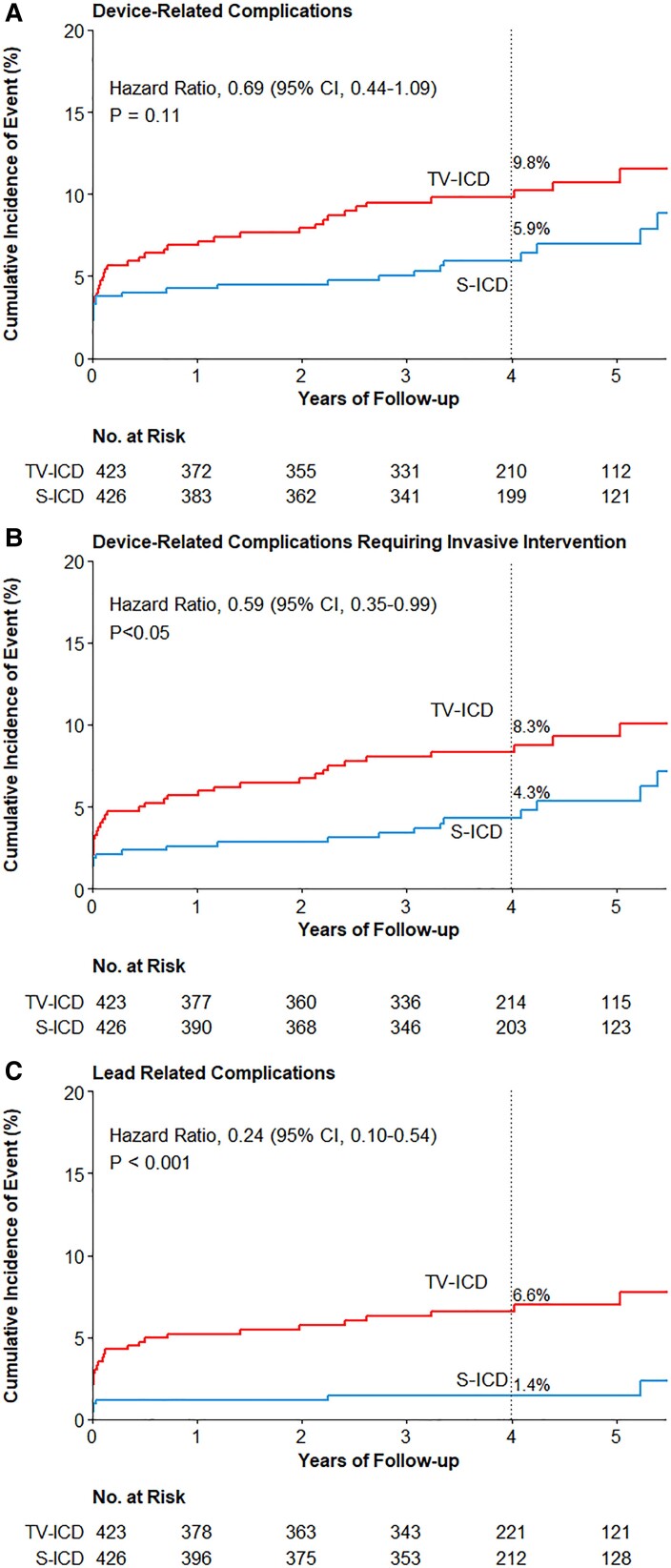
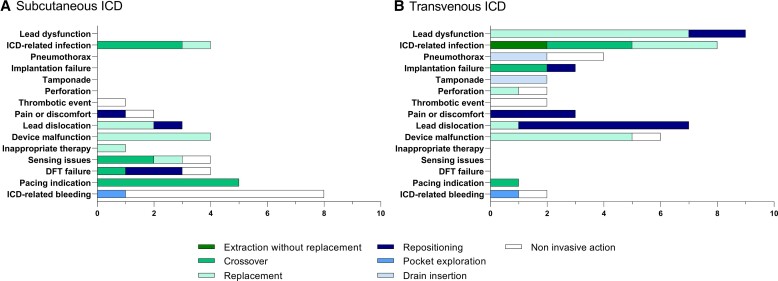
The PRAETORIAN trial is an international, multicentre, randomized trial in which 849 patients with an indication for ICD therapy were randomized to receive an S- ICD (N = 426) or TV-ICD (N = 423) and followed for a median of 49 months. Endpoints were device-related complications, lead-related complications, systemic infections, and the need for invasive interventions. Thirty-six device-related complications occurred in 31 patients in the S-ICD group of which bleedings were the most frequent. In the TV-ICD group, 49 complications occurred in 44 patients of which lead dysfunction was most frequent (HR: 0.69; P = 0.11). In both groups, half of all complications were within 30 days after implantation. Lead-related complications and systemic infections occurred significantly less in the S-ICD group compared with the TV-ICD group (P < 0.001, P = 0.03, respectively). Significantly more complications required invasive interventions in the TV-ICD group compared with the S-ICD group (8.3% vs. 4.3%, HR: 0.59; P = 0.047).
This secondary analysis shows that lead-related complications and systemic infections are more prevalent in the TV-ICD group compared with the S-ICD group. In addition, complications in the TV-ICD group were more severe as they required significantly more invasive interventions. This data contributes to shared decision-making in clinical practice.
皮下植入式心律转复除颤器(S-ICD)的开发旨在克服与经静脉 ICD(TV-ICD)治疗相关的导线相关并发症和全身感染。PRAETORIAN 试验表明,S-ICD 在不合适电击和并发症的联合主要终点方面不劣于 TV-ICD。本预设的次要分析评估了 PRAETORIAN 试验中的所有并发症。
PRAETORIAN 试验是一项国际性、多中心、随机试验,849 例有 ICD 治疗指征的患者被随机分为 S-ICD 组(N = 426)或 TV-ICD 组(N = 423),并随访中位数为 49 个月。终点为器械相关并发症、导线相关并发症、全身感染和需要侵入性干预。S-ICD 组 31 例患者发生 36 例器械相关并发症,其中出血最常见。TV-ICD 组 44 例患者发生 49 例并发症,其中导线功能障碍最常见(HR:0.69;P = 0.11)。在两组中,一半的并发症发生在植入后 30 天内。S-ICD 组导线相关并发症和全身感染明显少于 TV-ICD 组(P < 0.001,P = 0.03)。TV-ICD 组需要侵入性干预的并发症明显多于 S-ICD 组(8.3%比 4.3%,HR:0.59;P = 0.047)。
这项次要分析表明,与 S-ICD 组相比,TV-ICD 组导线相关并发症和全身感染更为常见。此外,TV-ICD 组的并发症更为严重,因为它们需要更多的侵入性干预。这些数据有助于临床实践中的共同决策。