Nantes Université, CHU Nantes, CNRS, INSERM, Center for Research in Transplantation and Translational Immunology, UMR 1064, ITUN5, Nantes, F-44000, France.
Institute of Biomedicine and Translational Medicine, University of Tartu, Tartu, Estonia.
Clin Transl Med. 2022 Aug;12(8):e988. doi: 10.1002/ctm2.988.
Immune homeostasis requires fully functional Tregs with a stable phenotype to control autoimmunity. Although IL-34 is a cytokine first described as mainly involved in monocyte cell survival and differentiation, we recently described its expression by CD8 Tregs in a rat model of transplantation tolerance and by activated FOXP3 CD4 and CD8 Tregs in human healthy individuals. However, its role in autoimmunity and potential in human diseases remains to be determined.
We generated Il34 rats and using both Il34 rats and mice, we investigated their phenotype under inflammatory conditions. Using Il34 rats, we further analyzed the impact of the absence of expression of IL-34 for CD4 Tregs suppressive function. We investigated the potential of IL-34 in human disease to prevent xenogeneic GVHD and human skin allograft rejection in immune humanized immunodeficient NSG mice. Finally, taking advantage of a biocollection, we investigated the correlation between presence of IL-34 in the serum and kidney transplant rejection.
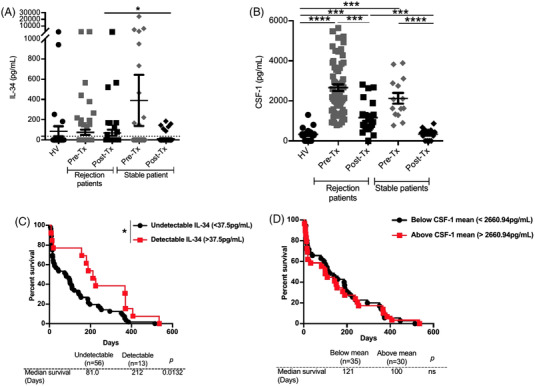
Here we report that the absence of expression of IL-34 in Il34 rats and mice leads to an unstable immune phenotype, with production of multiple auto-antibodies, exacerbated under inflammatory conditions with increased susceptibility to DSS- and TNBS-colitis in Il34 animals. Moreover, we revealed the striking inability of Il34 CD4 Tregs to protect Il2rg rats from a wasting disease induced by transfer of pathogenic cells, in contrast to Il34 CD4 Tregs. We also showed that IL-34 treatment delayed EAE in mice as well as GVHD and human skin allograft rejection in immune humanized immunodeficient NSG mice. Finally, we show that presence of IL-34 in the serum is associated with a longer rejection-free period in kidney transplanted patients.
Altogether, our data emphasize on the crucial necessity of IL-34 for immune homeostasis and for CD4 Tregs suppressive function. Our data also shows the therapeutic potential of IL-34 in human transplantation and auto-immunity.
-Absence of expression of IL-34 in Il34 rats and mice leads to an unstable immune phenotype, with a production of multiple auto-antibodies and exacerbated immune pathology under inflammatory conditions. -Il34 CD4 Tregs are unable to protect Il2rg rats from colitis induced by transfer of pathogenic cells. -IL-34 treatment delayed EAE in mice, as well as acute GVHD and human skin allograft rejection in immune-humanized immunodeficient NSG mice.
免疫稳态需要具有稳定表型的功能完全正常的 Tregs 来控制自身免疫。虽然 IL-34 最初被描述为主要参与单核细胞细胞存活和分化的细胞因子,但我们最近描述了它在大鼠移植耐受模型中的 CD8 Tregs 以及人类健康个体中激活的 FOXP3+CD4 和 CD8 Tregs 中的表达。然而,它在自身免疫中的作用及其在人类疾病中的潜在作用仍有待确定。
我们生成了 Il34 大鼠,并使用 Il34 大鼠和小鼠研究了它们在炎症条件下的表型。使用 Il34 大鼠,我们进一步分析了缺乏 IL-34 对 CD4 Tregs 抑制功能的影响。我们研究了 IL-34 在人类疾病中的潜在作用,以预防异种移植物抗宿主病和免疫人源化免疫缺陷 NSG 小鼠中的人类皮肤同种异体移植排斥反应。最后,利用生物样本集,我们研究了血清中 IL-34 的存在与肾移植排斥反应之间的相关性。
在这里,我们报告说 Il34 大鼠和小鼠中 IL-34 的缺失导致免疫表型不稳定,产生多种自身抗体,并在炎症条件下加剧,导致 Il34 动物更容易发生 DSS 和 TNBS-结肠炎。此外,我们揭示了 Il34 CD4 Tregs 明显无法保护 Il2rg 大鼠免受致病性细胞转移引起的消耗性疾病的影响,而 Il34 CD4 Tregs 则可以。我们还表明,IL-34 治疗可延迟小鼠的 EAE 以及免疫人源化免疫缺陷 NSG 小鼠中的 GVHD 和人类皮肤同种异体移植排斥反应。最后,我们表明,在接受肾移植的患者中,血清中存在 IL-34 与无排斥反应的时间延长有关。
总之,我们的数据强调了 IL-34 对于免疫稳态和 CD4 Tregs 抑制功能的至关重要的必要性。我们的数据还表明,IL-34 在人类移植和自身免疫中具有治疗潜力。