Ertl Laboratory, Vaccine Center, The Wistar Institute, Philadelphia, PA, United States.
Front Immunol. 2022 Aug 12;13:975803. doi: 10.3389/fimmu.2022.975803. eCollection 2022.
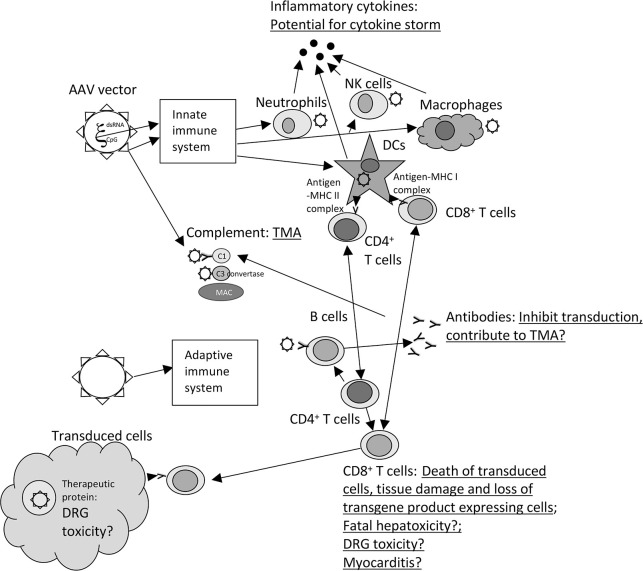
Gene transfer using adeno-associated viral (AAV) vectors has made tremendous progress in the last decade and has achieved cures of debilitating diseases such as hemophilia A and B. Nevertheless, progress is still being hampered by immune responses against the AAV capsid antigens or the transgene products. Immunosuppression designed to blunt T cell responses has shown success in some patients but failed in others especially if they received very high AAV vectors doses. Although it was initially thought that AAV vectors induce only marginal innate responses below the threshold of systemic symptoms recent trials have shown that complement activation can results in serious adverse events. Dorsal root ganglia toxicity has also been identified as a complication of high vector doses as has severe hepatotoxicity. Most of the critical complications occur in patients who are treated with very high vector doses indicating that the use of more efficient AAV vectors to allow for dose sparing or giving smaller doses repeatedly, the latter in conjunction with antibody or B cell depleting measures, should be explored.
在过去的十年中,腺相关病毒(AAV)载体的基因转移取得了巨大进展,已经治愈了血友病 A 和 B 等使人衰弱的疾病。然而,针对 AAV 衣壳抗原或转基因产物的免疫反应仍然阻碍了进展。旨在抑制 T 细胞反应的免疫抑制在一些患者中取得了成功,但在另一些患者中却失败了,特别是如果他们接受了非常高剂量的 AAV 载体。尽管最初认为 AAV 载体仅诱导低于全身症状阈值的微小先天反应,但最近的试验表明,补体激活可导致严重的不良事件。背根神经节毒性也已被确定为高载体剂量的并发症,严重的肝毒性也是如此。大多数严重的并发症发生在接受非常高载体剂量治疗的患者中,这表明应该探索使用更有效的 AAV 载体以节省剂量或反复给予较小剂量,后者与抗体或 B 细胞耗竭措施相结合。