Akter Sonia, Islam Md Shahinoor
Department of Chemical Engineering, Bangladesh University of Engineering and Technology, Dhaka, 1000, Bangladesh.
Heliyon. 2022 Aug 10;8(8):e10176. doi: 10.1016/j.heliyon.2022.e10176. eCollection 2022 Aug.
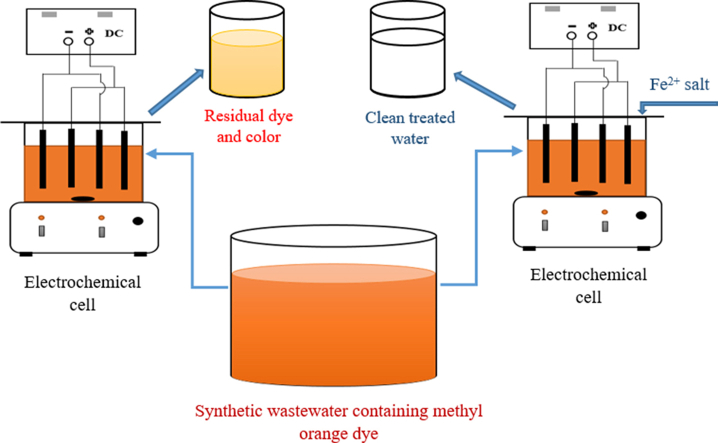
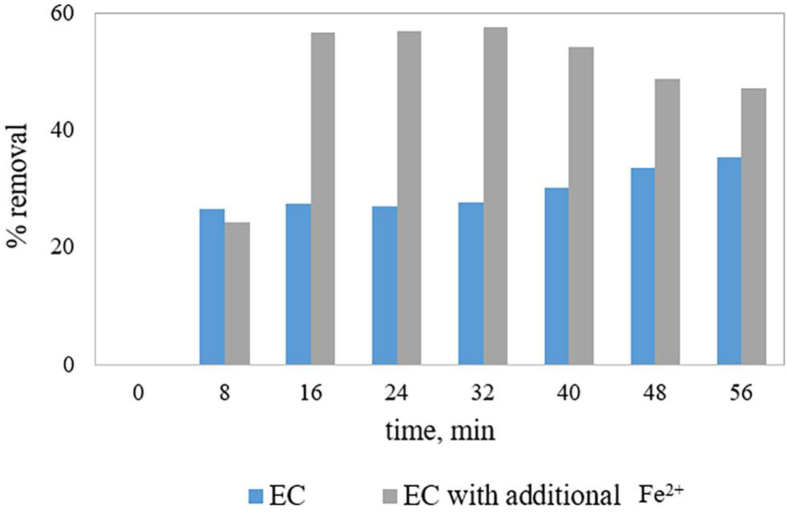
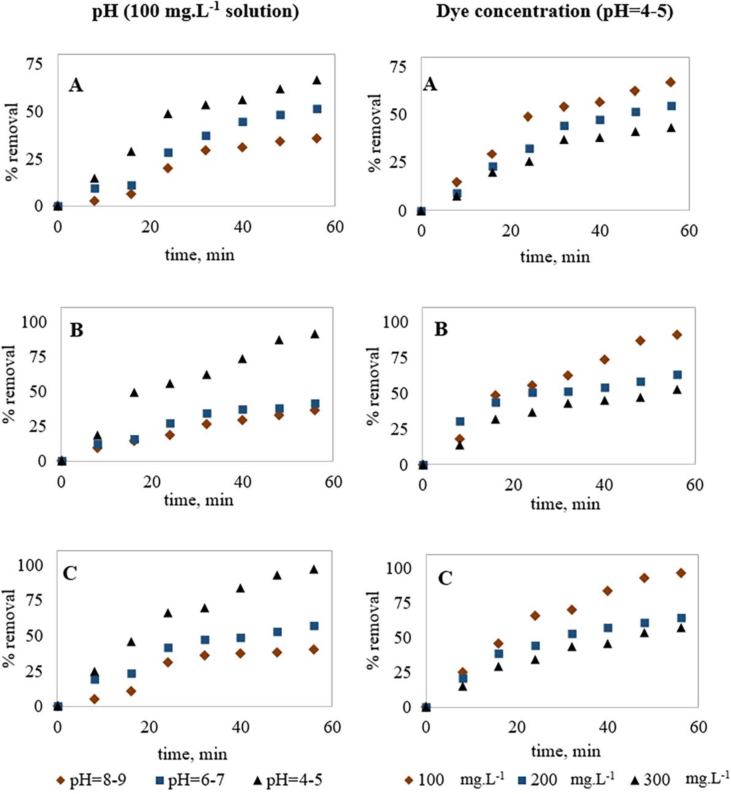
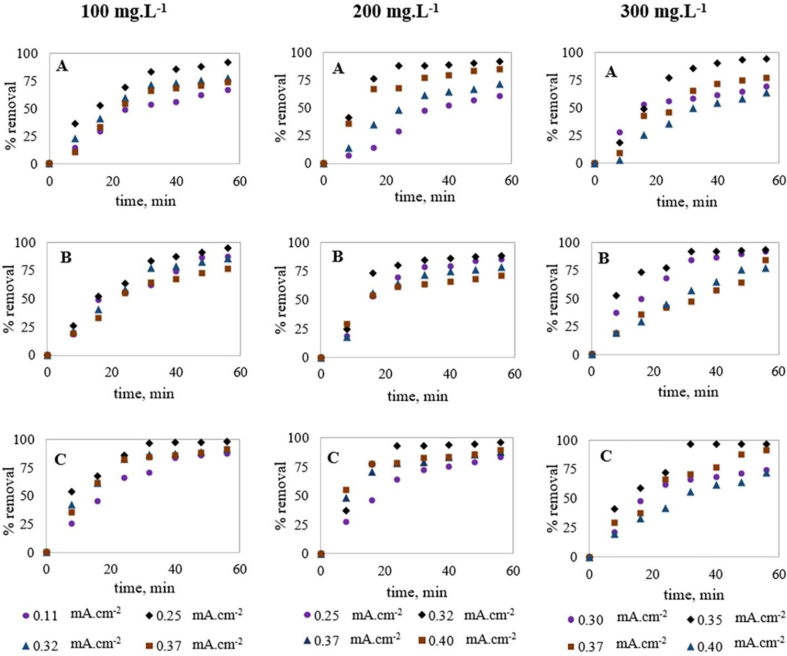
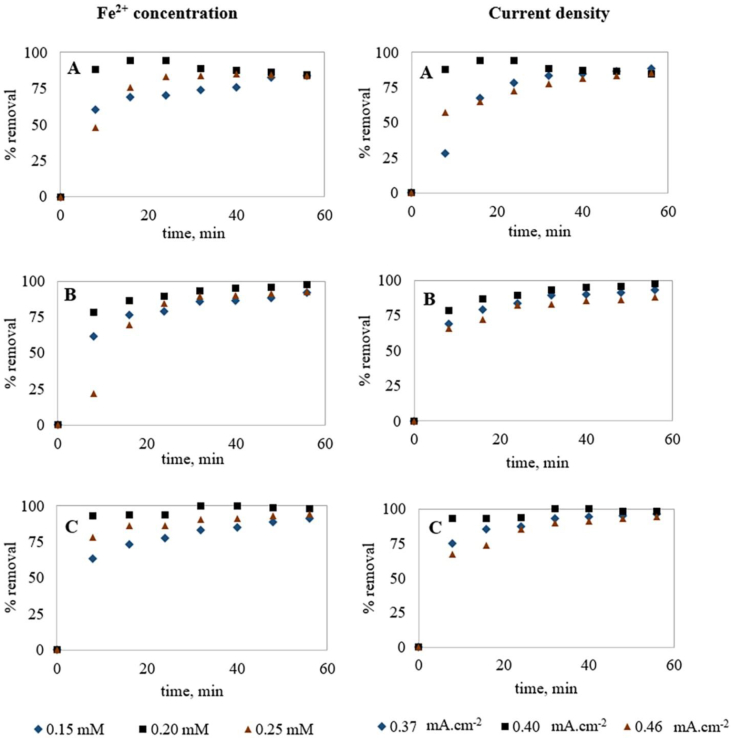
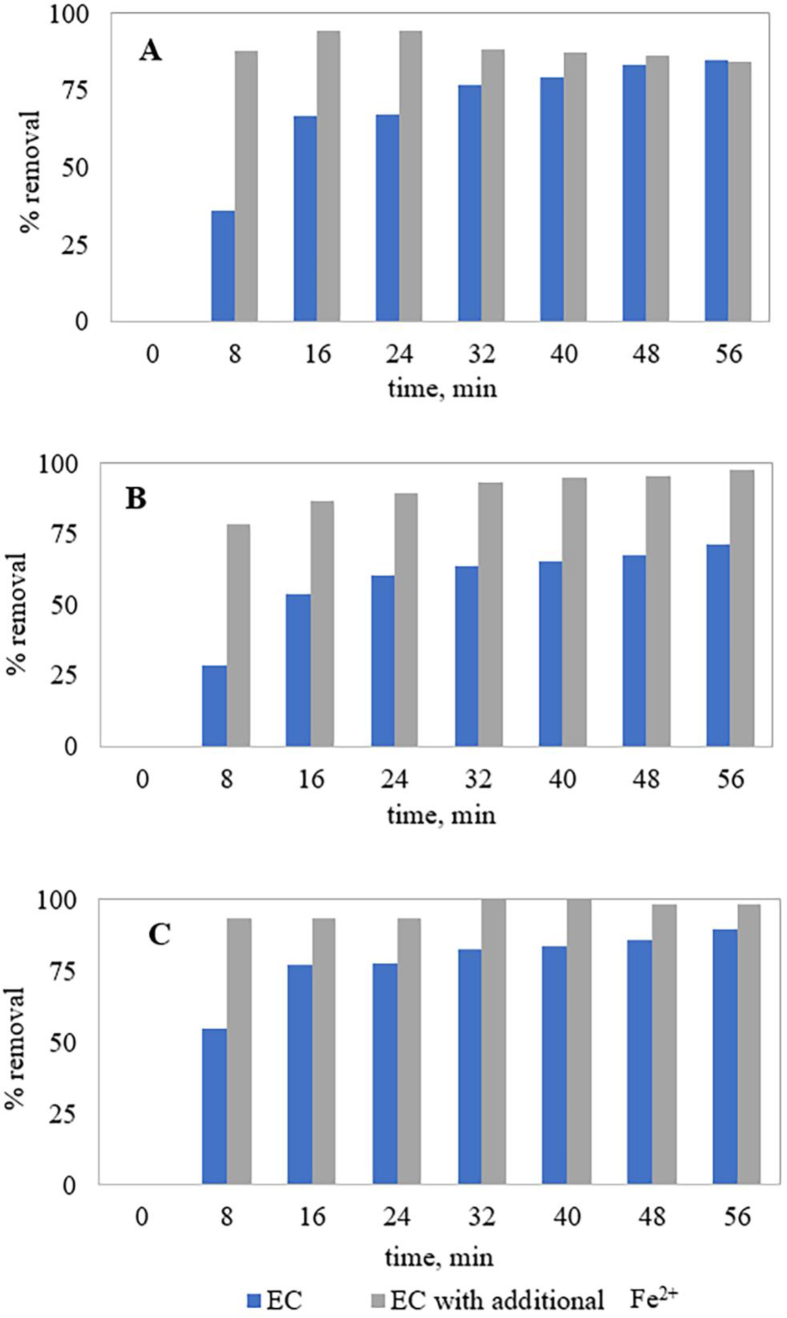
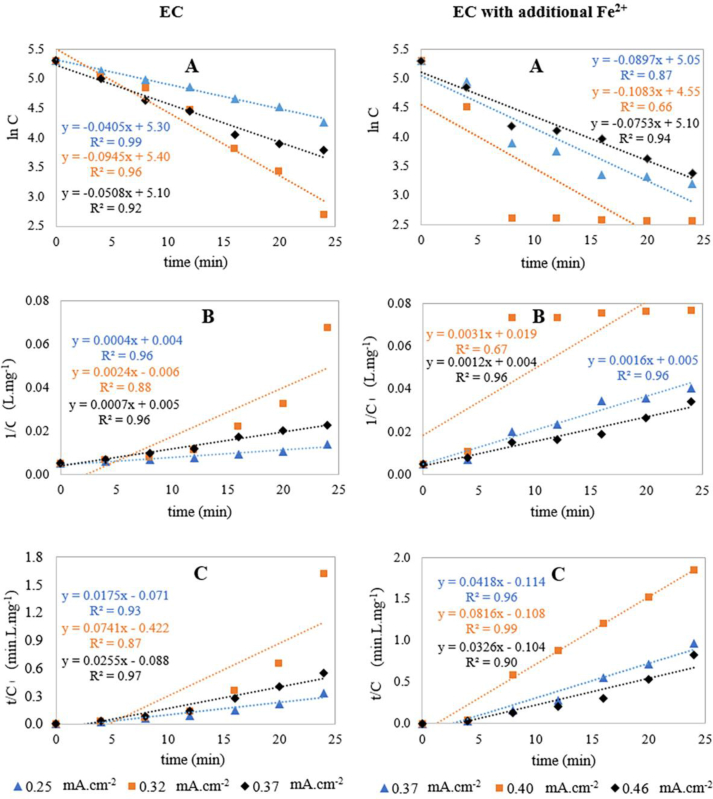
The wastewater generated from textile industries is highly colored and contains dyes including azo dyes, which are toxic to human and water-living organisms. The treatment of these azo dyes using conventional treatment techniques is challenging due to their recalcitrant properties. In the current study, the effect of additional Fe on electrocoagulation (EC) using Fe electrodes has been studied for the removal of methyl orange (MO) azo dye. pH between 4-5 was found to be optimum for EC and treatment efficiency decreased with increasing dye concentrations. With the addition of Fe salt, dye removal for a certain concentration was increased with the increase of current density and Fe up to a certain limit and after that, the removal efficiency decreased. The COD, color and dye removals were 88.5%, 93.1% and 100%, respectively, for EC of 200 mg.L dye solution using only 0.20 mmol.L Fe for 0.40 mA cm current density, whereas for EC, the respective removal efficiencies were 76.7%, 63.4% and 82.4% for 32 min. The respective operating cost for EC was $768 kg removed dye ($0.342 m), whereas, for EC with additional Fe salt, it was $350 kg removed dye ($0.189 m). The kinetic results revealed that the first-order kinetic model was fitted best for EC, whereas the second-order kinetic model was best fitted for Fe added EC. For real textile wastewater, 57.6% COD removal was obtained for 0.15 mmol.L Fe added EC compared to 27.8% COD removal for EC for 32 min. Based on the study we can conclude that Fe assisted EC can be used for effective treatment of textile wastewater containing toxic compounds like azo dyes.
纺织工业产生的废水颜色很深,含有包括偶氮染料在内的多种染料,这些染料对人类和水生生物有毒。由于其顽固性,使用传统处理技术处理这些偶氮染料具有挑战性。在当前的研究中,研究了额外添加铁对使用铁电极的电凝聚(EC)去除甲基橙(MO)偶氮染料的影响。发现pH值在4至5之间对电凝聚最为适宜,且处理效率随染料浓度的增加而降低。添加铁盐后,在一定浓度下,染料去除率随电流密度和铁含量的增加而提高,直至达到一定限度,之后去除效率下降。对于200mg.L的染料溶液,在电流密度为0.40mA/cm²、仅使用0.20mmol.L铁进行电凝聚时,化学需氧量(COD)、颜色和染料的去除率分别为88.5%、93.1%和100%;而对于电凝聚处理32分钟,相应的去除效率分别为76.7%、63.4%和82.4%。电凝聚的相应运行成本为每去除1kg染料768美元(0.342美元/m³),而对于添加了铁盐的电凝聚,每去除1kg染料的成本为350美元(0.189美元/m³)。动力学结果表明,一级动力学模型最适合电凝聚,而二级动力学模型最适合添加铁的电凝聚。对于实际纺织废水,添加0.15mmol.L铁的电凝聚可实现57.6%的COD去除率,而电凝聚处理32分钟的COD去除率为27.8%。基于该研究我们可以得出结论,铁辅助电凝聚可用于有效处理含有偶氮染料等有毒化合物的纺织废水。